When you click on links to various merchants on this site and make a purchase, this can result in this site earning a commission. Affiliate programs and affiliations include, but are not limited to, the eBay Partner Network.
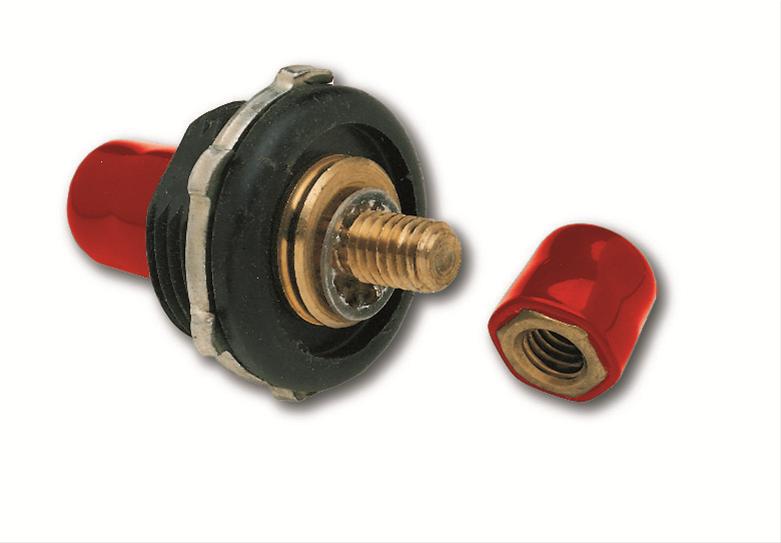
As part of my mid-winter reno-project, I’m adding a battery cut-off switch to my ’52 F1.
I decided that the switch should be located in the cab. At first, I was going to simply send the switched side back out to the engine area but couldn’t help thinking that, if I were a bad guy, with access to the switched side in the engine bay how hard would it be to bypass this switch and start the truck? Perhaps a jumper cable from the battery to the starter power lug? That got me thinking, and I arrived at the idea of moving the starter relay in the cab. If I did that, there would be no need to pass the switched power back to the engine bay. I’d simply pass the output from the starter relay back to the engine bay, so the worst anyone could do if they attempted to jump to this power point is run the starter.
My question to the audience…is there anything that you’ve seen or heard of that should keep me from moving the starter relay “inside”? I haven’t heard of these things bursting into flames, have you?
Catastrophic failure of the starter relay is rare. If I recall, Bob Jones (Bob49f2) had one pop once.
My biggest concern would be running the battery cables through the sheet metal, twice. You would need to be careful how they are protected. Especially the lead from the battery.
That said, I'm not sure it would achieve the security you're looking for. If they are trying to hot-wire your truck, they're already inside where you're moving the relay. They'd still have access to it.
I suspect maybe your ammeter's sampling rate was not capturing the peak draw, that's real low. Warm engine?
The specs say the starter motors can draw up to 550 amps, but they will only draw what's needed.
When I measured it the engine was cold, but summer (the only season its allowed out of the garage). I hadn't the presence of mind to check the maximum, the meter captures this.
I put the battery in and checked again...172 amps, but it is substantially colder than it was when I checked before. I did observe a 505A reading for a brief moment (less than a second, the screen update takes about a second), but then it hovered around 170 amps.
I'm using a Fluke 325 to measure. I'll see if I have an instrument in the lab at work that I can use to verify.
The switch has a 1000A surge rating; it would be nice if it had a time associated with it...."1000 amps for x seconds".
I'll start with what I hope to be the main takeaway: I would engineer the solution using the design specs and not try to reinvent the wheel.
Now, getting deeper here - I too lament that many of the cost attractive "consumer' components do not have real data sheets such as seems to be the case with your 1000A Peak Switch. It makes it hard to determine suitability.
Another curiosity is the very low CCA of your battery. Most 6V Group 1 batteries are much higher than 330 CCA:
Continental 1 Automotive Battery Group 1 6v Battery 625 CCA
Optima Red Top 800 CCA
NAPA Commercial Battery 6 Months Free Replacement BCI No. 1 640 CCA
Interstate Battery 1-VHD 640 CCA
Tractor Supply Traveller 6V Heavy-Duty Battery 640 CCA
DieHard HD Battery Battery 6V Battery 1 Group Size 700 CCA
Are you sure you are not confusing it with a 6V Deep Cycle Battery with a 330Ah rating (which really isn't ideal for a vehicle battery)?
As for the Fluke 325, I'd like to bring attention that it only rated for measuring 400A DC via the clamp.
And finally, as to your goal of foiling bad guys, maybe you are overthinking things:
Just me. If you are looking for theft protection, I would just add a good quality 10 to (15 amp would be better) toggle switch in a secret location up and under the dash. You wire that switch in series to your ignition switch and the Ignition terminal on your coil. With it in off position there would be no spark. The crookskies would need a voltmeter or a test light to figure out why it's not starting if they even hang around long enough to troubleshoot it. Sure they could just grab a wire to jumper the battery to the coil. But (assuming positive ground) they would probably tie it on the + side of the battery as they would trying to steal a 12 volt car, but still not getting spark.
I do sort of this, but I have an in line fuse going between my coil and my ignition switch. At the end of the driving season I just pull out the fuse. A time or two in the spring I forgot I needed to put the fuse back in. So I have even fooled myself! Easy to do!
I would still install a battery disconnect though. Even though I drive my truck alot during driving season. When I garage it I always loosen the big **** on the disconnect.
I'd have to agree with Hooler on this one. It seems like a lot of effort and adding potential problems to run heavy cables through the firewall just to relocate the solenoid for theft prevention. My 2c, fwiw, I think I might consider moving the solenoid below the battery tray and wrapping a sheet metal shroud around it to conceal it. If you really want a battery cut off switch, the cables could be run under the cab and the switch could be in the floor beside/beneath the seat. Personally, I'd prefer the ignition interlock switches described above and not mess with the battery cables. They could be totally hidden, or disguised as a choke **** or a heater control, etc.
Wayne, I like your ideas and they have got me thinking, that is a scary venture it itself.Thanks for some additional ideas, hide in plain sight, sniper tactic, I love it.
This Hennessey Takes the Expedition Tremor's Off-Roading Capability to the Next Level
Slideshow: The VelociRaptor Expedition gains a lift, upgraded suspension, Brembo brakes, and trail-ready equipment while retaining the stock 440-horsepower EcoBoost V6.
Rezvani's Latest Post-Apocalyptic Monster Is a Ford F-150 Raptor Underneath
Slideshow: Called the Fortress, the 850-horsepower pickup combines Raptor underpinnings with military-inspired features, survival equipment, and a starting price of $285,000.