When you click on links to various merchants on this site and make a purchase, this can result in this site earning a commission. Affiliate programs and affiliations include, but are not limited to, the eBay Partner Network.
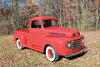
I have a quick question about the charging system and how it functions. I have a 1950 that has been restored to its original form. I currently have it converted to 12v system negative ground. I have purchased the OEM look alike battery for car shows that is a reshelled AGM battery. They are expensive and a pain to keep charged on a truck that only comes out a few times a year. I am going to drop a normal battery that i can leave on a trickle charger when not in use. But my question is how do these old generator charging systems work. What initiates the generator to start supplying voltage back to the battery. I know the relay is there but how/when does it tell it to charge? I can drive for about 10-15 minutes before I notice on the discharge gauge that it finally starts supplying voltage. This kills me on the short drives that this truck normally goes on. Is this just a normal thing on these old vehicles?
The generator should be putting out approximately 14V as soon as the motor is running. Attach a volt meter to the battery while the motor is running and see what its reading. If you aren’t getting a reading of 13-14V you got a problem with either the generator or voltage regulator.
First, we must determine what style system you have. There are many ways to do a 12V conversion. Was it done with an alternator? A generator? An alternator disguised as a generator? Internal or external regulator? Pictures of tour setup could help as well. Has your system been flashed/polarized if necessary? Have you taken your alternator/generator to the local parts chain for testing on their machine?
If you can find booklet no.3 ; of the 1951 ford service forum booklets.
I found it to be extremely useful for both my understanding and served as a guide for my mechanic as well. we had just about everything that could go wrong with this system; go wrong.
It goes into great detail in a simple to understand way with great illustrations and testing procedures.
We used this and ultimately found that we had a corroded bus bar connecting the 15 to the 30 amp circuit breaker. That was only after repairing and or replacing both generator and regulator as well as rewiring the entire engine harness again.
there’s an entire set for sale on eBay now.
this is the particular booklet but they’re all extremely good and worth having copies of.
I have a quick question about the charging system and how it functions. I have a 1950 that has been restored to its original form. I currently have it converted to 12v system negative ground. I have purchased the OEM look alike battery for car shows that is a reshelled AGM battery. They are expensive and a pain to keep charged on a truck that only comes out a few times a year. I am going to drop a normal battery that i can leave on a trickle charger when not in use. But my question is how do these old generator charging systems work. What initiates the generator to start supplying voltage back to the battery. I know the relay is there but how/when does it tell it to charge? I can drive for about 10-15 minutes before I notice on the discharge gauge that it finally starts supplying voltage. This kills me on the short drives that this truck normally goes on. Is this just a normal thing on these old vehicles?
Thanks for the input.
Its been a while since I have had a vehicle with a generator, but they usually start charging at a higher RPM than idle. This is because of the cut out relay inside the voltage regulator. Its job is to keep the battery from discharging through the Armature windings of the generator when the generator output is low, such as an idle condition or the motor is not running. Once you get the truck out on the open road and you get the RPMs up around 900 to 1000 you should see a Charge indication on your Ammeter for a little while until your battery voltage is back to normal again.
As mentioned earlier, it might be a good time to re-polarize your generator, simply pull off the battery and field wires from the Voltage regulator, touch them together, see a small spark, then connect them back normal again.
If you want to test your generator, a quick and easy way to do it is with a voltmeter connected between the battery terminal on the voltage regulator and ground, with the engine running, (watch your fingers and wires!) Disconnect the Field wire from the Voltage Regulator. While watching the voltage touch it to the Armature connection on the voltage regulator, increase the engine's RPM up to around 1200 to 1500 RPMs and you should see your voltage rise up to around 13 to 14 volts. If not, you have a bad generator or bad brushes inside your generator. If you did find that giving your generator "Full Field" gave you charging voltage, but when connecting the Field back to the Voltage Regulator the voltage went away, you have a bad Voltage Regulator.
Also, on later vehicles you would have an "idiot light" instead of a gauge for the generator output. At idle the light would go out and only come on with increased rpms.
Also, on later vehicles you would have an "idiot light" instead of a gauge for the generator output. At idle the light would go out and only come on with increased rpms.
I forgot about those GEN warning lamps. They could be added with an under the dash light you buy by from any auto parts store. You wire one of the connections to a positive IGN switched on power source such as your gauge cluster power connections and the other wire you will have to fish through your firewall and connect it to your ARM terminal on your Voltage Regulator. Once it's all connected, if you switch the IGN switch to ON, the light will come on due to the engine not running. Once you start the truck and the RPMs of the engine goes up, the cut out relay in your voltage regulator closes, and it in effect "by passes" the current away from the light, so the light is now off indicating your system is charging. There may be times you see it flicker, at idle and that would be normal.
Hope I got that all correct. It's been awhile since I have done that.
First, we must determine what style system you have. There are many ways to do a 12V conversion. Was it done with an alternator? A generator? An alternator disguised as a generator? Internal or external regulator? Pictures of tour setup could help as well. Has your system been flashed/polarized if necessary? Have you taken your alternator/generator to the local parts chain for testing on their machine?
It was done with the voltage regulator, purchased from LMC truck. It should be the setup that this truck had from the factory. It gets voltage at the generator when unplugged and eventually it will get it to the truck. Its more like the regulator has a delay to when it starts charging.
You keep referring to "factory original" system yet are talking 12V negative ground. This is an impossibly for a 1950 model year, which was a 6V positive ground type B charging system.
Which LMC regulator do you have? 47-0877? 47-0878? What model generator/alternator? Is this generator/alternator also of Type B charging system type?
I forgot about those GEN warning lamps. They could be added with an under the dash light you buy by from any auto parts store. You wire one of the connections to a positive IGN switched on power source such as your gauge cluster power connections and the other wire you will have to fish through your firewall and connect it to your ARM terminal on your Voltage Regulator. Once it's all connected, if you switch the IGN switch to ON, the light will come on due to the engine not running. Once you start the truck and the RPMs of the engine goes up, the cut out relay in your voltage regulator closes, and it in effect "by passes" the current away from the light, so the light is now off indicating your system is charging. There may be times you see it flicker, at idle and that would be normal.
Hope I got that all correct. It's been awhile since I have done that.
I was just a kid when I last rode in a vehicle with one of those. I must have remembered it backward. At my age I'm lucky to remember them at all...
Hey. Speedkid,
I think if it were mine and you were truly wondering
what the state of charge your battery is, I would just buy an under the dash, aftermarket voltmeter. That way you know what your ignition voltage is and if you do have charging issues.
This Hennessey Takes the Expedition Tremor's Off-Roading Capability to the Next Level
Slideshow: The VelociRaptor Expedition gains a lift, upgraded suspension, Brembo brakes, and trail-ready equipment while retaining the stock 440-horsepower EcoBoost V6.
Rezvani's Latest Post-Apocalyptic Monster Is a Ford F-150 Raptor Underneath
Slideshow: Called the Fortress, the 850-horsepower pickup combines Raptor underpinnings with military-inspired features, survival equipment, and a starting price of $285,000.