When you click on links to various merchants on this site and make a purchase, this can result in this site earning a commission. Affiliate programs and affiliations include, but are not limited to, the eBay Partner Network.
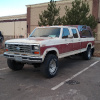
Hey guys, I recently bought a '76 highboy with a 390 in it and another 390 as a spare. I haven't measured the stroke on either of them yet, but the guy I bought it from seemed like a square shooter and the price was right even if they turn out to be 360's. When I bought it he told me that it was getting coolant in the oil and I hoped I could just do head gaskets and get it running, and maybe build up the spare engine on the side. I pulled it apart and was surprised to find some pretty deep scoring on cylinders 3 & 4. Cylinder 1 also has it but not as deep. I haven't rotated the crank to see what #2 looks like. Here's some pics:
#4
#3
#1
I'm pretty new to working on engines and I'm wondering what would cause these similar grooves on multiple cylinders on one side of the engine. 5-8 look fine. I'm not sure if it's related but the coolant issue seemed to be on the same side; I could tell because the truck has dual exhaust and I ran it briefly and got white smoke out the passenger tailpipe. And it looks like cylinder 4 has had some steam cleaning action. When I had it running it sounded fine and idled smooth with no knocking or anything. Anybody know what might be going on here?
Only the micrometer and a sonic test will tell you if you can go out far enough to save the block.
You can put an engine together and it will run with grooves like that, but it will burn oil at a pretty good rate, and leave a blue trail. You can run a hot plug but you'll have to keep a couple spare plugs with the case of oil you carry.
Wrist pins no longer secured in the piston. These FEs have what's known as "floating" wrist pins meaning that the small end of the connecting rod has a bushing and the wrist pin is secured inside the piston with snap rings instead of being pressed into the connecting rod.
Kind of common to see this failure....and yes, those are 390 pistons so unless somebody already broke into it and wanted an even lower compression 360, you have a 390 there.
Only the micrometer and a sonic test will tell you if you can go out far enough to save the block.
You can put an engine together and it will run with grooves like that, but it will burn oil at a pretty good rate, and leave a blue trail. You can run a hot plug but you'll have to keep a couple spare plugs with the case of oil you carry.
Yeah they're pretty deep. I'll have to measure and see but I'm not too hopeful that the block can be bored out enough. I guess I could just keep the oil topped off and pretend it's a diesel
Originally Posted by cleatus12r
Wrist pins no longer secured in the piston. These FEs have what's known as "floating" wrist pins meaning that the small end of the connecting rod has a bushing and the wrist pin is secured inside the piston with snap rings instead of being pressed into the connecting rod.
Kind of common to see this failure....and yes, those are 390 pistons so unless somebody already broke into it and wanted an even lower compression 360, you have a 390 there.
Ohhh that makes sense, I didn't know that's how the wrist pins are attached. And thanks for the piston ID. Could you tell by the shape or is there some other identifier?
Yeah they're pretty deep. I'll have to measure and see but I'm not too hopeful that the block can be bored out enough. I guess I could just keep the oil topped off and pretend it's a diesel
Ohhh that makes sense, I didn't know that's how the wrist pins are attached. And thanks for the piston ID. Could you tell by the shape or is there some other identifier?
360 pistons are 390 4V pistons. They have valve reliefs but no dish and a 1.760" nominal compression height. A 360 will end up with an almost .120" deck clearance (down in the hole) whereas a 390 4V with a longer stroke but shorter rod will be closer to .030".
The lower compression pickup 390 pistons are actually 410 Mercury pistons with a dish and valve reliefs and a 1.660" compression height to drop the compression considerably.
360 pistons are 390 4V pistons. They have valve reliefs but no dish and a 1.760" nominal compression height. A 360 will end up with an almost .120" deck clearance (down in the hole) whereas a 390 4V with a longer stroke but shorter rod will be closer to .030".
The lower compression pickup 390 pistons are actually 410 Mercury pistons with a dish and valve reliefs and a 1.660" compression height to drop the compression considerably.
410 piston front and 390 2V rear.
People have reported both the flat top 4v and the dished 2v in 360s. I have not seen a post where one was half and half.....
People have reported both the flat top 4v and the dished 2v in 360s. I have not seen a post where one was half and half.....
I've taken apart countless 360s and never encountered a 1.660" dished piston. Not saying they're not out there, but 7.9:1-ish on a "normal" 360 is bad enough. I couldn't imagine one in the high 6's.
At this point, the OP needs to look at the rods and see if his engines have the long narrow 352/360 rods or the short fat 390-up rods.....oh, and no half moon slot cut out in the flywheel flange.
No the 1.66" pistons are 410/390 pickup pistons. Those are flat top, giving a nominal 10.5 ratio in the 410 on top of the 3.98" stroke, quite a bit less on top of a 3.78" stroke.
The 2v/4v 390 pistons are both the 1.76"--just the dish is the difference for the most part. They are down the hole due to the shorter stroke despite the longer rod in the 360.
Either way, it's low compression and a sunken piston.
OP should be able to rotate and measure or find a BDC and TDC and measure.
The pictures he showed are dished. The pictures I showed (the cleaner piston) IS a 410 piston as you can see it cast right in it with the wrist pin snap ring)....and it's dished - NOT a flat top.
I don't think that'll bore out. The cylinders will have to be sleeved to repair the block. I've seen that happen on a small block Chevy one time and it ran like that long enough to wear through the cylinder wall and into the water jacket.
Thanks everyone for the replies and information, I really appreciate it and it's quite helpful. I'm planning to work on it tomorrow so I'll report back with some measurements.
This Hennessey Takes the Expedition Tremor's Off-Roading Capability to the Next Level
Slideshow: The VelociRaptor Expedition gains a lift, upgraded suspension, Brembo brakes, and trail-ready equipment while retaining the stock 440-horsepower EcoBoost V6.