When you click on links to various merchants on this site and make a purchase, this can result in this site earning a commission. Affiliate programs and affiliations include, but are not limited to, the eBay Partner Network.
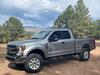
Anyone have experience doing the chalk test for determining PSI? I’ve never done it before but decided to try it out today. Had 295/70-18 Defenders installed a week or so ago (stock wheels) and the shop put 70/75 cold psi in them. They rode smooth but I know they just went by the door sticker (for stock 275/65-18 tires).
Anyway, below is where I stopped at. This was hot PSI as I drove about 10 miles to the spot I did the test at and it’s about 89* today.
Think the fronts look good but the rear could’ve came down a few more PSI. Just couldn’t wrap my head around such a big swing below the fronts. Maybe that’s what they really need tho?
I need to read up on this. I just got done towing a few days ago and need to air my tires back down, but would like to do something like this to know it’s good for the tire, not my comfort level. Although, even at around 70 all around, it’s a pretty comfy ride!
Michelin has a chart for tire pressure based on axle weight.
First step would be if daily driver or loaded go scale the truck. Set the pressure as stated by Michelin for your axle weight and you are good to go.
Common miss conception is to use the door placard. The door placard is for rated axle weight when loaded to the maximum allowable weight and is only good for the stock setup.
I am surprised you have any fillings left in your teeth with those pressures if running empty.
I’ll look up the chart from Michelin and try to get to the truck stop tomorrow and get it on the scales. Was curious to what it weighs anyway. Will be interesting to see how it compares to the chalk test.
When I picked the truck up at the dealer I didn’t make it 5 miles before stopping and dropping all 4 tires to 65psi. It rode like a go kart.
Surprisingly tho, the Michelins rode smooth with 70/75 in them. As smooth as the stock tires did at 65.
Some tires are designed where the center of the treads bow out and are designed to be driven more with the weight in the center than evenly distributed the full width of the tire so the chalk test would need to be interpreted differently based on the tire design
Some tires are designed where the center of the treads bow out and are designed to be driven more with the weight in the center than evenly distributed the full width of the tire so the chalk test would need to be interpreted differently based on the tire design
Where did you pick this info up at? Narrower tires have a more noticeable crown to them usually but all tires are meant to be run square to the pavement for the best wear. Chalk test is the same regardless.
I run an 8 psi difference between front and rear. Mine is a gas truck and it is lighter on the front that a diesel. I run 60 front and 52 rear in my 285/75-18 duratracs. My truck is almost 1000 lbs difference front to rear when empty, that is the reason the big pressure difference. Currently my rears are at 70 psi because i have been hauling equipment on the gooseneck. The ride really isn't much worse but I upgraded the shocks too so that helps with the rear end dancing around on rough roads as much as tire pressure.
The other thing you can watch is the psi gain from cold to warm depending on the speed and load. General rule is a 4 psi gain, more than that and you are probably underinflated, less than that you are probably overinflated.
If you not able to locate the chart I do have the chart saved somewhere on the hard drive. Let me know and I will search for it.
If you run across the chart you have post it up if you don’t mind. I’ve not been able to find a Michelin load / inflation table yet, but still looking.
Where did you pick this info up at? Narrower tires have a more noticeable crown to them usually but all tires are meant to be run square to the pavement for the best wear. Chalk test is the same regardless.
that would be true for all the passenger car tires that I've seen
there are absolutely off road tires that are designed to have a bow in the middle and be driven more on the middle section of the tire
I run my truck rears at 38 psi when not loaded but the chart says 35 psi if I remember correctly. The edges of the tire show I can drop them down a touch but like you I just can not convince myself to run a truck tire that low.
Was hoping the scales and load chart would corroborate the chalk test, but that doesn't seem to be the case.
According to the scales and load chart, the fronts could be ran at or below 35 PSI (3960 / 2 = 1980) and the rears much below that (2680 / 2 = 1340)
Now, if we consider the axle weight per tire (not dividing the load across both tires) the fronts would be 75 PSI @ 3960# and rears 45 PSI @ 2680#.
When comparing the stock 275/65-18 tires and what Ford lists on the door jamb sticker (70 PSI front / 75 PSI rear) doesn't make sense either, considering what the truck scaled at. https://tirepressure.org/lt275-65r18
The door jamb sticker shows my truck has Max Payload of 3246#. I guess if Ford spec'd the rear tires at 75 PSI, that would align with the chart above (3305#), but what do they base the spec for the front tires at 70 PSI (3150#) on?
This Hennessey Takes the Expedition Tremor's Off-Roading Capability to the Next Level
Slideshow: The VelociRaptor Expedition gains a lift, upgraded suspension, Brembo brakes, and trail-ready equipment while retaining the stock 440-horsepower EcoBoost V6.
Rezvani's Latest Post-Apocalyptic Monster Is a Ford F-150 Raptor Underneath
Slideshow: Called the Fortress, the 850-horsepower pickup combines Raptor underpinnings with military-inspired features, survival equipment, and a starting price of $285,000.