When you click on links to various merchants on this site and make a purchase, this can result in this site earning a commission. Affiliate programs and affiliations include, but are not limited to, the eBay Partner Network.
I’m new to this site and cars In general. I got interested in Ford trucks from watching Junkyard Digs and Thunderhead289 on YouTube. So, naturally I decided to jump right in and buy a non-running 1972 f-250 with a 360 that hasn’t run since ‘98. I learned how to make things run, and replaced the plugs, wires, distributor cap, rebuilt the motorcraft 2100 carb and replaced the fuel pump. I got her running, but now I’ve run into a new problem. When it heats up (not even under load) it starts to smoke from the top of the exhaust manifold. I took a video:
my temp gauge isn’t working so I’m not sure if it’s just overheating because the thermostat is stuck or water pump is gone, or if it’s just burning off crap from sitting for 23 years. I ran it for about 15 minutes twice and it never stopped smoking. Oddly there is no smoke from the actual back of the exhaust. My next step is to figure out the temp sending unit, then my cooling system issues. I just don’t want to put more work into it and find out it’s the rings or some other expensive thing. Does anyone have any other ideas or suggestions?
Ask yourself what is the Plan A and Plan B. If the smoking is leaking oil from the valve covers (willing to bet that's it) and the engine has no major issues, what is the next step? If the rings are bad, the engine caput, what's the next step?
If you're going through the motions and buying the parts, maybe have another engine that can accept the parts in the event the current one is worn out? My 2 cents, and exactly what I am currently doing. No point in buying a bunch of parts and them going to waste if it doesn't pan out.
Welcome to FTE, have fun and jump in with both feet!
I don't see any bolts on the valve covers. The top of the head has a lot of oil flying around from the rockers. The good news is that it looks like you have plenty of getting up there. Remove the valve covers and check to see if they are straight and that they are not puckered at the bolt hole locations. Install a good set of gaskets and a full set of bolts. Tighten slowly - just until contact first and then evenly 1/2 turn at a time so the gasket is evenly clamped. People have their own methods - I like to stick the gaskets to the valve covers with RTV so the gasket doesn't fall off when dropping the covers in place.
What you see is oil leaking past the valve covers on to the manifolds on both sides. There are some scenarios where the valve covers can fill up with oil with too much flow, improper assembly, or blocked drain holes but I suspect your issue is just gaskets and bolts.
Okay so I pulled the valve covers. They were extremely dirty so I cleaned them up the best I could but they’re far from perfect. See below:
Clean:
I put some RTV on to hold the gaskets during the install as GPatrick suggested. I haven’t run it yet to see if the problem is fixed, but I did find something else concerning. The valves look very crusty and have significant amounts of debris. Should I just try and clean them? Or do they have to be replaced? Left bank looks worse than the right…
The valve covers look pretty good. You are looking at the valve springs, keepers, and rockers on top. They are dirty but if you try to clean them with solvent the solvent will run down into the pan. Then you'll have to drain the oil, etc. A quick method that might work is to add a can/bottle of Seaform and run it for a while. This helps to clean up that kind of dirt. You will need to drain the oil and replace the filter and I'd actually add another can of Seafoam and repeat. This also can help loosen up stuck rings if the engine has been sitting for a while. Others have their own tricks but Seafoam has worked for me in a few cases. I haven't used in the fuel tank - just the crankcase.
With as much oil as you were dripping down the heads and on to the manifolds there is a good change that the spark plug recesses are full of oil. You don't want to pull the plugs out but you can remove the wires one at a time and soak up any oil. This will help prevent misfires and will also allow the smoke to clear a little sooner. The engine will smoke for a while until all the oil burns off - just keep an eye out for any further leakage.,
If you haven't yet do some searches for the correct oil to run in an old flat tappet engine. The standard stuff on the shelves of the parts stores do not contain sufficient zine to prevent rapid camshaft failure. Find a good 10-40 or so oil that has good zinc levels. Zinc contaminates catalytic converters so it has been reduced significantly in modern oils. Nearly all pushrod engines use roller lifters which can survive with low zinc levels. You may see recommendations to run a diesel engine oil and some are OK and others have also reduced zinc.
And, for oil filters, try to find Motorcraft. There may be a few out there that rate a little higher but there a lot more are not. I run them in all my Fords.
That engine will have or will have had a full PCV system - they pull air from the air filter on the left side and air is pulled out from the passenger rear. A improperly plumbed PCV can lead to a lot of dirt being pulled into the engine which will usually look worse on one of the two banks.
100% agree with GPatrick. When you change the oil, use the Shell Rotella 15w 40 for diesel engines. This has zinc and detergent to help clean the engine...use 6 quarts and the Motorcraft FL1A filter (can get this at Walmart or local auto parts stores). Some may disagree on this, but it has worked wonders on my FE360. I change my oil every 3,000 miles, or twice a year...whichever happens first. The white filter serves as a good place to write the mileage and date with a black permanent marker. When you pop the hood you can see the last date/mileage of the previous oil change.
2X on using Seafoam. I suggest you change the oil first with a new Motorcraft oil filter. The seafoam will pick up all kinds of crap and throw it in the filter. After running it with the seafoam change the oil again with another new oil filter.
Thanks to all for the suggestions. I have purchased shell rotel a 15w40 and 2 motorcraft filters, and 2 cans of seafoam. I assume seafoam just goes in through the valve cover. How long should I run it for?
Separately, the smoking issue is solved, just took forever to burn off the excess oil after I replaced the valve cover gaskets. I guess I replaced the water pump and thermostat unnecessarily, but it’s always good to have new parts on an old engine and learn in the process. Temp reads perfect now. The bottom left bolt on the water pump leaks a little bit. Can I just
use regular thread seal tape or does it need to be something special because the coolant gets hot?
Finally, accidentally hooked up a jump pack the wrong way (stupid I know 😂 and blew the fusible link. It blew my coil as well which started leaking so I replaced that and now it runs again. I did a little research and it said to solder one in. Do I have to solder or can I just splice? All the electronics work like they did before so I’m not sure what it affected. fairly certain alternator is not charging though.
Sorry for the smorgasbord, not sure if I should be starting new threads for each issue.
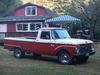
The bottom left bolt is the one that needs sealant on it. Im pretty sure it goes into a water passage. Got any pics of your truck to throw into the thread?
Here are some instructions from Seafoam. If you do a fresh oil change, add 1/2 can and run it for at least 300 miles. It recommends looking at your oil on the dipstick and if it gets really dark/black they suggest draining and refilling. https://seafoamworks.com/knowledge-b...crankcase-oil/
I was more aggressive on my 390. I put in a full can and ran it for about 100 miles to try to free up the rings. Did the trick but I repeated it once more.
Just pour it into the valve cover along with your oil. Make sure you have a full PVC system pulling fresh air out of the air cleaner on the driver's side and the PCV valve on the rear passenger side with a hose to the carb base or adapter plate. An open or improper plumbed system can draw dirt and moisture right into the crankcase.
Glad the smoke stopped - amazing what valve cover gaskets will do!
If you didn't fry your alternator you may have killed the voltage regulator. A parts store should be able to test the alternator. I think that soldering is recommended on the connections to ensure that the fusible link is indeed the weak link in the circuit. A crimped connection where you have limited contact between the wire and the connector may become the fuse. Not 100% on that reasoning but in my last link install I soldered all the but connectors that I used.
I was going thru valve cover gaskets like crazy. Even the expensive Edelbrock gaskets didn't last long. The problem turned out not to be the gaskets, it was the bolts, they were bottoming out. Not all of them, just a few. I tried to clean the holes out but found they weren't all the same depth from the factory. My fix was to use a stud kit. Haven't had a leak in the last 5yrs.
I was going thru valve cover gaskets like crazy. Even the expensive Edelbrock gaskets didn't last long. The problem turned out not to be the gaskets, it was the bolts, they were bottoming out. Not all of them, just a few. I tried to clean the holes out but found they weren't all the same depth from the factory. My fix was to use a stud kit. Haven't had a leak in the last 5yrs.
Christmas, I like the stud kit idea. Can you share the part # or where you purchased from? I'm in the same boat and will pull my valve covers to paint them and replace the leaking cork gasket.
Rezvani's Latest Post-Apocalyptic Monster Is a Ford F-150 Raptor Underneath
Slideshow: Called the Fortress, the 850-horsepower pickup combines Raptor underpinnings with military-inspired features, survival equipment, and a starting price of $285,000.



 and blew the fusible link. It blew my coil as well which started leaking so I replaced that and now it runs again. I did a little research and it said to solder one in. Do I have to solder or can I just splice? All the electronics work like they did before so I’m not sure what it affected. fairly certain alternator is not charging though.