When you click on links to various merchants on this site and make a purchase, this can result in this site earning a commission. Affiliate programs and affiliations include, but are not limited to, the eBay Partner Network.
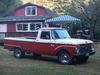
Picture included show how radius arm bushing “caps” or washers were oriented on truck, which seems right, symmetrically and intuitively, yet package directions and imprints on caps themselves say exactly the opposite. Unless, I’ve missed something, I’m actually going to have to do it their way: orient both caps in the same direction on front and back of pivot bushing assembly (second picture)
Just looks wrong, honestly…
Well since you didn't provide the information I requested from you (so much for common sense) so I looked through all the diagrams pertinent to the parts in your photo and there are no diagrams that are clear enough to support assembly one way or the other in the Ford master parts catalog for F100-F500 in the years 1973-1979. Your best bet now is to look in the Ford maintenance/service manual for your year and model truck. You'll need to look there for the torque specs for the nut at the end of the radius arm anyway. I noticed the cotter key in your picture is missing. Don't forget that in final assembly.
The OEM uses different bushings front side versus rear side.
The replacements look virtually the same, the instructions look clear enough. I'd have no issue with the manufacturer's directions for their bushing kit if mine.
Bushings/insulators are supposedly for this truck, but directions generally, like chilton and Haynes, are for the wishbone style radius arm, which does not have the 4 bolt clamshell around the axle (it has one bolt instead). Either way, I see no engineering reason for having the rear cup shape washer cap reversed. It’s not how this truck was done, nor is it intuitive. But it is clearly stated in the directions, and is repeated stamped on the cap itself. If other trucks with the same 4 bolt clamshell arrangement have the same configuration, then I may ignore the directions….
The OEM uses different bushings front side versus rear side.
The replacements look virtually the same, the instructions look clear enough. I'd have no issue with the manufacturer's directions for their bushing kit if mine.
Absolutely true. What difference could it make reversed? As I said, it just looks wrong. And I just like to ensure things are done right, otherwise what’s the point?
Bushings/insulators are supposedly for this truck, but directions generally, like chilton and Haynes, are for the wishbone style radius arm, which does not have the 4 bolt clamshell around the axle (it has one bolt instead). Either way, I see no engineering reason for having the rear cup shape washer cap reversed. It’s not how this truck was done, nor is it intuitive. But it is clearly stated in the directions, and is repeated stamped on the cap itself. If other trucks with the same 4 bolt clamshell arrangement have the same configuration, then I may ignore the directions….
The thing is when looking at the photo of your current radius arm bushings they don't look warn but more importantly the back one looks smaller, including the washer, than the one on the radiator side or am I just seeing things?
The thing is when looking at the photo of your current radius arm bushings they don't look warn but more importantly the back one looks smaller, including the washer, than the one on the radiator side or am I just seeing things?
I see what your seeing. I believe it’s because of the angle of the photo, and that the castle nut is loosened, but not yet disassembled. The passenger side is the one I’ve been doing, that shot is driver side. I’ll go look now….
The thing is when looking at the photo of your current radius arm bushings they don't look warn but more importantly the back one looks smaller, including the washer, than the one on the radiator side or am I just seeing things?
Its an illusion. The bushings and cup washer caps are the same size, and match the new hardware. The only difference is between the front cup washer cap and the rear cup washer cap; they are the same diameter and shape, but the front one has a larger diameter donut hole than the back. The new hardware reflects this also.
Maybe with the new washer if you mount it the way it is originally it could flatten the washer thus creating slack. But flipped the other way i think it would be more resistant to that.
Maybe with the new washer if you mount it the way it is originally it could flatten the washer thus creating slack. But flipped the other way i think it would be more resistant to that.
Just throwing something out there
Yeah, but it’s so unsymmetrical looking ; o )
Yes, the rubber bushing would react differently to shock waves and vibrations; the way it was on the truck would be more contained or stiffer, done the directions way it would have a more yielding profile, like, better able to absorb and diffuse kinetic vectors, or whatever. So, I’ll get laughed at in car shows, but it’ll handle better than any other rig???….
This Hennessey Takes the Expedition Tremor's Off-Roading Capability to the Next Level
Slideshow: The VelociRaptor Expedition gains a lift, upgraded suspension, Brembo brakes, and trail-ready equipment while retaining the stock 440-horsepower EcoBoost V6.