When you click on links to various merchants on this site and make a purchase, this can result in this site earning a commission. Affiliate programs and affiliations include, but are not limited to, the eBay Partner Network.
My 2021 F250 grill has quite a few large (3.5" x 3.5" ish) openings across the center, unlike the 2020 model does. Taking a queue from having to replace radiators on our jeep a couple of times now due to rock damage I'd like to avoid it on this truck. I've got a metal mesh behind the grill on the jeep now and haven't had issues since.
Anyone know of a "under grill" insert for these trucks?
If not, I found some black aluminum mesh on amazon that I can probably zip tie to the back of the grill cheap enough, was just hoping for something that was already made. https://smile.amazon.com/gp/product/B08PBL6MJ2
My 2021 F250 grill has quite a few large (3.5" x 3.5" ish) openings across the center, unlike the 2020 model does. Taking a queue from having to replace radiators on our jeep a couple of times now due to rock damage I'd like to avoid it on this truck. I've got a metal mesh behind the grill on the jeep now and haven't had issues since.
Did your Jeeps have air conditioning?
Were your Jeeps used on road for long drives? Or off road for recreation?
Does your 2021 F-250 have air conditioning?
Assuming it does, the F-250 will likely have an AC condenser (big) and power steering cooler (smaller) in front of the radiator, so the radiator in the F-250 will probably not be impacted directly by rock damage.
However, the radiator WILL be impacted by the installation of a mesh screen covering each of the grill openings. The mesh screen will create a pressure drop, reducing the air velocity through the radiator (that is already reduced by the two heat exchangers in front of it) that are among the factors that determined the radiator size, based on capacity to reject heat for a given engine load and gvwr, as determined at different climates, temperatures, and elevations.
Adding mesh will change the heat rejection efficiency of the radiator. Mesh will also cause turbulence and re circulation of air in front of the mesh, creating more restriction and reducing the volume of air that might otherwise freely flow through the grille in the same unit of time. Mesh will make the engine fan work harder, which will draw more horsepower away from the engine, while increasing heat.
If you lived in freezing climates, like North Dakota or Saskatchewan, adding mesh might not be a bad idea as a winter front, but it also might make a great web for ice dams to cling to. Compared to Canada, the winters in Missouri are mild.
If it were me, I'd want to cash in on all the factory engineering I already paid for with the price of the truck. Ford opened up the 2021 grille, departing from the big bold 2 bar "Super Chief" concept design dna, for a reason. I wouldn't want to learn what that reason was the hard way. If the entire idea of adding a mesh screen is to protect the truck so it will last longer, then blocking air flow through the grille seems counter productive toward that effort.
I did this with plastic mesh on my 2011 F350. No issues whatsoever with cooling efficiency. I bought the same for my 2019 just a bit tougher to cut and install. The 2011 grille is basically flat on the backside.
I tried to make a behind grill mesh with that same product. I was making patterns out of card board to make individual panels for sections of the grill..BUT when I was folding the 1 inch flanges in my design, the aluminum cracked.. Been looking for a stainless mesh..but the size I need is expensive so I put it all on the back burned for now.. May have to order a full sheet...most of the problem is finding what I want. The right size mesh and gauge. The aluminum sheet and size mesh was a perfect size IMO..but it didnt work for me
on my 2011, i just draped window screen material over the radiators zip tied. This was mainly to keep bug guts out. it was far enough back you really dont see it if your not looking for it.
When I was decades younger, with even less understanding of cooling systems than the precious little that I may or may not have now, I put window screen material immediately behind the front grille of the new Honda Civic I bought for my wife, to protect the fins from filling with bugs. Years later, that car overheated and blew a head gasket. It is the only automobile that I've ever owned that blew a head gasket. And it is the only automobile that I added window screen material too, which I of course subsequently removed.
Was that Honda Civics cooling system oversized, and designed to tow many times the vehicles own weight, over mountains, in the summer?
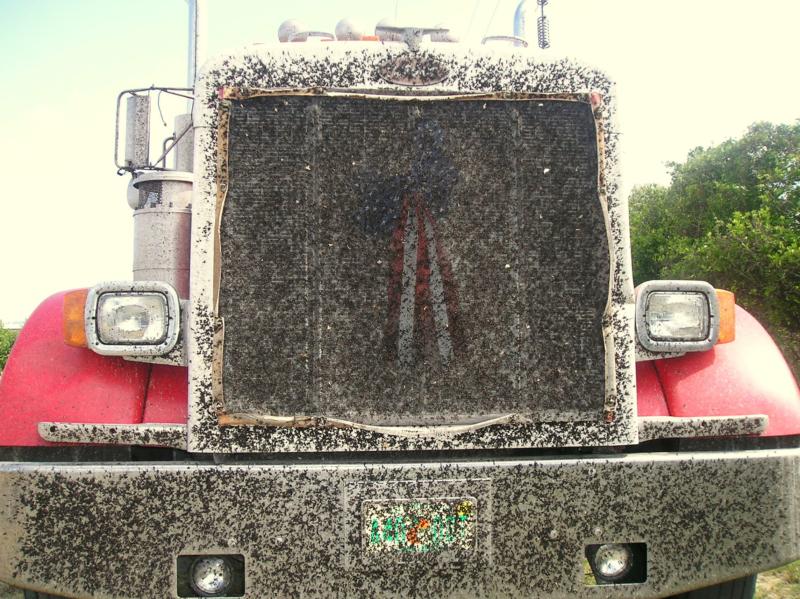
If the OP isn't towing heavy through the desert, I believe the Superduty has more than enough reserve capacity to handle a mesh screen with fairly large openings. After all, semi's have been using mesh bug screens for decades. There's a lot of bugs in the hot and muggy south:
Was that Honda Civics cooling system oversized, and designed to tow many times the vehicles own weight, over mountains, in the summer?
If the OP isn't towing heavy through the desert, I believe the Superduty has more than enough reserve capacity to handle a mesh screen with fairly large openings. After all, semi's have been using mesh bug screens for decades. There's a lot of bugs in the hot and muggy south:
The last comment about being analytical was humorous and true... in that there have been many analytical, computational, as well as experimental evaluations of bug screens over front grill areas.
Figure 3.23 below represents a graph of one such study, that was partially conducted at the Ford of Australia Climatic Wind Tunnel, as well as at the GM Holden Proving Grounds, in coordination with the School of Aerospace, Mechanical and Manufacturing Engineering of the Royal Melbourne Institute of Technology.
The book is 482 pages of "analysis", with more words and equations than there are bugs in front of that Pete, but the image below succinctly summarizes the results of many multiples of instrumentation and actual measurements, rather than just theoretical computation.
Since a radiator's job is to dissipate heat, the desired metric of measurement in the graph below is Specific Dissipation, shortened to "SD."
The blue line represents the base line.
The green line represents the addition of the bug screen. (resulting in less dissipation of heat at all speeds)
The gray line represents the addition of an air dam. (resulting in more dissipation of heat at all speeds)
The magenta line represents the application of the engine fan (resulting in significantly more dissipation of heat at lower road speeds, with demonstrably diminishing effects at higher road speeds)
When the 4WD air dams are removed, and bug screens are added, it appears that the native factory design of speed aided cooling efficiency could be compromised.
It is likely that the thermostat senses any deficit in natural heat dissipation in the form of higher temperatures, and turns on the engine fan, which is very effective at compensating, especially at lower road speeds.
The effective power of the engine fan could be why owner actions that undermine the cooling system, such as adding a bug screen or removing the air dam, are not noticed, because of the overwhelming power of the fan.
But that's just it... a powerful fan takes power to run, robbing horsepower from the engine, reducing the entire efficiency of the ensemble.
Even electric fans require power, as supplied by the alternator, driven by the engine, demanding more fuel consumption.
Cumulative consequences are not easily discerned in a single trip. If there is a cost to be paid, it will be in tiny increments over a long period of time, and as such, may not be noticed or even matter to most.
But whether or not an effect is casually observed doesn't necessarily mean that a cause doesn't carry a consequence.
I have a hard time believing that Ford did not build enough tolerance into the cooling system to overcome a window screen. My truck is running just like normal in 110 degrees of the Phoenix Summer.
This is what I did. I had a 2015 Silverado HD and cut a piece of black gutter guard to fit the small opening in the bumper. I did it to keep larger objects from bouncing up and hitting the cooler. Plenty of spacing to not cause heat transfer issues, too.
Thanks for the data @Y2KW57! As long as the fan can provide the necessary cooling when needed (as the data suggests) I'll keep running metal door screen behind my grilles. Out of the half dozen rigs we've run screens on none of them have heating issues. Guys running aftermarket bumpers and grill guards with mesh screens are losing airflow as well.
The previous owner of my F-450 didn't have a screen on. Now at 125k miles I need to pay a $1000 shop bill because the cooler is plugged full of bugs and my intercooler system can't keep up as intended on long, steep grades when loaded. So there's that to consider too.
I had a product called DBug from DBS, on my previous F150. It consisted of an aluminum mesh screen with grommets and bungee cords that mounted over the radiator. Went over 150,000 miles on it (5.4L) with no issues including towing near max rating many times. I used to monitor the engine with a scan gauge and noticed no differences in temps. I can’t find the product anywhere now but here is a link to a install write up about it. https://www.fordf150.net/articles/id...tallation.html
This Hennessey Takes the Expedition Tremor's Off-Roading Capability to the Next Level
Slideshow: The VelociRaptor Expedition gains a lift, upgraded suspension, Brembo brakes, and trail-ready equipment while retaining the stock 440-horsepower EcoBoost V6.
Rezvani's Latest Post-Apocalyptic Monster Is a Ford F-150 Raptor Underneath
Slideshow: Called the Fortress, the 850-horsepower pickup combines Raptor underpinnings with military-inspired features, survival equipment, and a starting price of $285,000.