When you click on links to various merchants on this site and make a purchase, this can result in this site earning a commission. Affiliate programs and affiliations include, but are not limited to, the eBay Partner Network.
"ALT" light came on suddenly yesterday, since I was 30 miles from home (and multimeter!) I ran by a local FLAPS and they diagnosed the problem as bad voltage regulator. Mine looked original and I have had to replace both battery and alternator over the years, so it seemed logical. But the light stayed on. Rediagnostic said the new regulator was bad. Still within the realm... but no replacement in the store. Went to the next store in the chain, picked up theirs and installed it - STILL had the light. The third store had yet another...and IT tested bad. Now I know one, maybe Chinese made new parts in a row could be bad... but three starts to strain the bonds of credulity. Luckily I had drawn an older gent who owned a '74... he suggested maybe the fusible link in the charging circuit was bad. So we jumpered from the field post on the back of the alternator using a 30A fuse to the battery positive... and all was well, light off, till I turned the engine off, at which point the 30A fuse blew. OK, try again... put in a length of fusible link instead of the fuse holder and everything worked great and I was able to make the ride home (by now late enough I had to use the headlights, but no problems arose.) Disconnected the jumper/fusible link when I parked the truck to avoid draining the battery. Okay, now for the questions...
1) I did not even know there was a fusible link IN this part of the truck, thought the only one was at the ignition. Where is it located? Is it a complete section of wire or is it just part of one of the wires?
2) Reading wire diagrams... how is a fusible link indicated? Are they rated by diameter, resistance, ?? Anyone know what spec of fusible link I need to buy for this?
3) Assuming I do not find anything wrong, is it plausible that the old one 'just blew' from age/increasing resistance? I will look for a short but I have seen no indicators of any other electrical issues.
4) Would the link probably be rated well above 30A (the size of the fuse that blew when I shut the engine down? If around 30A, having that fuse blow would make me worry more, if well above, losing the 30A would not concern me terribly. Thanks!
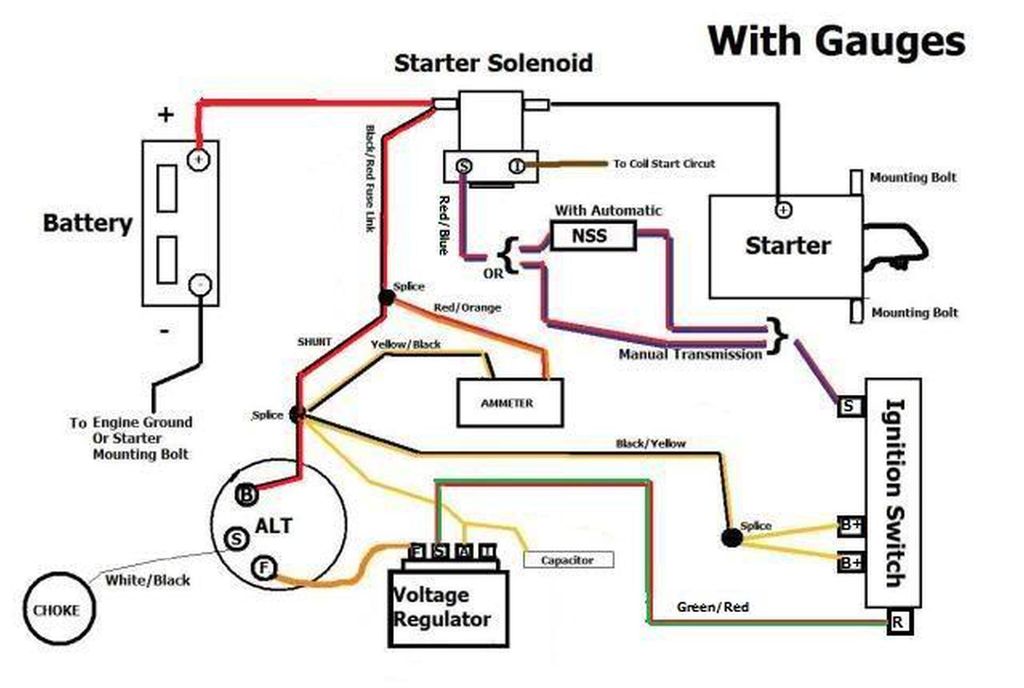
maybe this will help some on picture , and perhaps the bad voltage regulator blew the fusible link ? But I am no expert and unsure if this matches yours for this one is with gauges an not the lights
Hi HD - I think I can help, but need to get some clarification from ya concerning the checks and what-not that were done.
It is sadly true that replacement electrical items, such as regulators/alternators/starter relays, etc, have seen a nasty decline in quality over the years. However, to come up with 3 bad new ones in a row is fairly unlikely. That being said, i have to ask my first question(s): How were the regulators being diagnosed as bad? Put another way, did the part stores use a magic test box connected to the battery with the regulators installed (and bolted in) or were they tested out of the truck? Did the guy/gal take battery voltage readings before and during the running test if he/she had the magic box connected to your battery? If so, do you recall what they were?
For these old trucks, there is a fairly simple way to initially determine if you have either a bad regulator and/or a bad alternator. I can PM you the procedure if you want to try it on your own...all you need is a short piece of jumper wire (12-14 gauge) and a voltmeter (either digital or analog...I prefer a digital one for this check). You essentially did part of this test with your jumper wire trick to get home, but more on that later....
Anyway, second question...Do I assume you have a 74 model also? I read that the last gent you dealt with had a 74, but I did not see where you explicitly said what year your truck is.
Last question(s) for now: If/when the connector plug was removed from the original regulator, did you look at the condition of the terminals in the plug and/or the regulator? Were they clean? (most likely they had some corrosion on them). How about the mounting surface under the regulator (where the screws attach it to either the fender skirt or radiator core support)...any corrosion there? Lastly, was there an electrical noise suppression capacitor (condenser) attached alongside the regulator using one of the 2 screws?
There is a main charging wire fuse link that protects the charging circuit and other items that tie into this circuit. See the picture below (the fuse link is circled in red):
(photo credit: Robert Deverick)
I believe this is a 16 gauge fuse link in the picture. They are rated in gauge size, not amps. You should see it below the starter solenoid and once cleaned off, you should be able to read the gauge size on the flat side of the orange cylindrical portion. Fuse links are stated as such in the factory wiring diagram and should not be confused with regular fuses denoted with a "squiggly" icon in the diagrams. The diagram 72rt put up is a good one, but not a full wiring diagram that shows all the fuses or fuse links and not totally applicable to your setup (your doesn't have the ammeter gauge). If u want to see the diagram for a 74, go here:.https://www.fordification.net/tech/i...aster_2of8.jpg
Now, if you connected your jumper wire from the FIELD terminal on the back of the alternator to the + side of the battery, you essentially "full fielded" the alternator which forces it to go to maximum output for both current and voltage. I hope you didn't have to go far to get home because this is not good to do for more than a few seconds (up to minute max) and is hard on the alternator and battery. This full fielding test is done a different way and is part of the isolation test I mentioned earlier. When you full field a good alternator, it will load the engine down a little and usually make a whining noise. Remember anything like that? How about any alternator noise (lower pitch whine or anything else) before you put the jumper in?
I can go on, but to keep this somewhat short for now, I would be inclined to do the following: verify that the fuse link is either good or bad, double check all alternator connections, battery negative cable to engine block ground (cable condition, clean/tight connections, etc), same checks for the positive battery cable too, and the alternator to engine ground condition (the physical connection of the alternator mounting ears to the brackets/engine). I would then run the fault test mentioned earlier and see what that tells me. I don't know how old your current (pun intended) alternator is, but I kinda have a suspicion that it may have lost one of it's internal diodes. Lastly, how old is the battery and has it been properly load tested?
While I was at it, I would look for any fresh signs of toasty wires between the alternator/regulator/battery that might have resulted from the jumper you used.
Anyway, this is enough to chew on for awhile...hope this is of some help...
Haven't done anything as yet, but it is a '78 F100 with 300 cid and C6 trans and A/C. The alternator is about 2 years old, the battery 4. Battery was recently tested and good, alternator tests good. Regulator keeps testing bad. Test was using a tester that hooks to the battery's terminals, and tested before starting to get voltage, after starting, and then there was a pause period of about 4 minutes to allow everything to load up properly in the charging system (line of ascending blocks across the bottom of the tester to indicate tester status, took about 4 minutes for all blocks to fill in at which time it gave the regulator and alternator diode status. I'll take a look at the fusible link today, think that 16 is the magic number I was seeking!
and it looks like the fusible link is NOT the problem... when I removed both the regulator and starter solenoid, I discovered that at some point the main solenoid to alternator wire was severed and reattached using a wire nut! It was frayed badly and only a few strands were still connected, which I suspect was killing current flow, close to the solenoid so the wire nut was hidden under the battery cable. I trimmed back the wire to where the wire core looked healthy on each end and put a crimp-on splice in place as a temporary fix until I can just replace the entire wire. Haven't tested the charging voltage yet but on two brief starts the alternator light lit as it should and then went out. On to installing my new 4K tach and vacuum gauge!
and it looks like the fusible link is NOT the problem... when I removed both the regulator and starter solenoid, I discovered that at some point the main solenoid to alternator wire was severed and reattached using a wire nut! It was frayed badly and only a few strands were still connected, which I suspect was killing current flow, close to the solenoid so the wire nut was hidden under the battery cable. I trimmed back the wire to where the wire core looked healthy on each end and put a crimp-on splice in place as a temporary fix until I can just replace the entire wire. Haven't tested the charging voltage yet but on two brief starts the alternator light lit as it should and then went out. On to installing my new 4K tach and vacuum gauge!
Yes, glad you found it too. You proved out the fusible link because it's in the charge wire, not the field wire anyway. So you would never have had a charge by bypassing the field circuit if the charge wire was completely blown. Lucky for you those strands were still able to carry anything though!
Originally Posted by HoustonDave
The third store had yet another...and IT tested bad. Now I know one, maybe Chinese made new parts in a row could be bad... but three starts to strain the bonds of credulity.
Well I guess "you ain't from around these parts, er ya?" then?
Just kidding. It's just something we hear of more and more in the past few years. So while you're right that it should be an incredible coincidence, it's way more common than you think unfortunately. WAYYYY more common...
Originally Posted by HoustonDave
Luckily I had drawn an older gent who owned a '74... he suggested maybe the fusible link in the charging circuit was bad. So we jumpered from the field post on the back of the alternator using a 30A fuse to the battery positive... and all was well, light off, till I turned the engine off, at which point the 30A fuse blew.
I know you already have it sorted, and I alluded to this above, but I wanted to mention a couple of things for the next time.
Mainly, you can't do that! It's not good for the system normally as Highorder77 said. But hopefully you did not over load the battery because of the poor condition of your charge wire to begin with.
A full-fielded alternator can put out northwards of 17 or 18 volts into the system, and whatever it's rated amp output is (plus a few extra). Normally it's only used for a few moments while an ammeter is used to test output current to see if the alternator is up to it's rated capacity. So if your 55a alternator is only putting 35a through the charge wire while being full-fielded, the alternator (or a connection) is failing.
Don't know why the fuse blew, but it's possible that when shut down there is a momentary ground connection at the FLD terminal? Or maybe a voltage spike? Neither seems likely, but I don't know field theory from Adam, so one of the electrical gurus will have to clear that up. Overheated?
A fuse blows quickly, while a fusible link goes more slowly unless catastrophically overloaded. So maybe that's a clue? Not sure.
Originally Posted by HoustonDave
1) I did not even know there was a fusible link IN this part of the truck, thought the only one was at the ignition. Where is it located? Is it a complete section of wire or is it just part of one of the wires?
Some are complete sections, some are short sections, some are just the end link. The type you typically find at the local parts stores are a ring terminal, flag connection with the gauge rating molded in, and a short length of link wire.
I never remember the rule, but I think you protect a circuit based on 4 or 6 gauge sizes smaller than the wire you're protecting? So in that case a 10ga wire is protected by a 14ga or 16ga (which sounds about right) fusible link.
Obviously it helps to know, or be able to give a good guess as to the original wire size.
Originally Posted by HoustonDave
3) Assuming I do not find anything wrong, is it plausible that the old one 'just blew' from age/increasing resistance? I will look for a short but I have seen no indicators of any other electrical issues.
Luckily you found what was wrong, but I believe you are correct in that some of them just get old. But that "old" is probably brought on by being over-taxed over time, but never quite enough to blow it right away. A high output alternator installed, but using the same original charge wire could do it. A momentary high draw accessory would put more strain on it. Or 40+ years of hard use and high heat maybe?
Again, I don't know, but I bet you're not off base with the old age theory.
Originally Posted by HoustonDave
4) Would the link probably be rated well above 30A (the size of the fuse that blew when I shut the engine down? If around 30A, having that fuse blow would make me worry more, if well above, losing the 30A would not concern me terribly. Thanks!
Remember that it can't be rated to blow below the expected current. So if you have a 70a alternator (an option on our trucks in certain years) or even just a regular 45a alternator, your fusible link would not blow at anything less than probably at least 10a over that. But more likely 30a above the rating.
A relatively short length of 10ga wire like we have is probably good for 100a or more over that short distance. At least for a short time. So the fusible link that protects that wire is likely expected to blow around 80a or so. At least 70a I would think. Maybe Ford substituted a larger gauge charge wire for the 70a option? Some trucks even had a 100a large case 1G alternator option. Not sure when or what you had to do to get one, but it was out there. Maybe cop cars and ambulances and emergency service outfits got them.
Just wild guesses on my part, but I don't think I'm too far off. (at least on some of it!).
Anyway, sorry to rehash much of what was already discussed and you already knew, but some of it might be helpful info in the future.
(and as some know already, I just like to hear myself type sometimes)
The jumper I mentioned was to get us home... when this blew we were 30 miles away, and I'm too old to hitch-hike. I was in a position to take a chance.... lifetime warranties on both the regulator and the alternator, as well as a fire extinguisher. I figured if it ran comfortably in the O'Reilly's lot, it should not do anything but work or fail and unless it did so catastrophically, was willing to bet on it and try to make it home on battery.
My alternator is bottom end, so I probably am running minimum amperage through the wiring, plus my headlights are on a 12 gauge relay harness... I try to strain the old wiring as little as possible!
According to the fusible link package, two gauges smaller is what they recommend. So the length of 16 gauge fusible link I have should be adequate to protect a 12 gauge wire.
Rezvani's Latest Post-Apocalyptic Monster Is a Ford F-150 Raptor Underneath
Slideshow: Called the Fortress, the 850-horsepower pickup combines Raptor underpinnings with military-inspired features, survival equipment, and a starting price of $285,000.