





Disc upgrade question

Thread Starter
|
New User
Joined: Oct 2020
Posts: 9
Likes: 0
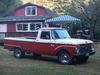
The vehicle is a 1969 f100. The valve is called a residual check valve. They're used to keep a slight bit of pressure in the wheel cylinder for faster brake response. Normally drum brakes use a 10lb valve and discs use a 2lb. My question is does anything need done other than switching the front to a 2lb valve and adding a adjustable proportioning valve?

Lead Driver
Joined: Jul 2011
Posts: 8,678
Likes: 191
From: On the Edge of the Desert
For best results, you will want to change the master cylinder to a larger bore. A common upgrade is the early 90s explorer/ranger master cylinder.
Personally, when I upgraded to disc brakes I kept them as manual (no booster). I like the feel of the pedal more, and have plenty of leg power to lock them up.
Personally, when I upgraded to disc brakes I kept them as manual (no booster). I like the feel of the pedal more, and have plenty of leg power to lock them up.
Lead Driver
Joined: Jul 2011
Posts: 8,678
Likes: 191
From: On the Edge of the Desert
Did I stutter?
Yes. 1" is the minimum considered acceptable with boosted discs. Even then, you'll have very touchy brakes. What you have will work, but you might not be happy with it.
1-1/16 or 1-1/8" result in a better feeling pedal.
Yes. 1" is the minimum considered acceptable with boosted discs. Even then, you'll have very touchy brakes. What you have will work, but you might not be happy with it.
1-1/16 or 1-1/8" result in a better feeling pedal.
Thread Starter
|
New User
Joined: Oct 2020
Posts: 9
Likes: 0
Trending Topics
Lead Driver
Joined: Jul 2011
Posts: 8,678
Likes: 191
From: On the Edge of the Desert
There are numerous threads here as well as other information all over the Internet on what needs to be done.
Fordification has a very well documented procedure on how to swap and what to get
Fordification has a very well documented procedure on how to swap and what to get
FTE Stories
Ford Trucks for Ford Truck Enthusiasts

10 Best Ford Truck Engines We Miss the Most!
Joe Kucinski
2026 Shelby F-150 Off-Road: Better Than a Raptor R?
Brett Foote
2027 Super Duty Carhartt Package First Look: 12 Things You NEED to Know!
Michael S. Palmer
10 Most Surprising 2026 Ford Truck Features!
Joe Kucinski
Top 10 Ford Trucks Coming to Mecum Indy 2026
Brett Foote
5 Best / 5 Worst Ford Truck Wheels of All Time
Joe Kucinski
Ford Super Duty: 5 Things Owners LOVE, 5 Things They LOATHE!
Joe Kucinski
Every 2026 Ford Truck Engine RANKED from WORST to FIRST!
Michael S. Palmer
The Best F-150 Deal of Every Trim Level (XL through Raptor)
Joe Kucinski
New User
Joined: May 2020
Posts: 14
Likes: 0
From: Los Angeles
@351Cleveland C4 Did you change the Brake Proportioning Valve and if so, who's did you use? I have read a lot of the aftermarket ones leak.
Thread Starter
|
New User
Joined: Oct 2020
Posts: 9
Likes: 0
F100's with four wheel drums didn't come with a proportioning valve, just a differential valve. Until now I haven't needed a proportioning valve (combination valve). That was the crux of the question. Looks like I need to switch out the 10lb check valve up front with a 2lb and add an adjustable proportioning valve to the rear. May try and find a combination valve off a disc brake truck though.

Tuned

Joined: May 2015
Posts: 413
Likes: 52
Also known as residual pressure valve. A number of old masters has RPV's in the outlet ports and the new and/or rebuilts often do not have them. They are also used in applications where the master sits below the wheel cylinders - some kit cars, or older cars where the master was below the floor. They can also be helpful when you have a large system volume and a relatively small master cylinder. It ensures that the wheel cylinders are full of fluid and ready to react. I needed to put in a 10psi valve in the rear circuit when I installed the Sterling rear.
What you may want or need in addition to what you have pieced together is a brake metering valve that is used in some Ford disc/drum applications. This is sometimes called and anti-dive valve. It ensures that the discs and drums apply at about the same time. Since there is more mechanical movement in the drums, they react a little slower than discs. To avoid the fronts hitting hard all at once causing a potential loss of control, the metering valve slows down the fronts a bit. Here is a better description https://www.freeasestudyguides.com/b...ing-valve.html . My 1970 F-250 has this valve. They are available today from some sources and there is a Chrysler version that seems to be easy to find. Ideally they are tuned to the vehicle where more or less pressure on the front brake circuit is required for the valve to open. You may or may not need one of these depending on how your truck reacts to braking. A sudden hard application is where it provides a factor of safety. In normal driving you may not know it was even there.
What you may want or need in addition to what you have pieced together is a brake metering valve that is used in some Ford disc/drum applications. This is sometimes called and anti-dive valve. It ensures that the discs and drums apply at about the same time. Since there is more mechanical movement in the drums, they react a little slower than discs. To avoid the fronts hitting hard all at once causing a potential loss of control, the metering valve slows down the fronts a bit. Here is a better description https://www.freeasestudyguides.com/b...ing-valve.html . My 1970 F-250 has this valve. They are available today from some sources and there is a Chrysler version that seems to be easy to find. Ideally they are tuned to the vehicle where more or less pressure on the front brake circuit is required for the valve to open. You may or may not need one of these depending on how your truck reacts to braking. A sudden hard application is where it provides a factor of safety. In normal driving you may not know it was even there.
Thread Starter
|
New User
Joined: Oct 2020
Posts: 9
Likes: 0
Also known as residual pressure valve. A number of old masters has RPV's in the outlet ports and the new and/or rebuilts often do not have them. They are also used in applications where the master sits below the wheel cylinders - some kit cars, or older cars where the master was below the floor. They can also be helpful when you have a large system volume and a relatively small master cylinder. It ensures that the wheel cylinders are full of fluid and ready to react. I needed to put in a 10psi valve in the rear circuit when I installed the Sterling rear.
What you may want or need in addition to what you have pieced together is a brake metering valve that is used in some Ford disc/drum applications. This is sometimes called and anti-dive valve. It ensures that the discs and drums apply at about the same time. Since there is more mechanical movement in the drums, they react a little slower than discs. To avoid the fronts hitting hard all at once causing a potential loss of control, the metering valve slows down the fronts a bit. Here is a better description https://www.freeasestudyguides.com/b...ing-valve.html . My 1970 F-250 has this valve. They are available today from some sources and there is a Chrysler version that seems to be easy to find. Ideally they are tuned to the vehicle where more or less pressure on the front brake circuit is required for the valve to open. You may or may not need one of these depending on how your truck reacts to braking. A sudden hard application is where it provides a factor of safety. In normal driving you may not know it was even there.
What you may want or need in addition to what you have pieced together is a brake metering valve that is used in some Ford disc/drum applications. This is sometimes called and anti-dive valve. It ensures that the discs and drums apply at about the same time. Since there is more mechanical movement in the drums, they react a little slower than discs. To avoid the fronts hitting hard all at once causing a potential loss of control, the metering valve slows down the fronts a bit. Here is a better description https://www.freeasestudyguides.com/b...ing-valve.html . My 1970 F-250 has this valve. They are available today from some sources and there is a Chrysler version that seems to be easy to find. Ideally they are tuned to the vehicle where more or less pressure on the front brake circuit is required for the valve to open. You may or may not need one of these depending on how your truck reacts to braking. A sudden hard application is where it provides a factor of safety. In normal driving you may not know it was even there.
I am going back to the '78 f150 I pulled the front from. Would the combination valve from that truck do truck?