When you click on links to various merchants on this site and make a purchase, this can result in this site earning a commission. Affiliate programs and affiliations include, but are not limited to, the eBay Partner Network.
My truck is low… front valance is 8.5” off the ground. With the trailer somewhat level and with 48” ramps, the valance hits the trailer deck about a foot from the end of the trailer. With serious jacking up front I can get it to clear, but it’s jacking up the suburban and the trailer quite a bit. I don’t like this situation. I do get some drop on the trailer rear end when the front of the truck gets up on the dove tail (and raises the suburban even more)
I’m looking for a solution and I’m thinking longer ramps would be the answer. I tried the calculator on race ramps site for ‘add on’ ramps and even with their best solution it’s not giving me what I want.
I experimented a little with a long 2x4 as a substitute ramp. With a level trailer I laid the 2 x 4 down the dove tail to see where it would hit the ground maintaining the dove tail slope. It was about 7’ behind the trailer. Jacking the trailer up some shortened that length, but 7' ramps aren't that objectionable I don't think...just heavy !
Anyone got a good formula for calculating this accurately before I start ‘rube goldberging’ my existing ramps. Youngsters might have to google rube goldberg.
There has got to be a geometric/trigonometric guru on this board somewhere… or at least someone smarter than me ( which is most of you) Waiting for your solutions to probably a simple fix.
All you need is some 1”x6” deck boards to make a up lift for the front tires to roll up onto prior to the valance rub
might need 1 or you might need more. Put one on each side. I do this quite often and it works fine
I use 2 X 12 x 4’ planks but this truck is low and the running boards probably hit as the front wheels pass onto the trailer longer ramps or lower trailer or a steeper hillside
Just drive your truck John then you don't have to worry about the trailer..
I was thinking the same thing.
I think you were on the right track on raising the front of the trailer / rear of the truck even if you don't like it.
It is done all the time at race tracks to get cars off / on trailers, they use a floor jack under the trailer jack foot.
Now if you don't like it because you are putting to much weight on the trailer jack by un-loading the sub suspension there is a fix.
Drive the rear wheels of the sub out on ramps. You can get some low profile plastic ramps (or built wood ones) that will raise the sub maybe 6" and that maybe enough to level the trailer ramps & deck to get the truck on / off. Might still need longer ramps.
This is also done at race tracks.
Dave ----
Just drive your truck John then you don't have to worry about the trailer..
Well yea, that's a good solution . But for instance I got to take it to the transmission shop next week to get it fixed..... that 'just drive it' goes out the window... it don't drive right now... and some of my intended trips are car shows over 300 miles one way... long haul and wife wants a vehicle for her there.. so trailering is the best option for those...
don't know about backing on... need to investigate that, but it's gonna throw the weight way behind the center of the wheels, which will probably change towing/hitch weight...
I'm still interested in longer ramps or ramp extensions...
I agree with the solution of putting planks down before the ramp. And longer ramps.. I have to do this with my wife's Honda Odyssey when I change the oil. Her front valance hits the ramp before the wheels. Has worked well. I use two short planks for each wheel. Staggered in in step pattern. One plank about a foot longer then the other.
When we had race cars, I took some 2 x 10 boards and nailed them together, 5 or 6 pieces high creating a ramp. Longest piece was about 3 feet and then shorter on top of that for each piece. Once at the track, the wood ramps went under the rear wheels of the truck and we drove up them. Worked great to change the angle of the trailer and ramps. Worked perfectly for us. They were a little heavy but never worried about them breaking. Still use them now for raising trucks up to work on them.
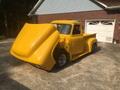
Your drawing is a little out of proportion where the 60" ramp shows in the drawing shorter than the 48" wooden ramp. However there is a method I have used to lower my RV height to get it in the barn. You can drop the entire trailer height 3-5" my letting the air out of the tires while you load the "Yellow Machine". You would have to carry a small portable air compressor to inflate the tires after loading or unloading.
This Hennessey Takes the Expedition Tremor's Off-Roading Capability to the Next Level
Slideshow: The VelociRaptor Expedition gains a lift, upgraded suspension, Brembo brakes, and trail-ready equipment while retaining the stock 440-horsepower EcoBoost V6.
Rezvani's Latest Post-Apocalyptic Monster Is a Ford F-150 Raptor Underneath
Slideshow: Called the Fortress, the 850-horsepower pickup combines Raptor underpinnings with military-inspired features, survival equipment, and a starting price of $285,000.