



Which Hitch do I have?

Thread Starter
|
Trailering
Joined: Mar 2008
Posts: 15
Likes: 0
From: Greenbank, WA
Which Hitch do I have?
I recently bought a 2003 F250 SuperDuty 4wd supercab V10 truck with the towing package.
Looking at the VIN Decoder info, I see that it could have either of 2 different receiver hitches.
"Dead Weight Hitch", or "Wt Distributing Hitch".
How do I tell which one the truck has?
Looking at the VIN Decoder info, I see that it could have either of 2 different receiver hitches.
"Dead Weight Hitch", or "Wt Distributing Hitch".
How do I tell which one the truck has?
Cargo Master


Joined: Jul 2008
Posts: 2,584
Likes: 62

Weight distribution is done between the trailer and the hitch. It is a form of drawbar (in the receiver like a ball coupler but more) that uses load bars attached to the trailer frame. By putting pressure on the load bars it tilts the drawbar forward.
Dead weight is a normal, non-weight distributing drawbar where the tongue weight rests on the "ball" (or pintle hook) entirely. In that case, the drawbar will have downward force and, when looking at the hitch from the drivers side, will have force clockwise against the hitch frame.
The WD hitches don't cause that clockwise force on the hitch. It helps to level out the trailer/truck.
Supposedly, the WD hitches transfer the tongue weight up front to the steer axle also. I would be curious to see scale tickets for the individual axles to see how much difference this really makes in practice. If it can transfer a large portion of the tongue weight to the steer axle there would have to be some serious "counter-clockwise force" (from the same drivers side vantage point) on the hitch frame to get that force through the truck frame up to the front axle....
So to simply answer your question - the hitch frame on the truck is the same. The accessories you use in the hitch account for whether or not it is WD or not....
Google weight distribution hitch and you'll find a bunch of options. I don't use them for as little as I pull and the variety of what I pull. However, if you have a trailer that you pull regularly that is heavy then it can be a good idea to run one.
One more tidbit - to get better weight transfer with the WD hitches - you can preload them by jacking up the hitch prior to torquing the arms (hook up to the coupler as you normally would, then use a floor jack under the hitch to take the tongue weight back off the tow vehicle plus some extra weight off the rear axle, or use the crank jack on the trailer, then torque the arms).
Dead weight is a normal, non-weight distributing drawbar where the tongue weight rests on the "ball" (or pintle hook) entirely. In that case, the drawbar will have downward force and, when looking at the hitch from the drivers side, will have force clockwise against the hitch frame.
The WD hitches don't cause that clockwise force on the hitch. It helps to level out the trailer/truck.
Supposedly, the WD hitches transfer the tongue weight up front to the steer axle also. I would be curious to see scale tickets for the individual axles to see how much difference this really makes in practice. If it can transfer a large portion of the tongue weight to the steer axle there would have to be some serious "counter-clockwise force" (from the same drivers side vantage point) on the hitch frame to get that force through the truck frame up to the front axle....
So to simply answer your question - the hitch frame on the truck is the same. The accessories you use in the hitch account for whether or not it is WD or not....
Google weight distribution hitch and you'll find a bunch of options. I don't use them for as little as I pull and the variety of what I pull. However, if you have a trailer that you pull regularly that is heavy then it can be a good idea to run one.
One more tidbit - to get better weight transfer with the WD hitches - you can preload them by jacking up the hitch prior to torquing the arms (hook up to the coupler as you normally would, then use a floor jack under the hitch to take the tongue weight back off the tow vehicle plus some extra weight off the rear axle, or use the crank jack on the trailer, then torque the arms).
Moderator
Joined: Jul 2010
Posts: 12,058
Likes: 1,565
From: Media PA
The hitch bolted to your truck is a receiver hitch, those two ratings are for either deadweight or using a WD system. The "drawbar" is the part that goes into the trucks receiver hitch and has a ball on the other end that the trailer attaches to, this drawbar can be either a standard ball setup (deadweight) or it can have one of several types of Weight Distribution that helps to move some of the trailer tongue weight back onto the trucks front axle when hitched and adjusted properly.
So yes, there was only one model of receiver hitch that came on your year and model truck, it just has those two different ratings depending on which type of "drawbar" is used to hitch up the trailer.
Cargo Master
Joined: Jul 2008
Posts: 2,584
Likes: 62
Thread Starter
|
Trailering
Joined: Mar 2008
Posts: 15
Likes: 0
From: Greenbank, WA
Ok, I was getting confused. That happens. sigh>
Hmm, looks like I may have an issue, since the old trailer I need to pull has a pintle hitch, and I don't see any weight distributing setups for that.
Hmm, looks like I may have an issue, since the old trailer I need to pull has a pintle hitch, and I don't see any weight distributing setups for that.
Trending Topics
Cargo Master
Joined: Jul 2008
Posts: 2,584
Likes: 62
Edit - my original links didn't work to exact products. I am going to test the ones here once this posts and make sure they work this time....
What kind of pintle hitch is it?
A lot of the ones I've seen/pulled have a bolt-on eye like this:
https://www.etrailer.com/Lunette-Rin.../T4840500.html
You can swap that for a ball coupler like this:
https://www.etrailer.com/Adjustable-...74-353-00.html
Of course, check the specs to make sure the bolt patterns line up to what you have etc....
If your trailer doesn't have that style of bolt-on ring, what does it have?
Is this trailer a community trailer of some kind where several trucks/hitches will pull it as well as other trailers that are set up the same way? Or are you the primary one that is going to be pulling it? This may play in to the feasibility of changing the coupler on the trailer. I would think it would be more logical to change the coupler to a ball and have other trucks swap drawbars (or have a dual purpose pintle/ball drawbar - they do exist - link below) than it would be to try and get a WD set up to work with a pintle.
https://www.etrailer.com/Ball-Mounts/Curt/C48006.html
OK, 2 links..
https://www.etrailer.com/Pintle-Hitch/Curt/C48190.html
There are 2 issues with using WD with a pintle:
1. The fitment of the ring against the hook is loose and there is play between the trailer and tow vehicle (when you hit the brakes, for example, if the tow vehicle has more braking power than the trailer the trailer will push forward and that will move the ring to the front of the hook opening = may be about 1/2" of movement or so). That shouldn't be a huge issue for WD set ups that use chains to attach the load arms to the side rails of the trailer frame - the chains can move with the set up.
2. Most, if not all, WD drawbars (that have the attachment points for the load bars) have a hole for a ball. I am not sure how you would adapt this to accept a pintle latch.
As in the above links - there are dual purpose ball/pintle hook combinations. So it is conceivable to have a latch that closes over top of a ball. However, I do not know if such a latch exists for mounting underneath a bolt-on ball, as opposed to one integrated in to a drawbar shank from the start. There are some combo multi-ball hitches with a pintle latch that works by going around the drawbar, however this won't work with a WD drawbar. See below for an example:
https://www.etrailer.com/Ball-Mounts...371802279.html
What kind of pintle hitch is it?
A lot of the ones I've seen/pulled have a bolt-on eye like this:
https://www.etrailer.com/Lunette-Rin.../T4840500.html
You can swap that for a ball coupler like this:
https://www.etrailer.com/Adjustable-...74-353-00.html
Of course, check the specs to make sure the bolt patterns line up to what you have etc....
If your trailer doesn't have that style of bolt-on ring, what does it have?
Is this trailer a community trailer of some kind where several trucks/hitches will pull it as well as other trailers that are set up the same way? Or are you the primary one that is going to be pulling it? This may play in to the feasibility of changing the coupler on the trailer. I would think it would be more logical to change the coupler to a ball and have other trucks swap drawbars (or have a dual purpose pintle/ball drawbar - they do exist - link below) than it would be to try and get a WD set up to work with a pintle.
https://www.etrailer.com/Ball-Mounts/Curt/C48006.html
OK, 2 links..
https://www.etrailer.com/Pintle-Hitch/Curt/C48190.html
There are 2 issues with using WD with a pintle:
1. The fitment of the ring against the hook is loose and there is play between the trailer and tow vehicle (when you hit the brakes, for example, if the tow vehicle has more braking power than the trailer the trailer will push forward and that will move the ring to the front of the hook opening = may be about 1/2" of movement or so). That shouldn't be a huge issue for WD set ups that use chains to attach the load arms to the side rails of the trailer frame - the chains can move with the set up.
2. Most, if not all, WD drawbars (that have the attachment points for the load bars) have a hole for a ball. I am not sure how you would adapt this to accept a pintle latch.
As in the above links - there are dual purpose ball/pintle hook combinations. So it is conceivable to have a latch that closes over top of a ball. However, I do not know if such a latch exists for mounting underneath a bolt-on ball, as opposed to one integrated in to a drawbar shank from the start. There are some combo multi-ball hitches with a pintle latch that works by going around the drawbar, however this won't work with a WD drawbar. See below for an example:
https://www.etrailer.com/Ball-Mounts...371802279.html
Last edited by KC8QVO; Jan 29, 2020 at 12:56 AM. Reason: links didnt work
FTE Stories
Ford Trucks for Ford Truck Enthusiasts

Top 6 Best Deals Available on New Fords & Lincolns Right Now
Brett Foote
This Hennessey Takes the Expedition Tremor's Off-Roading Capability to the Next Level
Verdad Gallardo
Top 10 Fords at 2026 Carlisle Ford Nationals
Joe Kucinski
3 Best / 3 Worst Parts of Modern Ford Ownership
Brett Foote
10 Amazing Upgrades That Solve Common Ford Truck Owner Headaches
Pouria Savadkouei
Every 2026 Ford Engine Explained
Brett Foote
10 Ugly Ford Trucks That We Still Kinda Love
Joe Kucinski
10 Things Every Truck Owner NEEDS (2026 Edition)
Michael S. Palmer
Rezvani's Latest Post-Apocalyptic Monster Is a Ford F-150 Raptor Underneath
Verdad Gallardo
Fleet Owner

Joined: Jan 2004
Posts: 26,007
Likes: 575
From: Brentwood,CA
Like I stated it's the same. Ford has a weight carrying capacity and a weight distributing capacity like all hitch receivers do.

Cargo Master

Joined: Dec 2015
Posts: 2,920
Likes: 515
The hitch bolted to your truck is a receiver hitch, those two ratings are for either deadweight or using a WD system. The "drawbar" is the part that goes into the trucks receiver hitch and has a ball on the other end that the trailer attaches to, this drawbar can be either a standard ball setup (deadweight) or it can have one of several types of Weight Distribution that helps to move some of the trailer tongue weight back onto the trucks front axle when hitched and adjusted properly.
So yes, there was only one model of receiver hitch that came on your year and model truck, it just has those two different ratings depending on which type of "drawbar" is used to hitch up the trailer.
So yes, there was only one model of receiver hitch that came on your year and model truck, it just has those two different ratings depending on which type of "drawbar" is used to hitch up the trailer.
Thread Starter
|
Trailering
Joined: Mar 2008
Posts: 15
Likes: 0
From: Greenbank, WA
For some reason, I never thought to dig into the details of hitch arrangements. I REALLY should have MANY years ago.
This is my trailer, and the pintle hitch is directly welded to the trailer frame.
And yes, I've towed this a bunch with an older ford truck - obviously without a WD Hitch. I'm now kind of amazed it never broke the truck.
Trailer is about 4000 lbs empty, and I have put 8000 lbs of scrap on it before.
This is my trailer, and the pintle hitch is directly welded to the trailer frame.
And yes, I've towed this a bunch with an older ford truck - obviously without a WD Hitch. I'm now kind of amazed it never broke the truck.
Trailer is about 4000 lbs empty, and I have put 8000 lbs of scrap on it before.
Cargo Master
Joined: Jul 2008
Posts: 2,584
Likes: 62
I would think it would be more logical to change the coupler to a ball and have other trucks swap drawbars (or have a dual purpose pintle/ball drawbar - they do exist - link below) than it would be to try and get a WD set up to work with a pintle.
There are 2 issues with using WD with a pintle:
1. The fitment of the ring against the hook is loose and there is play between the trailer and tow vehicle (when you hit the brakes, for example, if the tow vehicle has more braking power than the trailer the trailer will push forward and that will move the ring to the front of the hook opening = may be about 1/2" of movement or so). That shouldn't be a huge issue for WD set ups that use chains to attach the load arms to the side rails of the trailer frame - the chains can move with the set up.
2. Most, if not all, WD drawbars (that have the attachment points for the load bars) have a hole for a ball. I am not sure how you would adapt this to accept a pintle latch.
As in the above links - there are dual purpose ball/pintle hook combinations. So it is conceivable to have a latch that closes over top of a ball. However, I do not know if such a latch exists for mounting underneath a bolt-on ball, as opposed to one integrated in to a drawbar shank from the start. There are some combo multi-ball hitches with a pintle latch that works by going around the drawbar, however this won't work with a WD drawbar. See below for an example:
There are 2 issues with using WD with a pintle:
1. The fitment of the ring against the hook is loose and there is play between the trailer and tow vehicle (when you hit the brakes, for example, if the tow vehicle has more braking power than the trailer the trailer will push forward and that will move the ring to the front of the hook opening = may be about 1/2" of movement or so). That shouldn't be a huge issue for WD set ups that use chains to attach the load arms to the side rails of the trailer frame - the chains can move with the set up.
2. Most, if not all, WD drawbars (that have the attachment points for the load bars) have a hole for a ball. I am not sure how you would adapt this to accept a pintle latch.
As in the above links - there are dual purpose ball/pintle hook combinations. So it is conceivable to have a latch that closes over top of a ball. However, I do not know if such a latch exists for mounting underneath a bolt-on ball, as opposed to one integrated in to a drawbar shank from the start. There are some combo multi-ball hitches with a pintle latch that works by going around the drawbar, however this won't work with a WD drawbar. See below for an example:
For some reason, I never thought to dig into the details of hitch arrangements. I REALLY should have MANY years ago.
This is my trailer, and the pintle hitch is directly welded to the trailer frame.
And yes, I've towed this a bunch with an older ford truck - obviously without a WD Hitch. I'm now kind of amazed it never broke the truck.
Trailer is about 4000 lbs empty, and I have put 8000 lbs of scrap on it before.
This is my trailer, and the pintle hitch is directly welded to the trailer frame.
And yes, I've towed this a bunch with an older ford truck - obviously without a WD Hitch. I'm now kind of amazed it never broke the truck.
Trailer is about 4000 lbs empty, and I have put 8000 lbs of scrap on it before.
One of the details I did read through rings very true - when you use a WD hitch the force on the coupler (in the case of what appears to be all WD hitches now - the ball joint) reverses and instead of weight resting on the ball the load bars and draw bar put upward force on the ball = the "pulling apart" of the ball joint is what transfers the force to rotate the draw bar the opposite way.
If you think about the physics on a pintle - the ring would be forced up against the latch. Pintle latches aren't designed for that, the hook is designed to carry the weight downward and not have the ring forced up in to the latch.
So if it is your trailer your best bet might be to get to fabricating and replace the lunette ring with a 2-5/16" ball coupler. Then your world of WD hitches opens wide.

Laughing Gas
Joined: Feb 2014
Posts: 1,041
Likes: 72
From: Springfield
Thats a fair amount of wight but i still wouldn’t be too worried about it so long as your truck has good springs. Ive had estimated around 1500lbs tongue weight or more without a weight distribution hitch and it handled fine for how far I pulled it. I know for a fact the trailer once weighed in at 12k, no clue on tongue weight and with my springs it handled it great, ive had heavier behind the truck before that. All was done with a ball hitch but same weight.

More Turbo
Joined: Aug 2006
Posts: 576
Likes: 6
From: midland, Ontario
Balance your load on the trailer and pulling with just the pintle will not be an issue. Pulled bobcats on a pintle ring for the last 35 years with out an issue with weights in the 10-12k range.
Posting Guru
Joined: Aug 2007
Posts: 1,902
Likes: 26
From: BA, OK
Supposedly, the WD hitches transfer the tongue weight up front to the steer axle also. I would be curious to see scale tickets for the individual axles to see how much difference this really makes in practice. If it can transfer a large portion of the tongue weight to the steer axle there would have to be some serious "counter-clockwise force" (from the same drivers side vantage point) on the hitch frame to get that force through the truck frame up to the front axle.
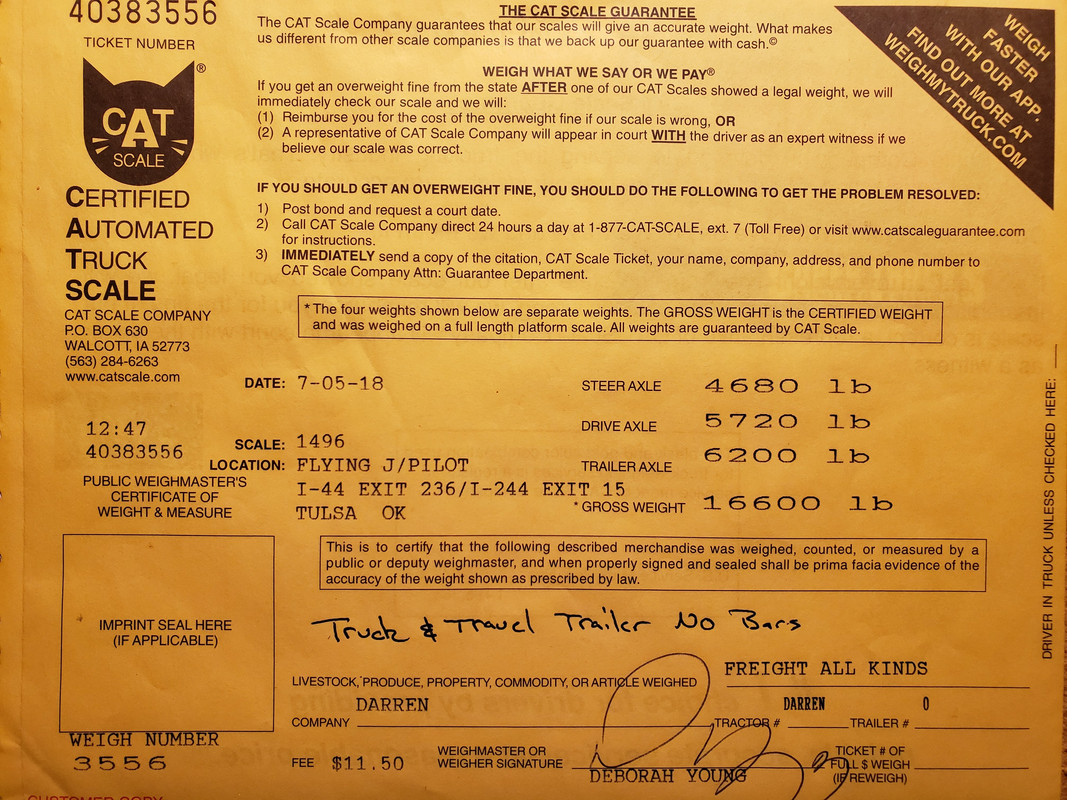
Truck & trailer no spring bars connected
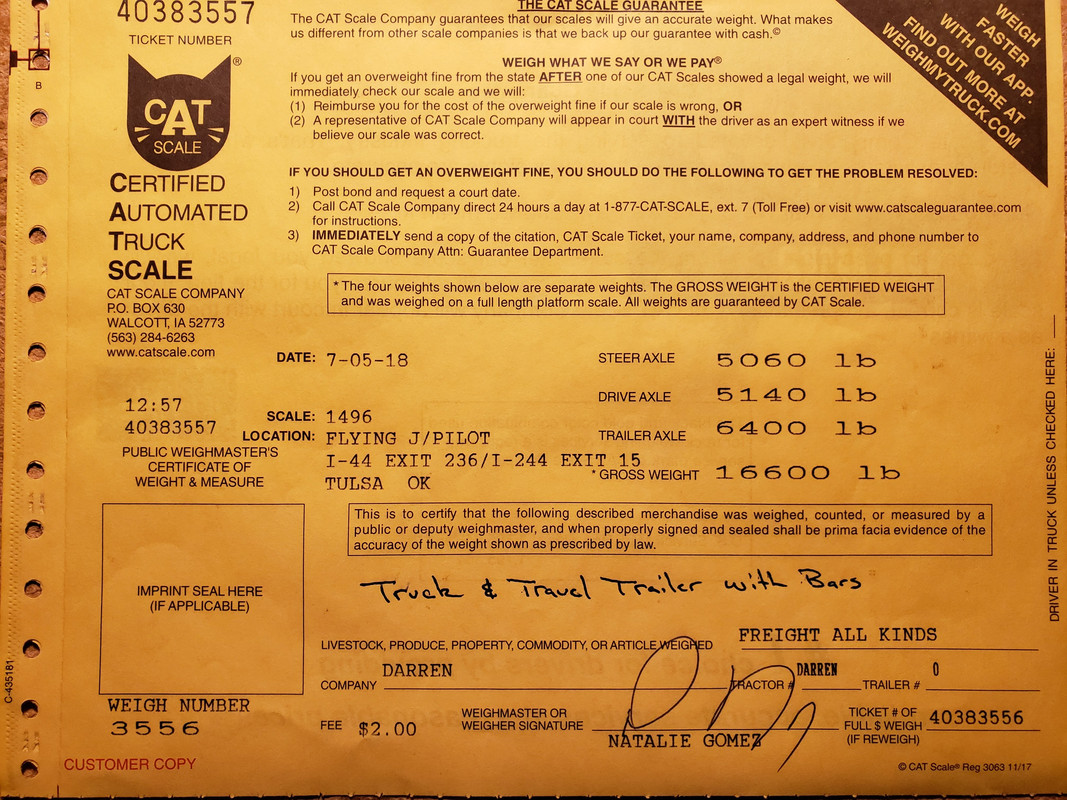
Truck & trailer with spring bars connected
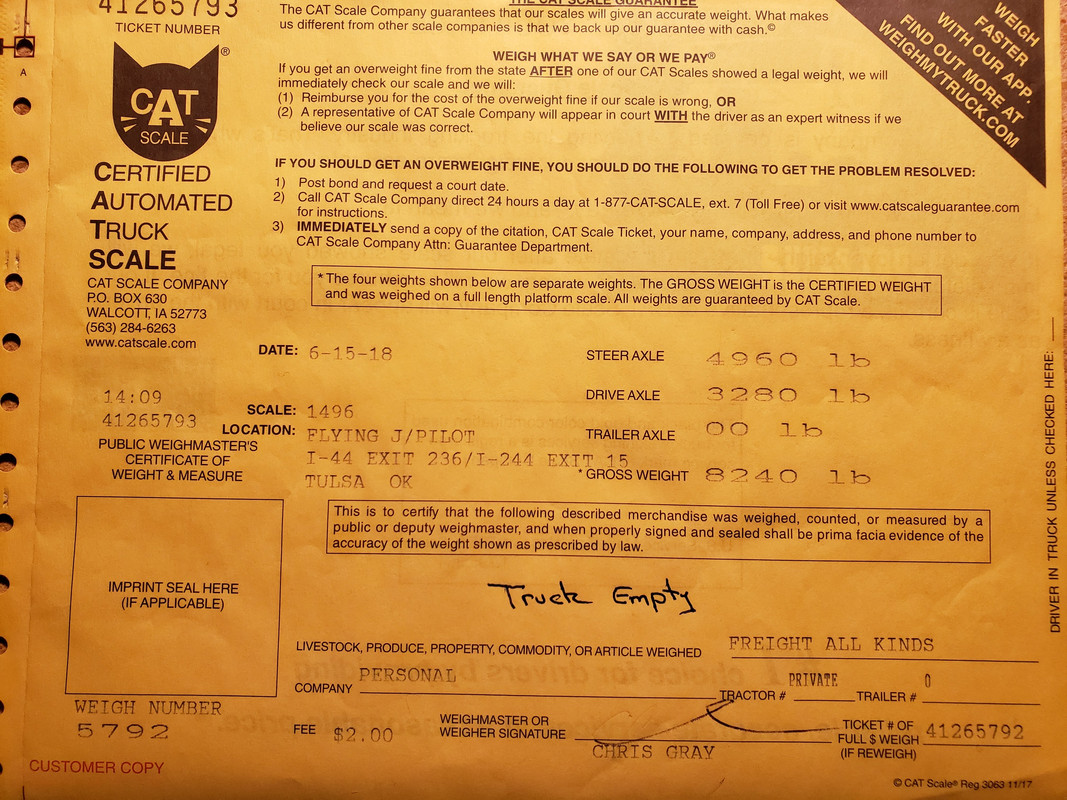
Truck unladen weight
As you can see the spring bars transferred almost 400 lbs of weight to the forward axle of the tow vehicle and 200 lbs of weight to the trailer axles.
A properly setup weight distribution hitch will add weight back to the front axle of the tow vehicle that the trailer is removing. As you can see from my weight tickets my setup is adding an additional 100 lbs of weight to the front axle with the trailer and spring bars connected compared to the unladen weight of the trucks front axle.