When you click on links to various merchants on this site and make a purchase, this can result in this site earning a commission. Affiliate programs and affiliations include, but are not limited to, the eBay Partner Network.
I have to ask, I installed my bags with individual inflation for each side. I placed the air chucks in the fuel door area seeing as I didn't go the wireless route. I set mine once on a trip and then once stopped at a gas station to air up. That was the only PITA because you have to remove the Fastgun but it was already off for fueling. Do you really need to have it controlled all the time? I set and forget and have comeback a week later and might have lost a psi per side. I wanted to go with onboard air but after using my set up, cant justify the expense. Just wondering how often you need to adjust yours
I have done set/forget for 15 years. There are so many variables when you’re on the road. For me-level after loading up-and then don’t worry about it. I am sure the on board compressor is nice, but i could not justify it.
I have done set/forget for 15 years. There are so many variables when you’re on the road. For me-level after loading up-and then don’t worry about it. I am sure the on board compressor is nice, but i could not justify it.
Agreed and I'm the one who typically justifies adding every upgrade (don't let my wife see this...)
I have to ask, I installed my bags with individual inflation for each side. I placed the air chucks in the fuel door area seeing as I didn't go the wireless route. I set mine once on a trip and then once stopped at a gas station to air up. That was the only PITA because you have to remove the Fastgun but it was already off for fueling. Do you really need to have it controlled all the time? I set and forget and have comeback a week later and might have lost a psi per side. I wanted to go with onboard air but after using my set up, cant justify the expense. Just wondering how often you need to adjust yours
Originally Posted by Bill Tex
I have done set/forget for 15 years. There are so many variables when you’re on the road. For me-level after loading up-and then don’t worry about it. I am sure the on board compressor is nice, but i could not justify it.
I would never have a system that doesn't have individual schader valves....To have a compressor system, or not, is a personal preference.
When I first put bags on the F250 they were set and forget, just like the stock truck. They were Air Lifts 5000 ultimate with the internal jounce. These can be run at 0 PSI should a leak develop. (The Firestones without the jounce have to have at least 5 PSI in them.) They were plumbed individually with one schrader valve in each wheel well. I had planned on the bags one year and the compressor and analog cockpit gauges / switches the next year. A year or so later I started learning about the automatic wireless air system. We live on the wet side of Oregon right at the base of the Coast Range mountains and can also be into the Cascades in about 45 minutes. Rain, mud, snow and ice are factors. Rough mountain roads, rough off pavement roads, steep supers, and then there is the farm and ranch use, etc..
A lot of factors that make being able to inflate or deflate bags from inside the pickup nice. Not a necessity, but nice.
Took me 3 more years of turning in pop cans and beer bottles, (instead of the 1 year), to get around to putting the Wireless Air on. (Brake jobs, new tires and "life" factored in as well). The auto feature keeps the pressure the same no matter what the AOA of the vehicle is. Take off from the house in 75 degree weather, get up the mountain, take off the next morning at 40° and you hear the compressor running adjusting for temp variations. You can check your PSI from the remote, no tire gauge needed and I don't have to clean rain and snow off my glasses after checking the pressure.
As the pitch / super on the road changes, one bag will bleed off some to keep the PSI the same. As the pressure on the bag is relieved, the compressor takes it back to the prescribed PSI. I've found some real advantages to being able to adjust the bags individually, on the fly, while "up on the mountain" here. As we get into changing parameters with the amount of super or other factors, I've changed the pressure in the bags from 10 to 30 on the drivers side and 100 on the curb side. As we are driving up the rough mountain logging roads and USFS/BLM roads if it seems like it is rocking too much I can bleed air and stiffen the ride. Some trips we take off with empty tanks and put on 450 lbs of water as we near our destination and I can easily adjust to compensate for that. Like a lot of things, it isn't necessarily a requirement, just a creature comfort. With the remote air, I can adjust the air on the fly for the given conditions, as conditions change and the best ride.
Probably where I see a lot of benefit is when we hook the boat up with it's 500-600 lbs. tongue weight, especially when the camper is on board and I have 300 to 500 lbs of gas in the boat tank and a 100 lbs of water in the boats water tank.
Right now the camper Is on our 350 pickup sitting in the driveway. The right duals are up on 2X8's and the right bag is at 100 PSI. The left duals are on the concrete and the bag is at 5 PSI. Also when off loading the camper, I run the bags up to 100 PSI. I run the jacks to ground then take the bags to 5 PSI. In the case of loading, I just hit the buttons and the bed comes up 2.5", taking that much travel off of the camper jacks. Just a convenience.
It's a personal preference as much as anything else. For the F350 with the Firestones I don't have to worry about something happening that takes the bags to zero. I've been without the system, and I've been with the system. If, for some reason I don't want the auto wireless air system operational and want to fill via the schrader valves, all I have to do is pull the batteries out of the remote. I did have the airline fitting on the Firestone go bad last fail and allow a slow leak. Never had that happen before, probably will never have it happen again, but with the air compressor it wasn't a problem and it could wait until we got home and I made a trip to the auto parts store..
Great write up. Makes sense. I like the unloading idea. That one is kinda neat.
I had a small leak on one of those air lines when I first installed it but pulled the hose and found a small burr on the end. Recut and its been great. While I liked the idea of the stainless lines, they didn't have a package with the larger bags. That being said, my main driver was the extra large bags and weight capacity of the 7500XLs that swayed me. I originally wanted HelWigs but they weren't in stock anywhere and all I could imagine was if something broke, where would I find parts. Ive rarely seen any need for pressure above 25 psi and typically its at 15 psi. Could be the larger bags or the fact I run both upper and lower StabilLoads.
In any event, I will look into this as a future modification. I like the fact that I can isolate it if I wanted, by connecting it to an up-fitter switch. If I went this route, Id want a 5 gallon tank and a heavy duty compressor. Then I could use it for tires too.
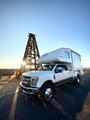
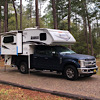
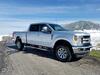
That one has been around for a while Ken. That very same Okanogan Camper (complete with the bumper sticker above the range hood vent,) has shown up on several different pickups over the past few years from various angles in stills and one video that I know of across several different truck and RV forums. It is a conversation starter!
Upon further inspection it seems to me that the background landscape is also different. It IS a conversation starter.....
Ken
It does happen, I've seen it a couple of times, but I've never seen it happen with a camper. Every time that I've seen something similar to this the pickups were loaded with gravel.
I had a call to a 'traffic hazard' on the highway one day. When I arrived I found a Chevy 3/4 ton long box nearly broken in half. Both rear tires were broken completely off. The rear bumper and axle were flat on the pavement. The bed pointed up, the cab pointed down with the front bumper nearly touching the ground. The bed was loaded, heaped up with 3/4 minus nearly to the top of the back window.
Saw the same thing a couple of months later in about the same spot. This time it was 250 loaded with gravel in the same fashion. The good news is that the Ford made it a 1/4 of a mile further down the highway. Both rear wheels were still on the pickup, but almost parallel to the pavement.
I also have the Airlift 5000 Ultimate bags with the WirelessAIR remote onboard compressor. When my camper dealer installed the system I had them also install the separate fill valves to each bag. They mounted them in the place of one of the fasteners for the rear wheel well liners. You can see the valve on the wheel well cover in the photo below. In case my onboard compressor should ever fail, I can manually fill each side independently.
I really like having the onboard compressor and ability to air the bags remotely, individually, or together as conditions require. I run mine with 5-10 lbs of air in the bags when empty even though they have internal jounce bumpers. I have not noticed any ride difference between having the bags and not.
The only problem I have had with them is my ground wire coming off the compressor did not have a proper ground connection to the frame so I would get an intermittent FAIL on the remote but once I figured that out it has been flawless since. I also wired the system into one of my upfitter switches so I can actually turn the system on and off. The reason I did this is because if the system is always on and an airbag needs aired up a little to where you have it set, it does not matter what time of day or night it is, the compressor is going to come on. That happened twice to me in the middle of the night while camping and woke us up so I rewired it to an upfitter switch. Having the ability to turn it on and off is really nice.
Rezvani's Latest Post-Apocalytic Monster Is a Ford F-150 Raptor Underneath
Slideshow: Called the Fortress, the 850-horsepower pickup combines Raptor underpinnings with military-inspired features, survival equipment, and a starting price of $285,000.