When you click on links to various merchants on this site and make a purchase, this can result in this site earning a commission. Affiliate programs and affiliations include, but are not limited to, the eBay Partner Network.
The desire to eliminate the bowl to de-clutter the valley made some sense. Now wanting to just eliminate the filter from the bowl makes no sense. It seems like you're focused on making mods instead of making improvements.
I still want to remove the housing from the valley to clean stuff up. But if it’s better to have it there to help remove air then maybe I will leave it. I haven’t made up my mind yet that’s why I’m asking questions here. I’m not sure what your meaning by I’m making mods? I would love to remove the housing. If you have an answer for the air then please let me know.
@vgk What @pirate4x4_camo and others are trying to tell you is that it takes more than just fuel system changes to run bigger injectors. Also, injector choice (and many other things) is highly dependent on intended use of the vehicle. Tell us what you envision the final end state of your engine to be. Be as detailed as you can.
I’m thinking at least 238cc injectors but I haven’t decided how much bigger I would go. My fuel system is a supporting mod I will do all the supporting stuff first.
I appreciate all the help so far guys. I think I have decided for now I will do the 4 line feed and retain the stock fuel bowl and filer. And I will also do the i tank hutch and harpoon mods and Add a pre pump filter. I think I will also get an in cab fuel pressure gauge. The 4 line feed will help with the flow I’m looking for and the in tank mods will help remove the air. Then if I’m seeing my psi drop considerably I will revisit the fuel bowl/ dual pump setup. This is a start though and I can add to it when I need to. Do any of you guys see a problem in that? Thanks for the help!
Pirate 4x4 has layed out some beautiful points here and I STRONGLY agree.
The history of all of these fuel system ‘mods’ is actually comical. The ‘cackle wars’ were the biggest topic of debate a couple years after the SuperDuty was released. The old timers just couldn’t get their heads around the deadheaded fuel system.
The reality is, after BILLIONS of cumulative miles, the stock fuel system has proven to work amazingly well for stock and mildly modified trucks.
The only exception being the in-tank mixing chamber, filters and failure-prone umbrella. This is easy to fix for less than a fast food meal for (2).
The ‘air in fuel’ argument is literally a non-issue. Sure, there are a few circumstances where air gets past the filter and must be pushed through the injectors - but this is not like running the truck out of fuel and forcing an air/fuel mixture through the nozzles at 20k psi. In extreme cases, the air equals a lack of lubrication and that damages injectors. The little air that gets in the ‘deadheaded’ fuel rails after removing the filter bowl or injectors is simply not a problem.
For stock to ~400HP, the stock system is more than adequate with in-tank mods and a WIX 33972 filter pre-pump. I have done this to literally dozens of trucks and MANY of those are running in-cab fuel pressure gauge.
We have found that about 500hp and up will run out of fuel with this set-up with high demand.
For these applications, I will use a RACOR PS120 and dual stock pumps in parallel feeding the stock fuel bowl and deadheaded fuel system. I like to use the ISSPRO fuel pressure gauge to turn on 2nd pump when needed.
The koolaid surrounding fuel system mods is STRONG. During the cackle wars, brothers fought brothers to the death on the forums - and they agreed Ford was wrong.
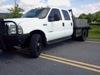
Not many people have ‘experimented’ with the 7.3 fuel system than I have. I started fooling around with my truck in 2005 and I’ve ‘modified’ dozens of trucks with vegetable oil conversions. By design, my VO system allows me to switch between ‘deadheaded’, ‘regulated return’ and ‘4-line feed’. My truck has 250k miles of ‘experimental’ fuel system(s) on it now and the trucks I’ve modified have millions of cumulative miles.
For VO conversions, I currently do the in-tank and pre-pump mods pictured above and then send diesel through the stock filter then through check valves and to the front of the heads. Then, the VO system has its own fuel tank, filters, fuel pump, regulator, etc and VO is fed to the rear of the heads.
This system has made over 500hp on the dyno with 238/80’s and tows like a boss.
IMHO, this valley is pretty ‘clean’ with stock filter.
All of that said, I think the 4-line feed from CNC isn’t a bad idea.
It eliminates the concern about ‘starving’ #8 (if you believe in that) by balancing supply from both ends of the heads. The stock lines are tiny and kinked up like a pretzel. They are also often worn through at the clamps and need replaced anyway.
It seems like you're focused on making mods instead of making improvements.
that sums it up nicely.
but hey, if messing around with vehicles is your hobby ( it is mine ). then it is a great way to learn by doing.
i strongly suggest not picking the fuel system to mess with like this for somebody who relies on the vehicle as a reliable daily driver or does not enjoy the hobby of DIY engineering. but if DIY engineering is your gig then have at it snd post up as you go. share your adventure with us.
but hey, if messing around with vehicles is your hobby ( it is mine ). then it is a great way to learn by doing.
i strongly suggest not picking the fuel system to mess with like this for somebody who relies on the vehicle as a reliable daily driver or does not enjoy the hobby of DIY engineering. but if DIY engineering is your gig then have at it snd post up as you go. share your adventure with us.
thanks, your post is on point as well. obviously earned from doing the work not reaping what you read about it on the internet.
during the cackle wars i dug into the in tank stuff even as far as conversations with the engineers at ford. my general conclusion was the in tank system works as intended, the issue is really more to do with ease of access and component service life. in other words it is stupid that a filter/screen is in a difficult to access location, that and the pickup foot can or has failed before it should. it should be and was intended to be a lifetime part.
for my purposes ( under 500 hp ). the stock configuration doesnt require modifications but may need some maintenance service.
edit. i realize the hutch / harpoon mod is well accepted as a needed mod but without personally testing and gathering quantifiable data either way I will remain skeptical. no trashing the mod, i just dont do them because i dont feel the need to allocate the time to test it. fwiw, i dont even recall which mod does what. in my mind they are just the tank mods.
OH yeah - the fuel bowl heater is completely unnecessary and useless factory part that has something to do with cold weather emissions or something.
It does not need need to be used in the stock filter or retrofitted to a custom fuel system!!!!
unless of course you live in a cold area or where emissions testing is required.
lets not forget, heat is not the enemy of diesel fuel in the same way it is to gasoline.
since diesel combust literally from the heat generated during the compression stroke it is advantageous to have the diesel within a certain starting temp range before it is injected that is much higher/hotter then gasoline which work “better” the colder it is. diesel is opposite that. ( and why the fuel rails are inside the head instead of plumbed externally.) to your comical point, people making mods to cool the diesel fuel supply.
Thanks for the reply’s guys. That setup where you have 2 different fuels in each side of the head is pretty cool. I appreciate the pictures too. With the in tank mod I was going to extend the return so if there is any air it’s sent to the other side of the tank. And with that draw straw did you cut it at a slight angle? It looks like you did. And how far did you put it off the bottom? I was thinking half an inch. Your valley definitely looks clean But I’m the kind of guy that knows it could be cleaner. I love in an area that gets really cold so I’m going to wrap my pre pump filter in a 12 volt heating blanket that way when it’s in the negatives I can turn it on. Gives me some peace of mind that the fuel won’t gell up in the filter. And that’s nice to know that the air isn’t as big as a problem as people say it is. Expecialy after the in tank mods are done I would think the air is not a problem.
Also, pirate 4x4, my thinking with the colder fuel is that it’s more dense so you get more of it per stop if it’s colder. And a hot truck that’s towing or running on the freeway I’m sure wouldn’t be picky with cold fuel. That being said I have no interest in a fuel cooler like some guys do that was just my thought on it. But to me another benefit of the 4 line feed would be that the returned fuel doesn’t flow threw the heads so the tank doesn’t get hot. I’m not sure if the benifits of more dense fuel outweigh the benifits of higher temp/ easier to fire diesel. Who knows I’m sure it’s a really smal difference
I’ve forgotten what conditions are required for fuel bowl heater to activate, but I don’t think it’s common outside the arctic. Now that you’ve alluded to it having some significant importance - I want to know if that is true!
The ‘hutch mod’ is deleting the mixing chamber and the QD fittings. The ‘harpoon mod’ is cutting the fill and vent tubes inside the tank.
I put a 90* bend on the bottom of new pick-up tube after removing the mixing chamber and failure-prone umbrella.
The pick-up needs to be directly on the BOTTOM of the tank. That is the only way to prevent an ecosystem from forming in the bottom of your tank.
Rezvani's Latest Post-Apocalytic Monster Is a Ford F-150 Raptor Underneath
Slideshow: Called the Fortress, the 850-horsepower pickup combines Raptor underpinnings with military-inspired features, survival equipment, and a starting price of $285,000.