When you click on links to various merchants on this site and make a purchase, this can result in this site earning a commission. Affiliate programs and affiliations include, but are not limited to, the eBay Partner Network.
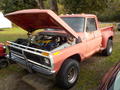
I have found a date casting number close to base of the oil filter in my truck, (see pic)..
The first number is tough to see but... would you say it could be a 3.? It has to be for the application as it is a 1973 truck,
So, 3D17 can be April 17, 1973 when it was casted at the foundry.? Engine was assembled April 24, 1973.
Is there a way to clean that part and have those numbers clearer.?
Others might add to this or make correction but with regards to Ford engine casting codes - but usually . . .
the 1st character is a letter
the 2nd character is a number
the 3rd character is a letter
the 4th character is a letter
For example - my casting code on my 1977 truck is D7TE which is a 1977 truck engine
If yours is indeed a 1970's Ford engine . . .
The 1st character should be a "D" (which stands for the 1970s decade of engines)
The 2nd character should be the specific year "3" (which stands for the last digit of the specific year = "3" for 1973)
The 3rd character should be "T" (which stands for type of engine = "T" for Truck engine)
The 4th character should be "E" (which stands for which Ford division engineered the part = "E" for "Engine" division
I can't determine what that first character is, to me it almost looks like an "A" but that can't be right. Looking at your profile, I gather that this engine is supposed to be a Ford 390ci
It looks like a 1973 Ford 390 truck engine should be a D3TE casting code (!)
Here's a list of the common engine casting number codes for 1973 Ford 390 motors . . .
D3TE – 1973-1978, 360/361/390/391 FE medium-block, 2-bolt mains, Truck
D3TE-1 – 1973, 390 FE medium-block, 2-bolt mains
D3TE-AC – 1973, 390 FE medium-block, 2-bolt mains
D3TE-HA – 1973, 390 FE medium-block, 2-bolt mains
D3TE-SA – 1973-1977, 330 FE medium-block, 2-bolt mains, Truck
I'd be somewhat careful and not wear away that code when you go to wirebrush it, you might end up with just a small obscure lump (worse than what it is now). Try taking several photos first before you start anything that can't be reversed, at least you'll have the photos to refer to later in case it doesn't end well. You might try casting light (worklight or flashlight etc) from different angles and take photos while doing so, sometimes light from just the right angle can clarify better detail
I'm kinda curious what you'll come up with and what the engine details actually are
The numbers you're talking about FlareSide are the engineering numbers (similar to part numbers, but not always an exact part number) for a given piece. The casting date codes are different than the engineering date coding.
Those characters, such as Josep is looking at will typically interpret down to the exact week of manufacture, if not the exact day. A "D3T..." number might have only been used in '73 model year trucks, but it might also (depending on the part) have been carried over multiple years until the next large engineering design change. The "casting numbers" are actual date codes that can narrow something down much better.
I've heard how to decode them so many times I'm embarrassed to say that I don't remember how to work them out. I remember some would work like an "E" decode as the 5th week of a particular year, or the 5th month of a particular year.
Although I have no idea how they decode something higher than 26 weeks with a single letter of the alphabet! Which is why I can't answer accurately. But someone will see this I'm sure. Lots of members here have that stuff down pat.
Hiya Paul! It's always good to see you on this forum and I enjoy reading many of your posts
You could very well be right and I had to pull out my folder (of my own truck) to see what I copied from the Ford factory-issue multi-book catalog set. I have this info saved on a small index cheat-card for quick reference (it took me a while to search it originally!). I will say, after endlessly (not done yet either!) searching for original parts for my truck (and for another Mercury project too!) I've gotten used to sifting through Ford part #'s and Ford engineering #'s (and Ford service part #'s too!) so I've got that down pretty well.
Ok, so here is what I was going by (using my own 1977 400cid as an example) and using the actual Ford book terminology . . .
Engine Cast Code: D7TE-A3B >>> 1977 Truck Engine (unsure what the suffix A3B truly means) - this number is cast in raised letters on the engine block behind the starter
Cast Code Date: 6H20 >>> 1976 June 20 (date the engine was cast) - this number is cast in raised letters directly below the above Cast Code
Stamp Code: 6H26-B >>> 1976 June 26 (date the engine was machined) - this number is stamped into the block behind the engine cylinder cover (aka "timing plate")
Trying not to get too off-course with the above but I guess I was getting confused and thinking the OP Josep66 was showing the primary casting # (showing decade + year) and not the actual casting date stamp!
My fault, I haven't had a 390 Ford since 1989 and I was thinking the # Josep66 had on his block in the photo was arranged like my 400 engine and he was showing the primary casting # - oops
Hiya Paul! It's always good to see you on this forum and I enjoy reading many of your posts
You could very well be right and I had to pull out my folder (of my own truck) to see what I copied from the Ford factory-issue multi-book catalog set. I have this info saved on a small index cheat-card for quick reference (it took me a while to search it originally!). I will say, after endlessly (not done yet either!) searching for original parts for my truck (and for another Mercury project too!) I've gotten used to sifting through Ford part #'s and Ford engineering #'s (and Ford service part #'s too!) so I've got that down pretty well.
Ok, so here is what I was going by (using my own 1977 400cid as an example) and using the actual Ford book terminology . . .
Engine Cast Code: D7TE-A3B >>> 1977 Truck Engine (unsure what the suffix A3B truly means) - this number is cast in raised letters on the engine block behind the starter
This (D7TE-A3B) is the ENGINE BLOCK ID CASTING NO. A3B signifies any engineering changes.
Cast Code Date: 6H20 >>> 1976 June 20 (date the engine was cast) - this number is cast in raised letters directly below the above Cast Code
6H20 - BLOCK CASTING DATE
Stamp Code: 6H26-B >>> 1976 June 26 (date the engine was machined) - this number is stamped into the block behind the engine cylinder cover (aka "timing plate")
6H26-B - ENGINE ASSEMBLY DATE
Trying not to get too off-course with the above but I guess I was getting confused and thinking the OP Josep66 was showing the primary casting # (showing decade + year) and not the actual casting date stamp!
My fault, I haven't had a 390 Ford since 1989 and I was thinking the # Josep66 had on his block in the photo was arranged like my 400 engine and he was showing the primary casting # - oops
Not trying to be an a$$ (although I usually am), but the above corrections are more concise.
The 105 below the CASTING DATE ID on the FE shown above signifies a 105 block which used newer casting/tooling on the later FE.
The casting date code in question here appears to begin with a 3 but has some casting slag attached to it. Since it's in a '73 model truck it is safe to assume that it's 3D17 which means that this particular block was cast on April 17, 1973.
I do nor really have much to add it looks like post # 8 &9 have it under control. I will go up to the shop tomorrow and ck some books I have to see if I can lend any advice.
Thanks for clarifying the date coding methodology. Now I'll see how long I remember before I forget!
Just have to remember "year of decade" and "month" and "day" and maybe I'll retain it longer this time.
I presume that you have to have all the numbers to confirm a date code, correct? Otherwise a "3" or a "6" or whatever could be sixties, seventies, or any ensuing decade. Correct?
This way the "D3" or "E7" or whatever it is would add ultimate meaning to the date of manufacture.
Thanks for clarifying the date coding methodology. Now I'll see how long I remember before I forget!
Just have to remember "year of decade" and "month" and "day" and maybe I'll retain it longer this time.
I presume that you have to have all the numbers to confirm a date code, correct? Otherwise a "3" or a "6" or whatever could be sixties, seventies, or any ensuing decade. Correct?
This way the "D3" or "E7" or whatever it is would add ultimate meaning to the date of manufacture.
Paul
I think you are talking to me. Correct me if I am wrong.
It is fairly simple. You first find the component ID CASTING NO.(D7TE-A3B) It will tell you the first year of design release.(1978 - D=1970 | 3=1973)). You then find the CASTING DATE ID and that will give you the date it was cast. It may be a few year beyond the actual ID CASTING NUMBER. The STAMPING NO. is the date of ENGINE ASSY, so that pinpoints it exactly.
You may also look for a foundry CASTING ID and PARTIAL VIN STAMPING to actually nail it all down.
As to SUFFIX A3B. The A will ID the casting. Let's say just for illustration the A ID'S an FE. Any other character in this position would ID another casting but from a different engine family. Not usual but it happens. 3 would signify any engineering change from the first casting as well as B might.
These are not actually ENGINEERING PN's but COMPONENT ID. NOS. An actual ENGINEERING NUMBER may appear similar but is not usually the same. The PN you see on the packaging is a SERVICE PART NUMBER. Parts are also identified as ASSEMBLY PN's for assembly. Once you get hold of the idea, it is not that complicated.
Thanks all for the informations posted, very interesting and helpful.!
Yes, Paul is right here I would say, as well as awhtx and 1977 Flareside 400.
Looks like the mystery is solved and I’m happy.!
This Hennessey Takes the Expedition Tremor's Off-Roading Capability to the Next Level
Slideshow: The VelociRaptor Expedition gains a lift, upgraded suspension, Brembo brakes, and trail-ready equipment while retaining the stock 440-horsepower EcoBoost V6.
Rezvani's Latest Post-Apocalyptic Monster Is a Ford F-150 Raptor Underneath
Slideshow: Called the Fortress, the 850-horsepower pickup combines Raptor underpinnings with military-inspired features, survival equipment, and a starting price of $285,000.