When you click on links to various merchants on this site and make a purchase, this can result in this site earning a commission. Affiliate programs and affiliations include, but are not limited to, the eBay Partner Network.
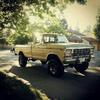
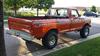
So starting to dig into my truck for an interior redo and exterior paint. Seems to be going deeper than I figured so truck will be sitting for probably six months. Plan was to pull the carb and disassemble. Store it until I'm done and rebuild with new gaskets etc. Fuel stabilizer in tank. Pull the distributor so I can occasionally spin pump, little oil in the plug holes and turn the crank. Oil change before firing it up again. Battery on the tender. Do I need to put some blocks under the axles to get tires off the ground? New tires and engine so want to make sure I don't ruin anything. This is where I'm at now. Fitting floor pans then start grinding interior. Thanks for any input. I'll probably have lots of questions.
Even though most setups can do six months "standing on their head" so to speak, I think that blocking up the axles to get the tires off the ground is a very good idea for new tires.
There are two schools of though for the fuel. On one hand a full tank has less air exposure and would theoretically reduce issues and give the stabilizer a better fighting chance.
On the other hand, an empty tank doesn't need any maintenance or heavy thinking at all!
Then again, on the third hand, six months is not enough to make the fuel detrimental to the engine anyway. But as with the tires, it does not hurt to be proactive and use stabilizer anyway.
All the rest of your ideas sound very reasonable. If you're going to be spritzing a little lube down the plug holes on a regular basis you can leave the plugs out to make sure no condensation has a chance to work it's mischief as well. Or if you live in a very moist environment, then leaving the plugs installed after oiling the cylinders would seem to be a good practice.
When pressurizing the system with the pump it's also a good practice to rotate the engine by hand to make sure that the lifters get a chance to flex and the oil gets a chance to pass through every orifice in the engine. Because you're not working on the engine in the first place it sounds like, you could even rotate the engine with the starter without causing any trouble it sounds like. Just making sure (twice and then a third time!) that you're in Neutral or in Park before you crank with the starter.
Pulling the carb apart is a great idea, as the evaporating fuel really likes to gum things up. I've had a carb sitting on an engine for 20 years now, but at least it's never had fuel in it so I figure I'm ok! Well, other than being a dope for letting an engine sit for so long without finishing the project that is!
Good luck. Sounds like you're all over it. Maybe someone else has some good insight, but sounds like you've got most of it down.
Oh, and I forgot to mention that since six months often turns into sixteen, or even sixty months(*!) you're good to plan ahead for things that are not even an issue at six months.
I lost track of time (got lazy) once and ruined two brand new Optima Blue Tops because I stopped charging them regularly and neglected to connect them to a maintainer. Managed to save one of the two, but it's only a shadow of it's former self I'm sure.
It's funny you say six months. I leave my truck every 1.5 years for at least six months. I've been in the Navy for 15 years now and I go on six month deployments. This is what I do.
1. Lucas Oil stabilizer - one quart of LOS and four quarts of oil. The day before I "store" it, I change the oil to this mixture and run engine for 20 minutes at idle.
2. Pure gasoline - No ethanol gas at all in both tanks. Fill to the brim. Ethanol is the devil's juice. Pure gasoline takes much longer to break down than E10, E15, or E85. Do this before the oil change.
3. Nothing in the combustion chamber. Do not fog the engine or transmission, that stuff doesn't work anyway.
4. Disconnect battery, both pos and neg.
5.Tires stay on the ground. If you are running radials, you will have no problems. The old bias plys would get flat spots, not radials. But if you want to put on jack stands, it won't hurt anything nor will it help with radials.
6. Cardboard on the dash and seat back pushed all the way forward. The sun causes the most damage to seats and dash pads, especially when the windows are up and there is no ventilation.
7. Do not push the parking brake (if not on stands). Just choke the wheels. Last thing you want is parking brakes to rust or seize to the drums and that sucks.
8. Rat and mouse poison pads in cab and under the hood. The big ones will deter squirrels away too under the hood.
I have seen guys fog their engines, lift on jack stands, put chemicals in gas tanks, and the list goes on. Literally, 9 time out of 10, those guys don't have the same luck that I do. I connect my battery and she fires right up. I get to laugh at them and say "You should have bought a Ford." as I drive away. I've done this for eight deployments so far with great results every time. Hope this helps.
Thanks for the input. Didn't really know if six months was a long time to sit. But, like Paul said, that can turn longer quickly. Probably did yesterday. Ended up pulling the front clip and fenders to access the bottom of pans etc for paint/rustproofing. Have to decide where I'm going to stop. Don't want a show truck. Just want it to last. Miss driving it already. Merry Christmas everyone.
6 months? I wouldn't even worry about it. Maybe I'm just stupid lucky, but I've never done anything to a vehicle that sits a year or more and I've never had a problem. Yes, gas will start to break down in a few months (allegedly), but it won't turn into that thick varnish that gums up carbs for quite a while. Years. I've had several friends who let a vehicle sit for a year or two and other than a dead battery, no issues with fuel or flat spotted tires. When I inherited my '77 F-250, it had a 1/2 tank of fuel that was ~9 months old (it sat for a while before my father passed away) and I fired with zero issues, other than a depleted battery.
Hell, my dad also had a '76 Old Cutlass that sat in a garage for ~20 years with a fully topped off tank of gas - all we did was swap fluids and filters, changed plugs, threw in a new battery and fired it up. Ran great, no issues, not even a rough idle. The fuel in the tank and carb even smelled fresh. Burned thru that entire tank, refilled with fresh gas and there was very little difference in performance. No fuel stabilizer was used.
I have truck that sat outside not driven in winter, first couple of years just battery tender and full tank of gas. In the spring had to always rebuild carb. Then I had the bright idea to start once a month and was rewarded with rotted out exhaust from tailpipe to manifold. Now days it sets not started all winter, gas tank full of non ethanol fuel, with double dose of stabilizer and battery tender. I also make sure good fuel and stabilizer have ran through the engine and completely warmed up driving back from filling it. This has worked for me for many years now. As long as it might sit, if you have other projects in mind on the underside next year it won't hurt to get a little oil on the nuts and bolts soaking in.
Rezvani's Latest Post-Apocalyptic Monster Is a Ford F-150 Raptor Underneath
Slideshow: Called the Fortress, the 850-horsepower pickup combines Raptor underpinnings with military-inspired features, survival equipment, and a starting price of $285,000.