


Checking back in with a towing question
Thread Starter
|
Tuned
Joined: Aug 2013
Posts: 414
Likes: 1
Checking back in with a towing question
Hello, I've not posted in a while now, but have not disappeared. Still have the van, and still loving it.
Question I have is about towing. I am going to use Bubba as the hauler for our 20' pontoon boat. As this is an E350 with the 7.5l and 4.11 gears. I am thinking this sub-3k pound load isn't going to be a problem as long as I use the tow/haul button. I did a ton of work last year on the engine and brakes so I'm not worried about reliability. But I've never towed with it before and am wondering if anyone has any tips on what to look out for. I read the towing capacity is somewhere in the neighborhood of 11,000 to 13,000 pounds, can I verify that somehow?
With the pontoon being a wide, flat-faced thing, are there any concerns with wind jostling it around or causing other handling issues?
Question I have is about towing. I am going to use Bubba as the hauler for our 20' pontoon boat. As this is an E350 with the 7.5l and 4.11 gears. I am thinking this sub-3k pound load isn't going to be a problem as long as I use the tow/haul button. I did a ton of work last year on the engine and brakes so I'm not worried about reliability. But I've never towed with it before and am wondering if anyone has any tips on what to look out for. I read the towing capacity is somewhere in the neighborhood of 11,000 to 13,000 pounds, can I verify that somehow?
With the pontoon being a wide, flat-faced thing, are there any concerns with wind jostling it around or causing other handling issues?
FTE Legend


Joined: Jun 2006
Posts: 31,930
Likes: 1,499
From: Ottawa, Ontario
Wind drag will probably be the only thing you notice and even then only at hwy speeds, otherwise you will forget it is back there. Make room for it when turning and changing lanes and measure the overall height so you know if there will be clearance problems anywhere you go, it would suck to back it into your driveway and run the canopy in to the eve of your house or garage for example.

Tuned
Joined: Dec 2009
Posts: 401
Likes: 20
If it has a hard top or a canvas top;take it down. If the pontoon traler is the type with narrow track,be careful on turns,they can tip. If the trailer is a bunk type ( where the pontoons sit on a cradle),it will sit higher. Aluminum pontoon boats are very easy to tow.Make sure you use wide enough towing mirrors and secure the boat to the trailer securely. I tow mine all over the place and dont have any problems.
Thread Starter
|
Tuned
Joined: Aug 2013
Posts: 414
Likes: 1
So I have a question, hope you guys can advise...
The van has what I believe to be a Pullrite hitch. It glides on a half-circle ring and the arm swivel point is way back near the axle. The half circle extends to behind both wheels, it's huge. Anyway, it was there when I got the van, stowed off to the right and pinned.
I never looked at it closely because I never needed it, but now that I do, I found it has a big problem. The pin ring on the arm was bent, likely from PO backing into something (I promise I did not and would admit it if I did). So, the pin was jammed into the parked/stowed position, but will not fit into the tow position because with the plate bent, the pin hole is misaligned and when inserted through the hole the arm is offset so the tow would not be straight. Ugly. I tried to bend it back, (knowing the outcome), and the plate broke off at the bent corner. And to be honest, even if it straightened out I would not have towed with it fearing it was compromised.
Now, my question is, I can't find parts or hardly any information about it!! Does anyone know about these Pullrites?
The van has what I believe to be a Pullrite hitch. It glides on a half-circle ring and the arm swivel point is way back near the axle. The half circle extends to behind both wheels, it's huge. Anyway, it was there when I got the van, stowed off to the right and pinned.
I never looked at it closely because I never needed it, but now that I do, I found it has a big problem. The pin ring on the arm was bent, likely from PO backing into something (I promise I did not and would admit it if I did). So, the pin was jammed into the parked/stowed position, but will not fit into the tow position because with the plate bent, the pin hole is misaligned and when inserted through the hole the arm is offset so the tow would not be straight. Ugly. I tried to bend it back, (knowing the outcome), and the plate broke off at the bent corner. And to be honest, even if it straightened out I would not have towed with it fearing it was compromised.
Now, my question is, I can't find parts or hardly any information about it!! Does anyone know about these Pullrites?
Thread Starter
|
Tuned
Joined: Aug 2013
Posts: 414
Likes: 1
Continuing the search... It seems the thing is made to actually move along that radius when towing rather than locking it with the pin at the center point, is that right?
It looks like this, if this is a help...
https://goo.gl/images/TrL42T
The thing is massive, really. If it's made to tow free like that, then I'm good. Otherwise I need that center pin mount fixed.
Sorry for the stream-of-consciousness feeling here, I apologize. Reading yet more, it seems it actually is supposed to travel along that radius, with the pivot point near the axle being how it is actually loading and trailering, feeling more like a 5th wheel. So I wonder why you can lock it at center then.... Anyway, again, if that is the case, I should be good to go? This hitch looks great and seems in good shape aside from the lock ring issue. Or, is this simply overkill for a 20' pontoon boat and I should swap it out for a more traditional receiver?
It looks like this, if this is a help...
https://goo.gl/images/TrL42T
The thing is massive, really. If it's made to tow free like that, then I'm good. Otherwise I need that center pin mount fixed.
Sorry for the stream-of-consciousness feeling here, I apologize. Reading yet more, it seems it actually is supposed to travel along that radius, with the pivot point near the axle being how it is actually loading and trailering, feeling more like a 5th wheel. So I wonder why you can lock it at center then.... Anyway, again, if that is the case, I should be good to go? This hitch looks great and seems in good shape aside from the lock ring issue. Or, is this simply overkill for a 20' pontoon boat and I should swap it out for a more traditional receiver?
Thread Starter
|
Tuned
Joined: Aug 2013
Posts: 414
Likes: 1
OK, I think I now understand... What helped me understand was remembering that a large accessory came with the hitch. This:
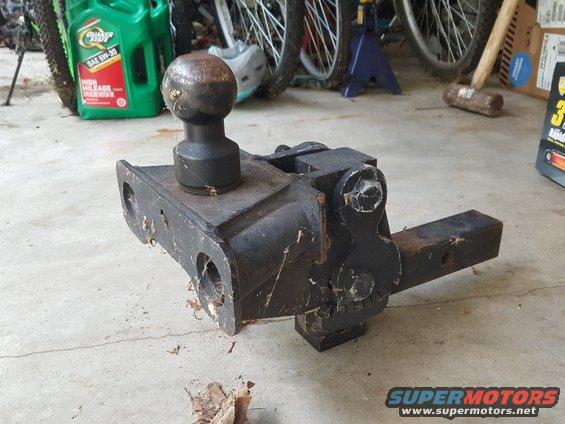
And now I believe I understand this hitch. That center lock on the radial swing bracket is for towing lighter loads, like my boat, that DO NOT require the two sway bars and wider movement, correct? And those sway bars stabilize it so it does not fold at the ball, like my boat would have done if I tried to tow with it that way, loosely. So, I lock it in for the 'standard' smaller load towing. That massive chunk I found today is for connecting the large trailer with the arms, right?.
So, I need to repair that hitch pin lock or replace the entire hitch. Since I do not need anywhere near the capacity the Pullrite offers, I will replace the hitch altogether. What's the best one for our E350's?
And for the record, I would not, under any circumstances, have attempted to tow until I fully understood the system, trust me.
And now I believe I understand this hitch. That center lock on the radial swing bracket is for towing lighter loads, like my boat, that DO NOT require the two sway bars and wider movement, correct? And those sway bars stabilize it so it does not fold at the ball, like my boat would have done if I tried to tow with it that way, loosely. So, I lock it in for the 'standard' smaller load towing. That massive chunk I found today is for connecting the large trailer with the arms, right?.
So, I need to repair that hitch pin lock or replace the entire hitch. Since I do not need anywhere near the capacity the Pullrite offers, I will replace the hitch altogether. What's the best one for our E350's?
And for the record, I would not, under any circumstances, have attempted to tow until I fully understood the system, trust me.
Trending Topics

Senior User
Joined: Sep 2018
Posts: 117
Likes: 0
From: Woodland, WA
The parents of a friend of mine pull their pontoon boat behind their mid '90's Ford E150 just fine, so you're good to go on towing capacity.
Sorry, I'm no help on the tow equipment questions.
Sorry, I'm no help on the tow equipment questions.
FTE Stories
Ford Trucks for Ford Truck Enthusiasts

Top 6 Best Deals Available on New Fords & Lincolns Right Now
Brett Foote
This Hennessey Takes the Expedition Tremor's Off-Roading Capability to the Next Level
Verdad Gallardo
Top 10 Fords at 2026 Carlisle Ford Nationals
Joe Kucinski
3 Best / 3 Worst Parts of Modern Ford Ownership
Brett Foote
10 Amazing Upgrades That Solve Common Ford Truck Owner Headaches
Pouria Savadkouei
Every 2026 Ford Engine Explained
Brett Foote
10 Ugly Ford Trucks That We Still Kinda Love
Joe Kucinski
10 Things Every Truck Owner NEEDS (2026 Edition)
Michael S. Palmer
Rezvani's Latest Post-Apocalyptic Monster Is a Ford F-150 Raptor Underneath
Verdad Gallardo
Hotshot


Joined: May 2003
Posts: 11,141
Likes: 25
From: south louisiana
OK, I think I now understand... What helped me understand was remembering that a large accessory came with the hitch. This:
And now I believe I understand this hitch. That center lock on the radial swing bracket is for towing lighter loads, like my boat, that DO NOT require the two sway bars and wider movement, correct? And those sway bars stabilize it so it does not fold at the ball, like my boat would have done if I tried to tow with it that way, loosely. So, I lock it in for the 'standard' smaller load towing. That massive chunk I found today is for connecting the large trailer with the arms, right?.
So, I need to repair that hitch pin lock or replace the entire hitch. Since I do not need anywhere near the capacity the Pullrite offers, I will replace the hitch altogether. What's the best one for our E350's?
And for the record, I would not, under any circumstances, have attempted to tow until I fully understood the system, trust me.
And now I believe I understand this hitch. That center lock on the radial swing bracket is for towing lighter loads, like my boat, that DO NOT require the two sway bars and wider movement, correct? And those sway bars stabilize it so it does not fold at the ball, like my boat would have done if I tried to tow with it that way, loosely. So, I lock it in for the 'standard' smaller load towing. That massive chunk I found today is for connecting the large trailer with the arms, right?.
So, I need to repair that hitch pin lock or replace the entire hitch. Since I do not need anywhere near the capacity the Pullrite offers, I will replace the hitch altogether. What's the best one for our E350's?
And for the record, I would not, under any circumstances, have attempted to tow until I fully understood the system, trust me.




Hotshot
Joined: May 2003
Posts: 11,141
Likes: 25
From: south louisiana
Thread Starter
|
Tuned
Joined: Aug 2013
Posts: 414
Likes: 1
The Pullrite I removed was maybe an inch behind the axle. The half-circle part was pretty close to touching the rear tires. I guess it worked well for the original owner who supposedly pulled a large trailer, but it was a bit of overkill for what I needed, so I figured it was best to remove the whole thing for a more 'conventional' hitch rather than to have the Pullrite repaired so I could lock it for small loads as designed. It was big enough that when the arm was swung off to the right, there was enough clearance to drop the full size spare tire out from inside the diameter.