



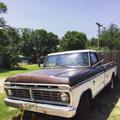

73 f-250 steering problems.

Lead Driver


Joined: Jul 2017
Posts: 9,616
Likes: 1,182
From: San Jose, CA
But you're correct that a little more or less toe would not act that way. A LOT of extra toe could certainly do it though.
Do you know what the spec is? Could too little preload cause that too, or would that end up more like just loose steering all around? A little extra wandering and following grooves perhaps?
Paul
Lead Driver
Joined: Jul 2017
Posts: 9,616
Likes: 1,182
From: San Jose, CA
The reason I feel that this conversion is important is that using "degrees" of angle keeps the steering pivot point (whether ball joints or king-pins) consistent no matter what size tire is installed. Using "inches" of toe however changes the angle for every change in a tire's overall diameter.
Now, there are arguments among us nowadays that I don't remember before. That is that toe-in (or toe-out) is measured as a comparison between the leading edge of the tire and the pivot point. Never in my life have I heard that until recently. For me it was always a comparison between the leading edge of the tire and the trailing edge of the tire. So an increase in tire diameter made the toe angle smaller while the actual inches remained the same.
Using angle as your core measurement should work fine if all tires remained exactly the same size. But since we so often change the size on our trucks, using angle measurements from an alignment machine would give a false toe measurement as compared to the old days.
I have always had the best luck using at, or near the factory specification for toe-in on my trucks, even with much larger tires. Now using angle as a form of measurement, guarantees that if you have larger tires, your toe-in numbers are increased.
Whether that's good or bad for every instance, I can't say. But it would not have worked for any of my trucks. I know that because I've experimented with larger and smaller toe settings for almost 50 years and I can tell you that adding too much more toe-in than stock does not feel good on my trucks.
So here's a question about your new tire setup. How much different are they in diameter than your older tires?
From my understanding the 265/75's are around 31". If I roughly overestimate to 32", that puts my radius at 16", TAN theta (the angle) = toe/radius, doing some math, toe = radius*TAN theta, and assuming an angle of 0.1 degrees, 16" * TAN (0.1) = 0.028. A 1/32 runs in at 0.031, so I'm close to two times that number to be at 1/16" total- all rough numbers, but in the ball park.
My Dunlop Mud Rovers from the nineties were over 34.5" tall on the vehicle. Some others I've measured were as much as a full inch shorter!
So yeah, accurate measurements are called for. Including using "rolling radius" as your starting point, rather than actual overall diameter. This takes into account the vehicle weight. Some heavy duty tires won't care about this, but regular tires (especially 15's) still squish quite a bit.
Sometimes the only way to find out is to experiment. Once you determine how far off the original spec they are based on the degrees and actual tire rolling radius, you can go from there.
Camber is pretty good, with the right side being a little much for my tastes these days. Yes, it's within spec so there would be no red flags. And it's not even at the high end (most likely between 1° min and 2° max?), but the higher readings on our rigs often lead to quicker tire wear on the outside. I bet your passenger side front tire wears the outer edge quicker than the rest?
This extra on one side promoted straighter running down the road.
But having double is more than normal. Something near 50% more is about average for camber, but less than that for caster.
And speaking of caster... Yours is very low.
I could be wrong since I don't have the specs memorized for your particular truck, but most people try to dial in between 4 and 8 degrees positive caster nowadays. Having 1 to 3 degrees was a throw-back to manual steering days, where more caster makes it harder to steer. Power steering pretty much ignores it and you don't even feel it, except as a more direct feedback through the wheel.
There are modern front wheel drive cars that use very low caster numbers and get away with it nicely. But many are still in the 6 to 8 degree range still. Some even use toe-OUT as a thing too!
For comparison, the caster spec on a late seventies 4wd Ford Bronco or F150 would have been 6 to 8 or so.
Back in the day when I had my '79, I do recall bringing the truck to an RV shop to have the I-beams bent into alignment. Granted, I was trying get my old truck to steer near perfect (I realize a near impossibility with these old trucks- they drive like old trucks). At this point, I'd just be comfortable going 55 MPG without wagging all over the lane.
No reason not to make it at least fun to drive again though. So keep at it. At least you're aware they don't drive like modern vehicles, and can take that into account. But it can still give you a sense of safety at some point.
A good way to do the rears at least is to use chalk, baby powder, or just dirt, and wipe it across the tread. Drive down the street straight and see where the medium was worn away. If it's only wearing in the center, there is too much pressure in the tires. If it goes all the way to the tread edge, it needs more pressure. You can do this daily until you get it right too, just by watching the dirt patterns whenever you pull up at home or your other destinations. Sometimes it's a little vague using the dirt-on-the-road method, but often it's quite clear where the wear is.
Being a pickup truck you don't want to just use your empty weight as your tire wear indicator. But you can use that low pressure point where it wears to within an 1/8" of the edge of the tread as your "minimum tire pressure" and that will be great for all of your empty-bed running. If that's the way you roll 99% of the time, this is a good pressure for you.
If you load up mild loads at the home center or move the neighbors's couch across the state now and then, you could add some to your base pressure and use that as your daily pressure for a safety measure on those days when you load up.
Or, as I do, use just over the base pressure 90% of the time, but know what is needed for safe travels when fully loaded. In my case it was something like 40psi empty and 70psi full. So when I knew I was going to grab a load of wood or dirt, I pumped them up prior to the job. But the rest of the time I was getting max mileage out of the tires and not beating my kidneys to death unnecessarily the rest of the time.
Just depends on your normal use, but you get the point about the test methodology.
The front tires get the same treatment, but due to the camber built in you can't get as accurate a picture and have to punt sometimes. Watching both inner and outer tread markers, and not letting the wear get outside of the tread-zone and on to the sidewall just because you lowered the pressure too much for that softer ride.
Have fun with the other project. Let us know how that goes too please. Hey, a gearhead doesn't care what kind of project it is. It's still at least somewhat interesting to us!
Paul
Mountain Pass
Joined: Mar 2008
Posts: 184
Likes: 0
From: S.C.
With rear Steer ( Steering Geometry behind the Wheels) once moving Forward the Wheels would won't to push Forward Edge Out. This being said from a Static position being close to Toe Out is only going to get worse. So if you are Close to Toe Out setting still you are Definitely Toe Out in Forward Motion. And Toe Out will Drive like what is Mentioned. I would Pull the Toe In a little @ a time and see if it makes a difference.

5th Wheeling
Joined: Sep 2018
Posts: 40
Likes: 2
I've got this same sway bar - has anyone seen any published information about how to adjust this primitive version of the sway bar? There is no image or mention of it in the 1974 Chassis shop manual. I stuck mine back on as best I could and tightened the bolts to 100 foot pounds with the wheels on the pavement - but the presence of the adjusting slots makes me wonder if there is a prescribed method to adjust this thing.

Tuned

Joined: Nov 2009
Posts: 261
Likes: 3
One thing I realized yesterday, I installed the sway bar without preload. All of my experience with sway bars usually requires some load on them. So, I'm thinking that whenever I have a moment to get my truck on flat ground that I loosen up the sway and re-torque down. It does beg the question, should the radius arms be pre-loaded? I've never seen a note regarding the torque on them requiring pre-load.
5th Wheeling
Joined: Sep 2018
Posts: 40
Likes: 2
When you say "pulled", do you mean pulled towards the front, pulled towards the back, or removed it entirely?
FTE Stories
Ford Trucks for Ford Truck Enthusiasts

Top 6 Best Deals Available on New Fords & Lincolns Right Now
Brett Foote
This Hennessey Takes the Expedition Tremor's Off-Roading Capability to the Next Level
Verdad Gallardo
Top 10 Fords at 2026 Carlisle Ford Nationals
Joe Kucinski
3 Best / 3 Worst Parts of Modern Ford Ownership
Brett Foote
10 Amazing Upgrades That Solve Common Ford Truck Owner Headaches
Pouria Savadkouei
Every 2026 Ford Engine Explained
Brett Foote
10 Ugly Ford Trucks That We Still Kinda Love
Joe Kucinski
10 Things Every Truck Owner NEEDS (2026 Edition)
Michael S. Palmer
Rezvani's Latest Post-Apocalyptic Monster Is a Ford F-150 Raptor Underneath
Verdad Gallardo
Ford Parts Specialist
Joined: Nov 2006
Posts: 88,826
Likes: 787
From: Simi Valley, CA

I have a '73 F250 2WD Camper Special.
One slight difference I've noticed is there is a "hard" sway bar that bolts between the radius arms. I recall having to use a bit of force to get it to fit and I'm wondering if I should pull it out or at least fiddle with moving it a bit in the slots?
One slight difference I've noticed is there is a "hard" sway bar that bolts between the radius arms. I recall having to use a bit of force to get it to fit and I'm wondering if I should pull it out or at least fiddle with moving it a bit in the slots?

5th Wheeling
Joined: Sep 2018
Posts: 40
Likes: 2
NumberDummy, does any of your reference material indicate torque values, or whether the truck should be on the ground or in the air, when installing that particular sway bar? I've looked at the factory chassis service manual for the 74 and it doesn't even mention the sway bar.
Ford Parts Specialist
Joined: Nov 2006
Posts: 88,826
Likes: 787
From: Simi Valley, CA
NumberDummy, does any of your reference material indicate torque values, or whether the truck should be on the ground or in the air, when installing that particular sway bar? I've looked at the factory chassis service manual for the 74 and it doesn't even mention the sway bar.
Tuned
Joined: Nov 2009
Posts: 261
Likes: 3
Ok, an update on this slow going issue. Finally had a moment to take the truck to a place that bends I-beams- pretty much knows what they are doing on aligning one of these old rigs. The gent confirmed my toe is where it should be and yes, the camber is +1* on each side (hence the need for I-beam bending and then readjusting the toe). Yet, that doesn't impact the stability / wander issue I've been having. He checked the steering system out and said it's all very tight, too tight. He mentioned it's either the box or the king pins. I told him the box is a fresh rebuild from Red-Head and that I did the king pins. Alas, the problem. I reamed the king pins with an adjustable reamer, opening them up until I got a nice tight slip fit. Yet, I may have not opened them up enough in fear of going too far. I asked him if I should try opening them up a bit more and he responded back that I could or simply deal with the wander until the bushings eventually wear / break in. Hmmm. I did notice that during the 50 mile trip to the alignment shop the instability issue seemed to get better so as long as I keep my speed down on the freeway, probably a good thing anyway.
They couldn't bend the i-beams this past week because the other "guy that knows" was out sick. So, I'm bringing the truck back next week to finally dial in the camber and readjust the toe.
I think I'll wait on opening up the pin bushings until the rest of the alignment work is done and then see how she drives. I don't drive the truck often, she's not a DD.
So the short of it, appears binding king pins are my primary issue.
Will update again. All this time spent inspired me to figure out what was wrong with my choke and work on my starting system too. Mini-starter going on sometime this weekend.
Happy 4th of July.
They couldn't bend the i-beams this past week because the other "guy that knows" was out sick. So, I'm bringing the truck back next week to finally dial in the camber and readjust the toe.
I think I'll wait on opening up the pin bushings until the rest of the alignment work is done and then see how she drives. I don't drive the truck often, she's not a DD.
So the short of it, appears binding king pins are my primary issue.
Will update again. All this time spent inspired me to figure out what was wrong with my choke and work on my starting system too. Mini-starter going on sometime this weekend.
Happy 4th of July.
Last edited by decaruby; Jul 4, 2019 at 11:04 AM. Reason: typos clarity
Tuned
Joined: Nov 2009
Posts: 261
Likes: 3
Well, just had the camber dialed in by one of the few shops in the bay area that still do this sort of thing and maybe it's just me, or maybe the fact that they had to readjust the toe once the camber was brought in (and they use the enter of the tire, not fixtures on the rims), but she seems to be driving a lot better. Having maybe a 100 miles on the truck now, seems like the pin bushings are wearing in a bit- at least, good enough to do 60-65, but still a bit of the two hands on the wheel white knuckling, but decent enough to tolerate while I continue to dial in other things with the truck. I'm thinking this winter I'll be replacing the leaf spring bushings and rear sway bushings, as well as the shocks. Thanks for the help and suggestions guys.