


Need Help Determining Safe Load

Thread Starter
|
New User
Joined: Jul 2018
Posts: 11
Likes: 11
MsLola,
It's possible that your truck may be lighter than I initially suggested. If so, and if your truck's GVWR is 8800 lbs., then you may have more payload capacity available. So, a quick trip to the scales is in order.
What more can you tell us about your 1996 Ford F250? For example, is is a regular cab, a supercab, or a crewcab? Is it a long bed (8 feet)? four-wheel drive of two? Is is a regular okl' F250, or is is an "F250 HD"? Are there vehicle stickers (certification and or payload) on the driver side "B" pillar, or perhaps somewhere else? Can you take and post pictures?
What size- and load range tires are on the truck? For example, are they 236/85R16E or ??? Is there any info about "maximum load" such as 3084 lbs at 80 psi or ??? The tire sidewalls should have this info. And, how old are the tires?
The 8600 lbs. GVWR suggests to me that it's an F250 HD, and the 3890 lbs. payload suggests you have a regular cab long bed two-wheel drive and load range E tires, all with a curb weight of ~4700 lbs.
The more info we have, the better we can help you figure out that you've got and to safely put it to best use.
It's possible that your truck may be lighter than I initially suggested. If so, and if your truck's GVWR is 8800 lbs., then you may have more payload capacity available. So, a quick trip to the scales is in order.
What more can you tell us about your 1996 Ford F250? For example, is is a regular cab, a supercab, or a crewcab? Is it a long bed (8 feet)? four-wheel drive of two? Is is a regular okl' F250, or is is an "F250 HD"? Are there vehicle stickers (certification and or payload) on the driver side "B" pillar, or perhaps somewhere else? Can you take and post pictures?
What size- and load range tires are on the truck? For example, are they 236/85R16E or ??? Is there any info about "maximum load" such as 3084 lbs at 80 psi or ??? The tire sidewalls should have this info. And, how old are the tires?
The 8600 lbs. GVWR suggests to me that it's an F250 HD, and the 3890 lbs. payload suggests you have a regular cab long bed two-wheel drive and load range E tires, all with a curb weight of ~4700 lbs.
The more info we have, the better we can help you figure out that you've got and to safely put it to best use.
Hello, yes,, you nailed it: my 1986 Ford F250 is indeed a HD (super duty), regular cab, 2WD, Long (8 ft.) bed, with a 460 V-8 gas engine in it, an air compressor with rear lift bags, load range E 16" tires, two gas tanks (I can tell how fast I'm going by watching the gas gauge!), and a beautiful new cab headliner. I bought it used several years ago and was told it has the "heavy duty everything, for towing, etc." The info for GVWR of 8,600# came from the factory sticker on the driver's side door post....along with the Front (3,125#) & Rear (5,915#) GAWR's.
Thank you for supplying the curb weight of 4,700 lbs......where did you get that info?! I've been searching all over for it!! I have seriously doubted that my truck weighs 6k ever since I ran across that info online somewhere. I found a reliable source for the formula to determine the ACTUAL payload capacity, and it is this: GVWR - Actual Curb Weight (full gas tanks, but no passengers) = Payload. And "Payload" is the max wet weight limit (fully loaded and ready to roll over bears) I can load into/onto my truck. (I understand that if I decide to tow anything, further calculations and considerations will be in order.) After that, all I need do is make very sure that the camper's COG is 50" if less. 50" is directly centered over the rear axle, I don't want to go behind that point with any load's COG.
As an aside, a couple years ago I made the foolish decision to move to Missouri. Everything I kept had to fit either in the bed of the truck or in my 2-horse, straight load trailer. Both were loaded to the gills...and then there was me, two dogs, and a cat! Well, the heat and humidity in MO nearly killed me, so I couldn't leave fast enough, but my point is that I never thought to weigh any of that and there were lots of books and other heavy stuff, and it took me a couple days packing to fit it all in!! I HAD to be very, very close, if not well over, my truck's hauling and towing capacity -- and we got over the Rockies without any issues. I have also hauled a little over a ton of hay on the truck without issue. Even so, it's good to know what I'm supposed to be doing to stay safe....guess I'm getting cautious in my old age!
Please tell me where you got that curb weight info!
Thanks much!!!
Thread Starter
|
New User
Joined: Jul 2018
Posts: 11
Likes: 11
It is a 460 V-8 gas engine, HD, 8' bed
Thread Starter
|
New User
Joined: Jul 2018
Posts: 11
Likes: 11
It's a 2WD
Thread Starter
|
New User
Joined: Jul 2018
Posts: 11
Likes: 11
MsLola,
It's possible that your truck may be lighter than I initially suggested. If so, and if your truck's GVWR is 8800 lbs., then you may have more payload capacity available. So, a quick trip to the scales is in order.
What more can you tell us about your 1996 Ford F250? For example, is is a regular cab, a supercab, or a crewcab? Is it a long bed (8 feet)? four-wheel drive of two? Is is a regular okl' F250, or is is an "F250 HD"? Are there vehicle stickers (certification and or payload) on the driver side "B" pillar, or perhaps somewhere else? Can you take and post pictures?
What size- and load range tires are on the truck? For example, are they 236/85R16E or ??? Is there any info about "maximum load" such as 3084 lbs at 80 psi or ??? The tire sidewalls should have this info. And, how old are the tires?
The 8600 lbs. GVWR suggests to me that it's an F250 HD, and the 3890 lbs. payload suggests you have a regular cab long bed two-wheel drive and load range E tires, all with a curb weight of ~4700 lbs.
The more info we have, the better we can help you figure out that you've got and to safely put it to best use.
It's possible that your truck may be lighter than I initially suggested. If so, and if your truck's GVWR is 8800 lbs., then you may have more payload capacity available. So, a quick trip to the scales is in order.
What more can you tell us about your 1996 Ford F250? For example, is is a regular cab, a supercab, or a crewcab? Is it a long bed (8 feet)? four-wheel drive of two? Is is a regular okl' F250, or is is an "F250 HD"? Are there vehicle stickers (certification and or payload) on the driver side "B" pillar, or perhaps somewhere else? Can you take and post pictures?
What size- and load range tires are on the truck? For example, are they 236/85R16E or ??? Is there any info about "maximum load" such as 3084 lbs at 80 psi or ??? The tire sidewalls should have this info. And, how old are the tires?
The 8600 lbs. GVWR suggests to me that it's an F250 HD, and the 3890 lbs. payload suggests you have a regular cab long bed two-wheel drive and load range E tires, all with a curb weight of ~4700 lbs.
The more info we have, the better we can help you figure out that you've got and to safely put it to best use.
Brand new tires, load range E....will have to look at tires for their load range later....on way to 4th of July party now!! Thanks & HAPPY 4th OF JULY!!!

Mountain Pass

Joined: Nov 2017
Posts: 107
Likes: 6
A regular cab, long bed 2WD with a gas engine is about the lightest truck you can get as far as curb weight goes. The short cab/long bed is also good for weight distribution. I think it will carry an 8-9ft camper without slideouts just fine if you keep an eye on the weight and not carry much extra stuff. It may need new shocks depending on their age.
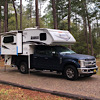
I once carried a Lance 915 on a 2008 Silverado 2500HD reg. cab LB 4x2. It did have some sway but rode fine overall. Sway was better after I got rid of the roof AC. Granted, the truck was 20year younger than yours, but the GVWR wasn't that much more at 9200. Total weight weighed was around 8800.
I once carried a Lance 915 on a 2008 Silverado 2500HD reg. cab LB 4x2. It did have some sway but rode fine overall. Sway was better after I got rid of the roof AC. Granted, the truck was 20year younger than yours, but the GVWR wasn't that much more at 9200. Total weight weighed was around 8800.
Logistics Pro


Joined: Apr 2000
Posts: 4,334
Likes: 306
From: Mills River

Thank you for supplying the curb weight of 4,700 lbs......where did you get that info?! I've been searching all over for it!!
Info from a couple of sources helped estimate your truck's curb weight. One is the difference between the GVWR and the max payload reference, so 8600 - 3890 = 4710 lbs.
I also found this source. It a third party site but there's enough data to suggest some level of accuracy, and it too shows an 8600 lb. GVWR. The curb weight for the 1996 F250 HD reg cab long bed 4x2 model described appears to be 2510 lbs. (front) plus 2004 lbs. (rear) = 4514 lbs.
However, this is for your base truck model configuration with the smaller V8 and a manual transmission. With the BIG V8 and an auto trans, your particular truck will be heavier. Accordingly, your truck's original curb weight may very be in the 4710 - 5000 lbs. range, depending on other factory accessories. The best way to know for sure would be to have your truck weighed (with full tanks and you outside) at a CAT scale.
So, even at 5000 lbs. curb weight, it looks like you've a useful payload spec (3600 lbs.?) to work with. Just remember that payload means everything -- and everybody -- that you put on- or in the truck.
Good news about the new load range E tires! Note that the E just means the maximum load is based on 80 psi inflation. The actual load rating (xxxx lbs.) depends on the actual tire size. Size and max load specs are both moulded onto the tire sidewalls. Don't forget to check the spare for size and age...
HTH,
Jim / crewzer
Info from a couple of sources helped estimate your truck's curb weight. One is the difference between the GVWR and the max payload reference, so 8600 - 3890 = 4710 lbs.
I also found this source. It a third party site but there's enough data to suggest some level of accuracy, and it too shows an 8600 lb. GVWR. The curb weight for the 1996 F250 HD reg cab long bed 4x2 model described appears to be 2510 lbs. (front) plus 2004 lbs. (rear) = 4514 lbs.
However, this is for your base truck model configuration with the smaller V8 and a manual transmission. With the BIG V8 and an auto trans, your particular truck will be heavier. Accordingly, your truck's original curb weight may very be in the 4710 - 5000 lbs. range, depending on other factory accessories. The best way to know for sure would be to have your truck weighed (with full tanks and you outside) at a CAT scale.
So, even at 5000 lbs. curb weight, it looks like you've a useful payload spec (3600 lbs.?) to work with. Just remember that payload means everything -- and everybody -- that you put on- or in the truck.
Good news about the new load range E tires! Note that the E just means the maximum load is based on 80 psi inflation. The actual load rating (xxxx lbs.) depends on the actual tire size. Size and max load specs are both moulded onto the tire sidewalls. Don't forget to check the spare for size and age...
HTH,
Jim / crewzer
Thread Starter
|
New User
Joined: Jul 2018
Posts: 11
Likes: 11
Thank you for supplying the curb weight of 4,700 lbs......where did you get that info?! I've been searching all over for it!!
Info from a couple of sources helped estimate your truck's curb weight. One is the difference between the GVWR and the max payload reference, so 8600 - 3890 = 4710 lbs.
I also found this source. It a third party site but there's enough data to suggest some level of accuracy, and it too shows an 8600 lb. GVWR. The curb weight for the 1996 F250 HD reg cab long bed 4x2 model described appears to be 2510 lbs. (front) plus 2004 lbs. (rear) = 4514 lbs.
However, this is for your base truck model configuration with the smaller V8 and a manual transmission. With the BIG V8 and an auto trans, your particular truck will be heavier. Accordingly, your truck's original curb weight may very be in the 4710 - 5000 lbs. range, depending on other factory accessories. The best way to know for sure would be to have your truck weighed (with full tanks and you outside) at a CAT scale.
So, even at 5000 lbs. curb weight, it looks like you've a useful payload spec (3600 lbs.?) to work with. Just remember that payload means everything -- and everybody -- that you put on- or in the truck.
Good news about the new load range E tires! Note that the E just means the maximum load is based on 80 psi inflation. The actual load rating (xxxx lbs.) depends on the actual tire size. Size and max load specs are both moulded onto the tire sidewalls. Don't forget to check the spare for size and age...
HTH,
Jim / crewzer
Info from a couple of sources helped estimate your truck's curb weight. One is the difference between the GVWR and the max payload reference, so 8600 - 3890 = 4710 lbs.
I also found this source. It a third party site but there's enough data to suggest some level of accuracy, and it too shows an 8600 lb. GVWR. The curb weight for the 1996 F250 HD reg cab long bed 4x2 model described appears to be 2510 lbs. (front) plus 2004 lbs. (rear) = 4514 lbs.
However, this is for your base truck model configuration with the smaller V8 and a manual transmission. With the BIG V8 and an auto trans, your particular truck will be heavier. Accordingly, your truck's original curb weight may very be in the 4710 - 5000 lbs. range, depending on other factory accessories. The best way to know for sure would be to have your truck weighed (with full tanks and you outside) at a CAT scale.
So, even at 5000 lbs. curb weight, it looks like you've a useful payload spec (3600 lbs.?) to work with. Just remember that payload means everything -- and everybody -- that you put on- or in the truck.
Good news about the new load range E tires! Note that the E just means the maximum load is based on 80 psi inflation. The actual load rating (xxxx lbs.) depends on the actual tire size. Size and max load specs are both moulded onto the tire sidewalls. Don't forget to check the spare for size and age...
HTH,
Jim / crewzer
Thanks for that info! Originally, I had assumed the formula for determining curb weight was, as you said, the GVWR - the payload, but then I started reading some other things that seemed to say something different and it became very confusing. Good news = it really was very simple and straight forward all along. (glad that's over!) Now it's all about measurements and keeping an eye on that COG.
The 1995 Lance 945 I went to see this morning was in very good shape for it's age, but the black water tank was fully exposed = subject to freezing. I thought they were all at least enclosed, even if they're not heated. (Live & learn.) While I was measuring as many clearances and distances as I possibly could, I discovered that my homemade, custom bumper sticks out at least two inches farther than the rear, underside of the camper.
It would mean that the whole camper would have to sit farther back on the bed of the truck in order to accommodate the bumper. The bumper is welded to the frame of the truck, so it ain't going nowhere. And two inches backwards shifted the COG to a point that was still within a safe range, but it was just enough too far back for me to feel comfortable with it. Plus, even though I liked the extra counter top space in that 945, it left no storage room for me to put heavier items farther forward in the unit to help with the COG /weight distribution. So, even though it was a long drive on a very hot day without air conditioning and I was greatly disappointed, I learned a lot and will be that much more discriminating as the search for just the right camper continues. And so it goes.
P.S. All 5 tires are the same & all brand new.....still need to double check the load range printed on the tire.
THANK YOU, EVERYONE, FOR YOUR HELP AND ADVICE.
Senior User
Joined: Jul 2018
Posts: 188
Likes: 4
Go get your truck weight at a scale, full of fuel and what you normally carry. That's the ONLY way to get true weights.
Mine comes in at 10,600 fully loaded and ready to camp. 1990 lariat xlt, 460/ZF-5...scaled curb is 6,578lbs full of fuel and me at the wheel. approx. 1,800 rear, 4,700 front. Scaled with C/O approx. 5,800 rear and 4,800 front. Over my 10,000lb GVWR but well under my axles, and it a 1990 S&S 11SC and is a 4-season unit.

Mine comes in at 10,600 fully loaded and ready to camp. 1990 lariat xlt, 460/ZF-5...scaled curb is 6,578lbs full of fuel and me at the wheel. approx. 1,800 rear, 4,700 front. Scaled with C/O approx. 5,800 rear and 4,800 front. Over my 10,000lb GVWR but well under my axles, and it a 1990 S&S 11SC and is a 4-season unit.
FTE Stories
Ford Trucks for Ford Truck Enthusiasts

Top 10 Fords at 2026 Carlisle Ford Nationals
Joe Kucinski
3 Best / 3 Worst Parts of Modern Ford Ownership
Brett Foote
10 Amazing Upgrades That Solve Common Ford Truck Owner Headaches
Pouria Savadkouei
Every 2026 Ford Engine Explained
Brett Foote
10 Ugly Ford Trucks That We Still Kinda Love
Joe Kucinski
10 Things Every Truck Owner NEEDS (2026 Edition)
Michael S. Palmer
Rezvani's Latest Post-Apocalyptic Monster Is a Ford F-150 Raptor Underneath
Verdad Gallardo
Top 10 Most Expensive Ford Trucks Ever Sold on Bring a Trailer
Joe Kucinski
2027 Ford Super Duty Buyer's Guide (Every Model, Engine, & Package)
Brett Foote
1st Gear
Joined: Apr 2024
Posts: 1
Likes: 2
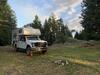
My 2020 F250 XLT with camper package has a 10,000 lb GVW. Listed payload is 3055 lb so curb weight from the factory was 6945. The only things I've added are Torklift camper tie downs and a few miscellaneous items like bed cover, floor mats, etc. I recently got the truck weighed and actual curb weight is now 7030 Lbs, so calculated payload is now 2970 which is plenty for my small slide in camper, two passengers, bike rack and all our gear.

6th Gear
Joined: May 2024
Posts: 6
Likes: 6
From: Virginia & North Carolina
This challenge of payload limits made it really hard to purchase the right truck and took us over a year to find the right combo. We really didn't want to go DRW as it's my daily driver now. You cannot rely on dealers or private resellers to even know where to look to find the data you need to make the right purchase. More than once I had to direct them past the VIN data plate to the capacity data plate. We ended up going with a 2019 F350 6.2L gasser 4WD SRW and we will just be under the 4,196# payload available with a 11,300# GVWR once you add a wet NL 8-11 with gear and occupants.
Last edited by pkkmc96; May 4, 2024 at 10:34 AM. Reason: forgot to add year
6th Gear
Joined: May 2024
Posts: 6
Likes: 6
From: Virginia & North Carolina
...I'd also second the CAT scale weight check. You have to add on all the aftermarkets to the door jam data plate...it adds up fast. In case this helps others an XLT of same year, drivetrain and engine, etc. was 200# lighter than the Lariat by the door jam. Unfortunately that truck had tons of aftermarket add ons to include wicked heavy bumpers, etc. We ended up even on payload with the nicer outfitted Lariat since it still had mostly OEM...



Thread
Thread Starter
Forum
Replies
Last Post
cmk2008
1987 - 1996 F150 & Larger F-Series Trucks
1
May 27, 2012 11:04 PM