When you click on links to various merchants on this site and make a purchase, this can result in this site earning a commission. Affiliate programs and affiliations include, but are not limited to, the eBay Partner Network.
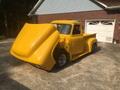
My Cab floor is fully insulated in both DynaMat and DynaPad. The remainder of the cab is insulated with DynaMat. My Mufflers are located directly below my Seat. They are O.E.M. Reproduction 440/Hemi units that are nice and mellow. That said, I have a city-street RPM drone that resonates me into becoming an axe-murderer.... Has anyone tired exhaust-wrapping mufflers to reduce drone?
Edit: Forgot to mention that the exhaust pipes exit at the corners of the rear fenders.
You can dampen/eliminate the resonance by adding mass (weights) to the system upstream of the mufflers. This can be accomplished by using heavier pipe equal to or greater than the manifolds, or if you have sophisticated sound software, placing weights at strategic points in the system. Wrapping the system will help a little.
Exhaust pipes exit at the corner of the rear fenders behind or in front of the wheels? The farther back you can have your mufflers (nearer the axle is more ideal) and pipes exit, the less resonation you will have, says about every exhaust person I know. Mufflers under the cab and pipes exiting in front of the wheels will always be loud and/or obnoxious.
I worked at Midas for 4+ years (many years ago) and found that most cars/trucks droned with tailpipes exiting straight out (horizontal) and didn't with tips turned down. Very noticeable with convertibles. Point being pipes and mufflers aren't so much the cause of drone as are the exit points.
An equalizer tube or "X" tube might help. In my 49 mufflers are right behind the cab and then the exhaust dumps down right in front of the rear axle. Horrible drone right off idle.
My plan is to extend the pipe to straight out of the rear and I think that will fix it. Right now its low on my priority list.
As others have said, I think exit points effect the drone more than anything
Very nice looking system. I assume all the hangers are isolated? The resonance you hear is sound pressure. A low amplitude vibration created by the exhaust cycles of the engine and the type of muffler used. In order to attenuate this, the frequency must be either masked or changed to a level beyond the normal hearing spectrum.
As a public service and as a life saving precaution to those within axe range I guess I could step in, take one for the team and take your truck. No.......no......I insist. However, this will be a real hardship for me as I'll have to suffer years and years of abuse and ridicule from friends and acquaintances alike. I'd have to wait until no one was in earshot to start the truck. I'd have to be the first one to arrive and the last to leave so that I wouldn't subject those around me to the drone.
I wouldn't make this offer to just anybody, but I consider you a friend and I'd like to help you out.
As a public service and as a life saving precaution to those within axe range I guess I could step in, take one for the team and take your truck. No.......no......I insist. However, this will be a real hardship for me as I'll have to suffer years and years of abuse and ridicule from friends and acquaintances alike. I'd have to wait until no one was in earshot to start the truck. I'd have to be the first one to arrive and the last to leave so that I wouldn't subject those around me to the drone.
I wouldn't make this offer to just anybody, but I consider you a friend and I'd like to help you out.
l'll have to suffer years and years of abuse and ridicule from friends and acquaintances alike.
Dude, Haven't I already given you years of abuse and ridicule?...... Yer too kind. I think I have a few solutions:
1. Never drive in the City
2. Drive only at 25 or 40 MPH and never in-between.
3. Swap out the 3.0s for a set of 5.13s....
I hadn't considered Resonance as "Mixer" points out which is a Systemic Product. It could render the so-called "barrier" of exhaust-wrap useless. I was focused on db levels thinking that when the pulses enter the "Can", there was less of an acoustic barrier. I might try it though. May dampen the energy.
This is what I will be doing for my '68 Mustang with magnaflow mufflers....the drone is right at cruzing speed and is annoying....I pulled this off the net.
w
The concept behind drone is pretty simple; nearly everything has a resonant frequency...exhaust systems, electronic RLC circuits, even gravitation has resonance. At peak resonance, the amplitude of the wave at the resonant frequency shoots up to many times higher than normal amplitude. With sound resonance, it pops up when a certain frequency emitted from the engine resonates with the exhaust system and muffler to create that nasty in-cab drone. Unfortunately this resonance often has its peak right in the area where you want to cruise, between 55-75mph.
The solution is a 1/4 wave resonator tube. Simply put, it is a small piece of exhaust pipe with a flat capped end welded nearly perpendicular to the exhaust flow post-muffler that serves to take some of the resonant amplitude and shoot it back into the exhaust pipe out of phase with the resonant frequency to bring down the amplitude. If you've ever taken a physics class, this is in the 'standing wave dynamics' chapter. Mufflers are designed to bring down the amplitude or volume of the exhaust note at all RPMs, but they typically can't do anything about resonance. Corsa mufflers have a built-in resonator that works decent, but only with the entire exhaust kit. Sometimes you'll run across a setup that drones at an RPM the Corsa muffler and exhaust wasn't designed to combat, so theres a chance the internal resonator will do little to no good.
Things you need to know to build the resonator:
-RPM that drone occurs at
-Number of cylinders (engines with simultaneous firing cylinders like the SRT-10 truck will divide this number by two)
You will also need to know the speed of sound. It varies with temperature, but is generally accepted to be 343m/s.
Say your V8 truck resonates at 2000rpms, right at cruising speed. You'll need to find the frequency of the drone. Units here are pulses per second, or Hertz.
f = RPM * pulses/rev * (1/60)
f = 2000 rev/min * 4 pulses/rev * (1/60)
f = 133.34 pulses/second = 133.34Hz
At 2000rpms, your V8 fires 4 times per revolution. RPM is in minutes, so divide by 60 to reduce to seconds. Now you need to find the length of the wave at the frequency you just calculated. Wavelength is denoted by lambda (λ), units are meters.
λ = v/f = speed of sound / frequency
λ = (343m/s)/(133.34Hz)
λ = 2.572 meters
This gives you the length of a full sound wave. The idea here is to reintroduce a sound wave into the exhaust that is 180° out of phase with your drone frequency. To do this, you build your resonator tube at exactly one-fourth the length of the resonant wave. By the time the sound wave enters the resonator tube, bounces off the end and re-enters the exhaust stream, the amplitude is exactly opposite of the drone frequency and will lower or eliminate the volume of the drone.
Dividing the wavelength by 4 gives you 0.643m, or about 2.1 feet. Its long and kind of awkward, but someone who has had to deal with a droning truck on a road trip will likely sacrifice the space to make it fit
The diameter of the tube you'd need is debatable, as I haven't tried different sizes of tubing. When I built mine, I took a shot in the dark and went with 2" pipe on my 3" exhaust. It gives about half the surface area at the end of the tube to bounce off of. I assume a larger resonator tube would allow more sound to bounce back and cancel more of the drone noise. However, space is somewhat limited when you are sending an exhaust pipe off of your existing pipe at some odd angle. You can bend the resonator tube to some extent, but it needs to be mandrel bent, not more than one bend or more than ~30°. If the bend is too sharp, the sound will bounce back too early and the resonator will work poorly or won't work at all.
The reason for this is simply the fact that sound waves do not necessarily 'flow' with whatever medium they are travelling in. Sound is a pressure wave, and any obstacle (bends) will return the wave prematurely. To minimize 'obstables' in the resonator tube, the straighter it is, the better it will work. The intent is not to randomly scatter the sound wave as a radius will tend to do, but to send it back to the exhaust precisely when it is needed.
Rezvani's Latest Post-Apocalyptic Monster Is a Ford F-150 Raptor Underneath
Slideshow: Called the Fortress, the 850-horsepower pickup combines Raptor underpinnings with military-inspired features, survival equipment, and a starting price of $285,000.


















 Mufflers are designed to bring down the amplitude or volume of the exhaust note at all RPMs, but they typically can't do anything about resonance. Corsa mufflers have a built-in resonator that works decent, but only with the entire exhaust kit. Sometimes you'll run across a setup that drones at an RPM the Corsa muffler and exhaust wasn't designed to combat, so theres a chance the internal resonator will do little to no good.