


Fuse Box

Thread Starter
|
Freshman User
Joined: Jan 2018
Posts: 47
Likes: 0
From: Long Beach, Ca
Fuse Box
Hello,
First off…If I had any more experience I would qualify as a novice electrician. I have tried searching this forum for about a week and haven't been able to find what I am looking for, so if you know that this question has been asked/answered please point me in the right direction and accept my apologies.
That being said, I will try to give you as much information as I can so I only have to bother you once JI want to add a fuse box to make it easy for me to trace and maintain adding some electrical stuff to my truck. I have 3 projects planned, but would like to have room for expansion.
Winch: 17'
Rear 12v: 25’
Interior 12v: 12’
I already purchased 100’ spools of black and red 10-gauge wire based on the winch manual.The winch says it will draw 55 amps at 1,000lbs (Bike is 700lb + me. Another 200lb, so 900 pounds seems like a good calc). I doubt I will use any other devices at the same time, as I run the winch, so that should be the only load during winching. Also, I will keep the engine running to prevent draining the battery.I plan to mount the fuse box very close to the battery under the hood. I was hoping that 10-gauge wire would be heavy enough to run a gang box. (Single lead from battery then separate circuits out to devices).Does this sound like a bad idea?
Do you know of any fuse, or breaker, boxes that meet the requirements?
What would you recommend?
*Edited to add: The winch came with an inline circuit breaker, but I don't know what it is rated at. I am hoping to not have a pile of spaghetti running to the battery terminal.
Cheers and thanks in advance!
First off…If I had any more experience I would qualify as a novice electrician. I have tried searching this forum for about a week and haven't been able to find what I am looking for, so if you know that this question has been asked/answered please point me in the right direction and accept my apologies.
That being said, I will try to give you as much information as I can so I only have to bother you once JI want to add a fuse box to make it easy for me to trace and maintain adding some electrical stuff to my truck. I have 3 projects planned, but would like to have room for expansion.
- I am about to wire up a Badlands 2500# inch to pull my motorcycle into my truck.
- I am also going to wire a double 12v outlet inside the truck
- An additional marine style 12v at the very rear of the bed.
Winch: 17'
Rear 12v: 25’
Interior 12v: 12’
I already purchased 100’ spools of black and red 10-gauge wire based on the winch manual.The winch says it will draw 55 amps at 1,000lbs (Bike is 700lb + me. Another 200lb, so 900 pounds seems like a good calc). I doubt I will use any other devices at the same time, as I run the winch, so that should be the only load during winching. Also, I will keep the engine running to prevent draining the battery.I plan to mount the fuse box very close to the battery under the hood. I was hoping that 10-gauge wire would be heavy enough to run a gang box. (Single lead from battery then separate circuits out to devices).Does this sound like a bad idea?
Do you know of any fuse, or breaker, boxes that meet the requirements?
What would you recommend?
*Edited to add: The winch came with an inline circuit breaker, but I don't know what it is rated at. I am hoping to not have a pile of spaghetti running to the battery terminal.
Cheers and thanks in advance!

Moderator


Joined: Jan 2001
Posts: 57,025
Likes: 2,756
From: Virginia

That is house wiring specs. But I do sort of follow them also, even though the car manufacturers don't. Along with the distance, I agree 10 gauge is a little small for the winch. Since you have plenty of 10 gauge wire, I would just run 2 10 gauge wires side by side to the rear. So that means you might as well run 2 10 gauge also from the battery to the aux fuse box.
Try to put the aux fuse box as close to the battery as possible. The reason I say this, unless you put a 60 amp circuit breaker or a large mega fuse right near the battery, the two 10 gauge wires going from the battery to the fuse box will be unprotected. This is ok if the distance is short, the possibilities of them getting in trouble will be minimized.
No reason you could not install a aux fuse block like this one
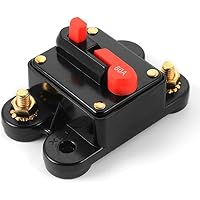
But in your situation, I believe you would have to come off that large stud with a circuit breaker like this to feed your winch, and then use the 30 amp or smaller fuse slots for your other uses.
Try to put the aux fuse box as close to the battery as possible. The reason I say this, unless you put a 60 amp circuit breaker or a large mega fuse right near the battery, the two 10 gauge wires going from the battery to the fuse box will be unprotected. This is ok if the distance is short, the possibilities of them getting in trouble will be minimized.
No reason you could not install a aux fuse block like this one
But in your situation, I believe you would have to come off that large stud with a circuit breaker like this to feed your winch, and then use the 30 amp or smaller fuse slots for your other uses.
Moderator
Joined: Jan 2001
Posts: 57,025
Likes: 2,756
From: Virginia
P.S. I guess you could put that 60 amp circuit breaker near the battery, then run your double 10 gauge winch wires from the circuit breaker to the winch, and also run a single 10 gauge from the same spot over to feed the aux fuse box if it was some distance from the battery.

Fleet Owner


Joined: Apr 2008
Posts: 24,324
Likes: 5,136
From: 0,0,1
It's the same either way, wire gauge size is based on amperes not voltage. The only time smaller wire is designed in is when on/off duty cycles are engineered to allow for cooling of the conductors between the cycles.
Moderator
Joined: Jan 2001
Posts: 57,025
Likes: 2,756
From: Virginia
In the situation in this thread, a single 10 gauge wire or even two side by side, run out in the open along the metal frame of a vehicle, are going to be able to carry more than 30 amps each without overheating. Most factory alternators in the 40-60 amp output range only have a single 10 gauge output wire to the battery. The manufacturers like to push the limits, especially since copper is not cheap. A dime saved on a milllion cars adds up.
With this winch, I would be more concerned with voltage drop more than anything else. I would want to maximize the performance of the winch by trying to get the most power back to it from the battery up front.
Thread Starter
|
Freshman User
Joined: Jan 2018
Posts: 47
Likes: 0
From: Long Beach, Ca
Thanks guys,
you're awesome for taking the time.
So showing my ignorance again,
does doubling a wire double it's capacity? If I understand you, even though the wires are insulated separately, by putting two of them in parallel, instead of a 30A capacity, they now team up for 60A?
you're awesome for taking the time.
So showing my ignorance again,
does doubling a wire double it's capacity? If I understand you, even though the wires are insulated separately, by putting two of them in parallel, instead of a 30A capacity, they now team up for 60A?
Trending Topics
Moderator
Joined: Jan 2001
Posts: 57,025
Likes: 2,756
From: Virginia
Thanks guys,
you're awesome for taking the time.
So showing my ignorance again,
does doubling a wire double it's capacity? If I understand you, even though the wires are insulated separately, by putting two of them in parallel, instead of a 30A capacity, they now team up for 60A?
you're awesome for taking the time.
So showing my ignorance again,
does doubling a wire double it's capacity? If I understand you, even though the wires are insulated separately, by putting two of them in parallel, instead of a 30A capacity, they now team up for 60A?
FTE Stories
Ford Trucks for Ford Truck Enthusiasts

Top 6 Best Deals Available on New Fords & Lincolns Right Now
Brett Foote
This Hennessey Takes the Expedition Tremor's Off-Roading Capability to the Next Level
Verdad Gallardo
Top 10 Fords at 2026 Carlisle Ford Nationals
Joe Kucinski
3 Best / 3 Worst Parts of Modern Ford Ownership
Brett Foote
10 Amazing Upgrades That Solve Common Ford Truck Owner Headaches
Pouria Savadkouei
Every 2026 Ford Engine Explained
Brett Foote
10 Ugly Ford Trucks That We Still Kinda Love
Joe Kucinski
10 Things Every Truck Owner NEEDS (2026 Edition)
Michael S. Palmer
Rezvani's Latest Post-Apocalyptic Monster Is a Ford F-150 Raptor Underneath
Verdad Gallardo
Thread Starter
|
Freshman User
Joined: Jan 2018
Posts: 47
Likes: 0
From: Long Beach, Ca
THANKS!
I think what I'll do is run a double to a small fuse box, probably 3 circuits, then use the provided breaker for the separately. The fuse box will only be for the outlets with very little load. Not quite as simple as I'd hoped, but still pretty clean.
Thanks all for your help!
Cheers!

Thread
Thread Starter
Forum
Replies
Last Post
halder
1973 - 1979 F-100 & Larger F-Series Trucks
7
Oct 5, 2009 05:08 PM