



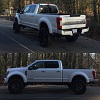


Front Air Dam?
Hotshot


Joined: Apr 2013
Posts: 10,121
Likes: 654
From: NH
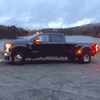
The air dam gives you improved fuel efficiency. That's why it is there, no other real purpose. The 2017 air dam is a more significant piece than it was on all previous Super Duty trucks, and unfortunately the cuts in it for a snowplow are substantial...at least with Fisher. My cuts are almost 5" wide for the push frame to come through and allow room for the plow frame to mate. Somewhat ugly, but I'm leaving it on for any fuel economy it adds.

Freshman User
Joined: Jan 2018
Posts: 32
Likes: 0


I just did this a couple days ago and have been sick as a dog since that night, I don't have a pic after taking the car catchers off, and it was night time when I finished, but I can put one up if anybody would like.
Hotshot
Joined: Apr 2013
Posts: 10,121
Likes: 654
From: NH
Also known as "Prius Catchers," they are the pieces of metal that hang down from the frame as seen in mciokiewicz's second picture with the cut air dam. Because the frame of the Super Duty sits high up, it would not make direct contact with the bumper of another vehicle but likely overrun it instead.
These were first seen on the Excursion years ago.
These were first seen on the Excursion years ago.
Cargo Master

Joined: Sep 2012
Posts: 3,061
Likes: 39
From: Laramie, WY
The air dam gives you improved fuel efficiency. That's why it is there, no other real purpose. The 2017 air dam is a more significant piece than it was on all previous Super Duty trucks, and unfortunately the cuts in it for a snowplow are substantial...at least with Fisher. My cuts are almost 5" wide for the push frame to come through and allow room for the plow frame to mate. Somewhat ugly, but I'm leaving it on for any fuel economy it adds.
FTE Stories
Ford Trucks for Ford Truck Enthusiasts

10 Things Every Truck Owner NEEDS (2026 Edition)
Michael S. Palmer
Rezvani's Latest Post-Apocalyptic Monster Is a Ford F-150 Raptor Underneath
Verdad Gallardo
Top 10 Most Expensive Ford Trucks Ever Sold on Bring a Trailer
Joe Kucinski
2027 Ford Super Duty Buyer's Guide (Every Model, Engine, & Package)
Brett Foote
Top 10 Ford Truck Tragedies
Joe Kucinski
AEV FXL Super Duty - the Super Duty Raptor Ford Doesn't Make
Brett Foote
Lobo Vs Lobo: Proof the F-150 Lobo Should Be Even Lower!
Michael S. Palmer
Ford's 2001 Explorer Sportsman Concept Looks For a New Home
Verdad Gallardo
10 Best Ford Truck Engines We Miss the Most!
Joe Kucinski
Hotshot
Joined: Apr 2013
Posts: 10,121
Likes: 654
From: NH
Just my guess but I doubt it makes any fuel mileage difference with a plow on the truck. I also don't think it has to do with fuel economy, I think it is used to create a slight negative pressure under the truck at high speeds for stability. I'll be adding a big one to my old '67 when I take it out on the salt flats.

Thread Starter
|
Tuned
Joined: Dec 2017
Posts: 289
Likes: 6
From: Berwick, Maine
Also known as "Prius Catchers," they are the pieces of metal that hang down from the frame as seen in mciokiewicz's second picture with the cut air dam. Because the frame of the Super Duty sits high up, it would not make direct contact with the bumper of another vehicle but likely overrun it instead.
These were first seen on the Excursion years ago.
These were first seen on the Excursion years ago.

Tuned


Joined: Nov 2017
Posts: 302
Likes: 5
From: Whidbey Island
This is the first post that makes sense of why the four-wheel-drive air dam so long. They're there simply to cosmetically cover the car catchers. Am I correct that the car catchers are not on the two wheel drive models?



More Turbo

Joined: Apr 2017
Posts: 628
Likes: 12
From: Madison WI
Air dams for years have been used to create a low pressure zone behind them. This helps pull air through the radiator and provide better cooling.
Not sure how much difference it makes pushing a brick wall through the air, gas mileage wise, but maybe a little. Maybe its only purpose it to hide the underside of the truck when viewed from the front? I replaced mine with the 2WD version. There's so much less wind resistance, now I'm getting 25+ mpg...
Not sure how much difference it makes pushing a brick wall through the air, gas mileage wise, but maybe a little. Maybe its only purpose it to hide the underside of the truck when viewed from the front? I replaced mine with the 2WD version. There's so much less wind resistance, now I'm getting 25+ mpg...

Posting Guru
Joined: Dec 2017
Posts: 1,441
Likes: 8
They definitely have an aero effect for mileage. Semi-trucks have been running them for years. Notice that the non-aero semi's, don't. If they didn't work, they wouldn't have 87 bolts holding them on.
-The cut on the mirrors, they aren't square anymore.
-The more raked windshield.
-The chunky tailgate. Notice that Dodge and GM also have that now. Why isn't the tailgate flat? That duck tail spoils the airflow, to reduce drag.
-Notice how the truck looks square and classic on the front clip when viewed from the side. But the hood and fenders are beveled.
-Skinny tires.
-Blocking the front axle helps economy. A motorcycle has a worse coefficient of drag than a school buss. That axle has more drag than your grill.
-Even the roof clearance lights are egg shaped.
The radio guy missed the memo though. No idea why these trucks don't have the radio antenna in the windshield.
It's just convenience that they can hide the car catchers there. Weird though, did the car catchers help a frontal safety rating? Or is this a preemptive thing? I don't recall a law that says they need to be there.
-The cut on the mirrors, they aren't square anymore.
-The more raked windshield.
-The chunky tailgate. Notice that Dodge and GM also have that now. Why isn't the tailgate flat? That duck tail spoils the airflow, to reduce drag.
-Notice how the truck looks square and classic on the front clip when viewed from the side. But the hood and fenders are beveled.
-Skinny tires.
-Blocking the front axle helps economy. A motorcycle has a worse coefficient of drag than a school buss. That axle has more drag than your grill.
-Even the roof clearance lights are egg shaped.
The radio guy missed the memo though. No idea why these trucks don't have the radio antenna in the windshield.
It's just convenience that they can hide the car catchers there. Weird though, did the car catchers help a frontal safety rating? Or is this a preemptive thing? I don't recall a law that says they need to be there.