


Battery/Alternator Issues

Lead Driver
Joined: Aug 2003
Posts: 7,592
Likes: 10
From: **** hole San Jose ca.
I had a friend who did not notice this same thing an shorted two from the longer field lug to long before calling me for help.
I saw how close it was an just filed off some dressed the threads so the nut would come off & no ok an reinstalled the Alternator.
I also had to do it on a alternator, I got from a box store..
The main thing is you don't want it to shorting out on the engine block right.
So cut the lug shorter and be done with it.
Orich
I saw how close it was an just filed off some dressed the threads so the nut would come off & no ok an reinstalled the Alternator.
I also had to do it on a alternator, I got from a box store..
The main thing is you don't want it to shorting out on the engine block right.
So cut the lug shorter and be done with it.
Orich
Laughing Gas
Joined: Mar 2010
Posts: 1,028
Likes: 5
From: San Francisco East Bay
I had a friend who did not notice this same thing an shorted two from the longer field lug to long before calling me for help.
I saw how close it was an just filed off some dressed the threads so the nut would come off & no ok an reinstalled the Alternator.
I also had to do it on a alternator, I got from a box store..
The main thing is you don't want it to shorting out on the engine block right.
So cut the lug shorter and be done with it.
Orich
I saw how close it was an just filed off some dressed the threads so the nut would come off & no ok an reinstalled the Alternator.
I also had to do it on a alternator, I got from a box store..
The main thing is you don't want it to shorting out on the engine block right.
So cut the lug shorter and be done with it.
Orich
Ok, thanks for saying so. I'll review the clearance issue. Making the lugs shorter is pretty straightforward.
BTW, the main mounting bolt was tight on my alternator... I always check that again after I apply tension to the fan belts.

Hotshot


Joined: Mar 2013
Posts: 14,255
Likes: 199
From: Phoenix, Az.
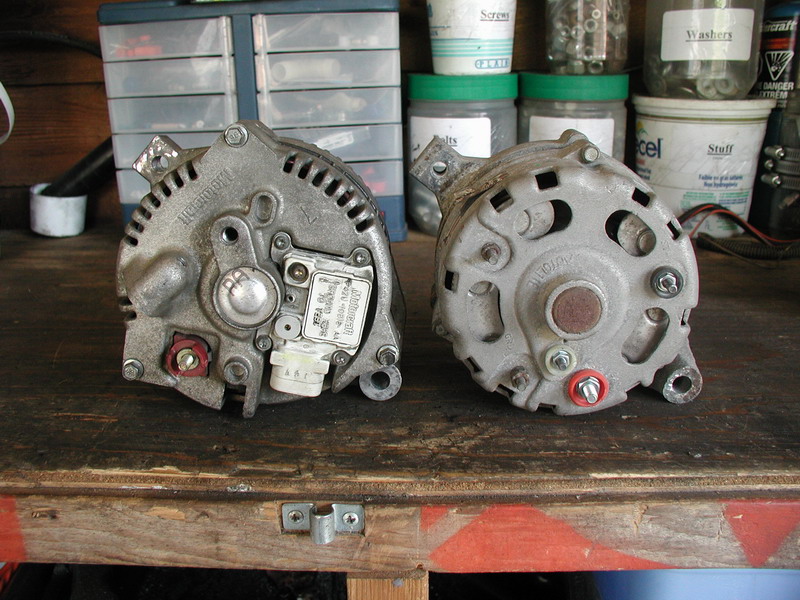
I've got a '70 360, and I'm concerned that the back of my alternator is too close to the engine.
In addition to making those lugs shorter, what's the possibility of adding some insulation? It seems like I ought to be able to glue a rubber or plastic mat on the block to insulate that area. Heat would obviously degrade it over time.
Any guess about how much of a gap is needed to keep those lugs from arcing over to the engine?
In addition to making those lugs shorter, what's the possibility of adding some insulation? It seems like I ought to be able to glue a rubber or plastic mat on the block to insulate that area. Heat would obviously degrade it over time.
Any guess about how much of a gap is needed to keep those lugs from arcing over to the engine?
Laughing Gas
Joined: Mar 2010
Posts: 1,028
Likes: 5
From: San Francisco East Bay
0.045 inch (ie. "spark plug") gap should be able to withstand several thousand volts before arcing over... won't be getting that much out of the alternator. I think Orich's right, the mounts on the alternator would have to be loose for those lugs to get that close to the engine.
In my younger days, I was once privileged to witness a 200,000 volt corona. The test equipment failed on Friday evening, arced over and the very air ionized, causing a conductive path that didn't stop until they shut down the power supply on Monday morning.
I've also seen the million-volt Tesla coil in operation at Fry's, in Fremont, CA.:
Makes my alternator seem kinda puny.
Hotshot
Joined: Mar 2013
Posts: 14,255
Likes: 199
From: Phoenix, Az.
It's the voltage that causes arcs (think "sparkplug"... why does an engine have a Coil? Gotta boost the voltage to make the plug fire...)
0.045 inch (ie. "spark plug") gap should be able to withstand several thousand volts before arcing over... won't be getting that much out of the alternator. I think Orich's right, the mounts on the alternator would have to be loose for those lugs to get that close to the engine.
In my younger days, I was once privileged to witness a 200,000 volt corona. The test equipment failed on Friday evening, arced over and the very air ionized, causing a conductive path that didn't stop until they shut down the power supply on Monday morning.
I've also seen the million-volt Tesla coil in operation at Fry's, in Fremont, CA.: https://www.youtube.com/watch?v=Ij2HPfJ05nM
Makes my alternator seem kinda puny.
0.045 inch (ie. "spark plug") gap should be able to withstand several thousand volts before arcing over... won't be getting that much out of the alternator. I think Orich's right, the mounts on the alternator would have to be loose for those lugs to get that close to the engine.
In my younger days, I was once privileged to witness a 200,000 volt corona. The test equipment failed on Friday evening, arced over and the very air ionized, causing a conductive path that didn't stop until they shut down the power supply on Monday morning.
I've also seen the million-volt Tesla coil in operation at Fry's, in Fremont, CA.: https://www.youtube.com/watch?v=Ij2HPfJ05nM
Makes my alternator seem kinda puny.
Amperage (conductance) is the power moving along.
Voltage is the "push" that moves the power.
Seeing your video makes me curious how many volts is in an average lightning bolt.
Laughing Gas
Joined: Mar 2010
Posts: 1,028
Likes: 5
From: San Francisco East Bay
Geophysical conditions matter; what happens in the High Sierras probably takes a lot less volts than what happens during a lightening storm out on the Great Plains.
I've been caught in a lightening storm in the High Sierras. It's enough to scare the Atheism out of a person!

Hotshot
Joined: Mar 2013
Posts: 14,255
Likes: 199
From: Phoenix, Az.
I'm not so sure there's anything "average" about lightening.
Geophysical conditions matter; what happens in the High Sierras probably takes a lot less volts than what happens during a lightening storm out on the Great Plains.
I've been caught in a lightening storm in the High Sierras. It's enough to scare the Atheism out of a person!
Geophysical conditions matter; what happens in the High Sierras probably takes a lot less volts than what happens during a lightening storm out on the Great Plains.
I've been caught in a lightening storm in the High Sierras. It's enough to scare the Atheism out of a person!
I g**gled it out of curiosity.
According to the National Severe Storm Laboratory, a single lightning bolt can have 100 million to 1 billion volts, and it contains billions of watts, depending on whether it is positive lightning or negative lightning. Lightning strikes ground in the United States approximately 25 million times each year.
Positive lightning, which comprises less than 5 percent of all lightning, originates on top of the clouds, rather than the lower portion of the storm, as negative lightning. These type of lightning can travel up to 25 miles horizontally in the air before they strike the ground and are sometimes called "bolts from the blue." Because of the greater distance to the ground, they develop much higher voltages.
FTE Stories
Ford Trucks for Ford Truck Enthusiasts

AEV FXL Super Duty - the Super Duty Raptor Ford Doesn't Make
Brett Foote
Lobo Vs Lobo: Proof the F-150 Lobo Should Be Even Lower!
Michael S. Palmer
Ford's 2001 Explorer Sportsman Concept Looks For a New Home
Verdad Gallardo
10 Best Ford Truck Engines We Miss the Most!
Joe Kucinski
2026 Shelby F-150 Off-Road: Better Than a Raptor R?
Brett Foote
2027 Super Duty Carhartt Package First Look: 12 Things You NEED to Know!
Michael S. Palmer
10 Most Surprising 2026 Ford Truck Features!
Joe Kucinski
Top 10 Ford Trucks Coming to Mecum Indy 2026
Brett Foote
5 Best / 5 Worst Ford Truck Wheels of All Time
Joe Kucinski
Laughing Gas
Joined: Mar 2010
Posts: 1,028
Likes: 5
From: San Francisco East Bay
From the 1964/72 Ford Truck
Parts and Accessories Catalog
Section 145
page P-8244
Engine Wiring System (8 Cylinder 360, 390 engine)
1968/72 F100/350
In the upper left corner, where the Alternator is shown, it looks like there are some insulating caps designated "10A375".
Would that help stop shorting from the field terminal to the engine block?
Any idea what the full part number is and if they are still available?
Parts and Accessories Catalog
Section 145
page P-8244
Engine Wiring System (8 Cylinder 360, 390 engine)
1968/72 F100/350
In the upper left corner, where the Alternator is shown, it looks like there are some insulating caps designated "10A375".
Would that help stop shorting from the field terminal to the engine block?
Any idea what the full part number is and if they are still available?
Hotshot
Joined: Mar 2013
Posts: 14,255
Likes: 199
From: Phoenix, Az.
From the 1964/72 Ford Truck
Parts and Accessories Catalog
Section 145
page P-8244
Engine Wiring System (8 Cylinder 360, 390 engine)
1968/72 F100/350
In the upper left corner, where the Alternator is shown, it looks like there are some insulating caps designated "10A375".
Would that help stop shorting from the field terminal to the engine block?
Any idea what the full part number is and if they are still available?
Parts and Accessories Catalog
Section 145
page P-8244
Engine Wiring System (8 Cylinder 360, 390 engine)
1968/72 F100/350
In the upper left corner, where the Alternator is shown, it looks like there are some insulating caps designated "10A375".
Would that help stop shorting from the field terminal to the engine block?
Any idea what the full part number is and if they are still available?
Laughing Gas
Joined: Mar 2010
Posts: 1,028
Likes: 5
From: San Francisco East Bay
Ok, thanks for letting me know.

Thread
Thread Starter
Forum
Replies
Last Post
phoneman91
1987 - 1996 F150 & Larger F-Series Trucks
2
May 6, 2010 04:22 PM