When you click on links to various merchants on this site and make a purchase, this can result in this site earning a commission. Affiliate programs and affiliations include, but are not limited to, the eBay Partner Network.
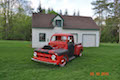
Hey yall, Ive been browsing for awhile prepping to start my project truck (55 F100) and first off some of yall do some AWESOME work!! This is going to be my first build and I hope that I can do stuff half as good as some of yall!!
My biggest question right now is how strong are these stock frames? I know guys have put some larger gas engines in, and they've been fine with boxing the front 1/3 or so. But my project is going to be putting out close to 1200 ft/lbs of torque; and Im worried about twisting/flexing too much. Im trying to do this on somewhat of a budget, so spending 5k-10k on an aftermarket frame is kind of out of the question.
So give me yalls opinion/experience with these stock frames. Will boxing the frame stiffen/strengthen it enough?
1200 ft lbs/ torque will twist a semi-truck. It will destroy a 55 F100 frame. For that kind of power, I'd recommend an aftermarket chassis designed for the application. My 2c.
I don't know about a semi truck...but I understand what youre sayin. I know a lot of guys that are running that or more in their modern trucks (diesel) with no frame modifications, but I assume these frames aren't as thick/strong which is why im asking
Stu on here posted this info in another thread. If you take these frame section modulus values to an engineer and tell him you want to put a 1200 ft-lb drivetrain in it, he's going to laugh. These trucks were made to flex to absorb the forces from crappy roads, driving across farm fields, etc. They are low-grade steel that is very forgiving in terms of flex, very different from the stiff, high-strength steels used in modern frames.
The question often becomes how much torque can you actually put to the ground. You have to be able to react the torque to apply it to the frame. Also the 1200 lb ft is presumably at the flywheel so don't forget that most transmissions in first gear multiply that by 2.5 to 3 or more so the torque at the driveshaft could be 3000 to 4000 lb ft. To visualize that torque imagine a steel bar mounted to the front of the frame and sticking out 10 feet to the side with 400 lbs on it. The frame will twist, probably a lot. Will it fail, I don't think so. At least not applying the torque just one time. Over time there is no doubt it will fatigue.
Now imagine the loads at the engine mounts. 4000 lb ft over 1.5 ft (Span between mounts) will apply over 2600 lbs of load to your engine mounts. Regular engine mounts and a stamped steel cross member will not handle that sort of load.
Could you do what you are asking? Sure. But without a lot of strengthening it's not a case of whether you will break something, just when.
Thanks for all the info guys. That's the one thing I was hoping not to hear HAHA...but if Im gonna build it I want to build it right the first time. The wife may not be too excited to hear this but oh well; good thing Im on the other side of the world right now.
Mike those numbers will be to the ground numbers btw. My drivetrain will be a 6.0L PSD with 600-650 rwhp and a built trans which will equate to a torque rating somewhere around 1100 -1200 at the rear end.
Out of curiosity, where are you getting this 2.5-3 times multiplier? From what I know there's a power LOSS usually 10-15% from flywheel to rear end. Just curious
Out of curiosity, where are you getting this 2.5-3 times multiplier? From what I know there's a power LOSS usually 10-15% from flywheel to rear end. Just curious
Modern manual transmission drive trains will have 12% to 18% losses due to friction etc. Automatic transmissions in low gears without the torque converter locked up can be much higher.
Gears are a wonderful thing. The transmission multiplies the torque and drops the engine RPM, the rear axle does the same thing. Using round numbers for an average gas engine let's say you have 300 lb ft of torque at the flywheel. Your transmission has a 3:1 first gear ratio. The torque at the driveshaft will by 3 X 300 or 900 ft lbs at 1/3 of the engine speed. Now lets assume that your rear axle has a 3:1 ratio. Same deal at the wheels you will have 3 X 900 lb ft or 2700 lb ft at 1/3 of the driveshaft speed. If your tire is 3 ft (36") in diameter you will be applying 2700 / 1.5 (radius of the tire) = 1800 lbs force at the tire contact patch. There are all kinds of assumptions in these calculations but for rough numbers it's pretty close.
So your 1200 ft lbs at the wheels is a little unrealistic, you will have much higher torque at the wheels in first gear.
As an example I have an '07 VW Touareg V10 TDI that is rated at 553 lb ft at the flywheel. It has a crawl gear in low range (transfer case) that can (with no losses) put over 27,000 lb ft to the wheels in 1st gear.
553 (engine torque) X 4.15 (1st gear)x 2.66 (low range) x 4.56 (axle)= 27,838 lb ft (with no losses)
Do a google search for 'Touareg 747' and watch it pull a 747.
The loads on drive train components , frame, engine mounts etc can be staggering. A little planning will save you a lot of $$$ in broken parts later.
If you are worried about the strength of the stock frame just beef it up. There are plenty of ways to add strength to the stock frame. You can add plate, C-channel or rectangle tubing to the inside of the frame rails. And then box the frame. Modify, replace crossmembers with stronger ones or add more.
If you still don't think the F100 frame is strong enough. The pick up a frame out of a same age group of F600. Then just shorten it to the wheel base you want.
Stu on here posted this info in another thread. If you take these frame section modulus values to an engineer and tell him you want to put a 1200 ft-lb drivetrain in it, he's going to laugh. These trucks were made to flex to absorb the forces from crappy roads, driving across farm fields, etc. They are low-grade steel that is very forgiving in terms of flex, very different from the stiff, high-strength steels used in modern frames.
Just a clarification, dont want to bash you ALBUQ.
Any type of steel has the same stiffness given that the compared structure has the same dimensions, despite high or low grade.
A high grade steel has higher yield point, That will make it harder to make a permanent deformation onto the structure. But it will have the exact same stiffness as a low grade steel bur that steel will leave a permanent deformation much easier
This is a very common missinformation, that different typer of steels has different stiffness. That is not the case. The stiffness of steel is same as Youngs modulus and is really close to same for all types of steel.
Not bashing you ALBUQ, just a friendly "just saying"
Point taken, Jim! In this context I was trying to point out that with the big torque he's planning, he's more likely to get beyond the elastic range of a stock frame.
...but if Im gonna build it I want to build it right the first time. The wife may not be too excited to hear this but oh well; good thing Im on the other side of the world right now.
As I read through this I got curious. Just what the heck are you going to do with 1200 ft-lbs of torque on a truck designed for just over 100? Modifications are a funny thing. If not planned right you end up going from one problem to the next. For example say you install an engine like that. The next thing to go is the clutch. So you strengthen the clutch then the trans fails. So you beef up the trans then the U-joints fail. So you fix that then the driveshaft turns itself into a pretzel. You put in a thicker drive shaft and then the rear axles break. You fix that then the motor mounts fail, or the frame or the rear suspension. They may not fail in that order but they will fail on hard use where ever the next weakest link is.
Sorry jboy but there are a lot of talented folks on here and I think that the best of them will all tell you that you are overpowering the truck. But it is your truck and your money. Hope that you have a lot of it.
P.S. IMHO you could build a really nice, well balanced 1955 Ford truck for the money that you you are going to put into the engine alone. Bet your wife would be happier too.
Pete, I believe the 1200 ft-lbs is engine torque multiplied by the gear ratios. I'm also not sure what the point of that much engine is, but obviously (considering all the big blocks being put in these) we're in the minority.
When you think about torque you also gave to consider the resistance its being applied against. Whether you set a torque wrench to 50# or 500# doesn't make much difference until it's actually attached to something. What exactly are you planning to do with all of that torque? Leave the truck on a trailer and post the dyno sheet in the window? Tie a strap to Bigfoot and pull it around backwards? It makes a difference...
Best bet for that much torque is to screw a body onto a late model pickup frame that can handle the power.
Rezvani's Latest Post-Apocalyptic Monster Is a Ford F-150 Raptor Underneath
Slideshow: Called the Fortress, the 850-horsepower pickup combines Raptor underpinnings with military-inspired features, survival equipment, and a starting price of $285,000.