


tire size
Hotshot


Joined: Oct 2009
Posts: 16,194
Likes: 4,805
From: Burbank, WA
All of the documentation we could find determined the 15" wheels weren't introduced until 1953. For 1950 on the F1 (F47 in Canada) the standard tire was 6.00x16. 6.50x16 was optional, and if you wanted to realize the full 4700gvw rating, you had to order the optional tire.

Logistics Pro


Joined: Jun 2011
Posts: 4,997
Likes: 422
From: u-rah-rah Wisconsin
All of the documentation we could find determined the 15" wheels weren't introduced until 1953. For 1950 on the F1 (F47 in Canada) the standard tire was 6.00x16. 6.50x16 was optional, and if you wanted to realize the full 4700gvw rating, you had to order the optional tire.
Marmon-Herrington Man


Joined: Jul 2005
Posts: 11,986
Likes: 446
From: Central Illinois

All of the documentation we could find determined the 15" wheels weren't introduced until 1953. For 1950 on the F1 (F47 in Canada) the standard tire was 6.00x16. 6.50x16 was optional, and if you wanted to realize the full 4700gvw rating, you had to order the optional tire.
My wheel references in some instances list separately wheels manufactured by Kelsey-Hayes Canada. However, none of these half ton Ford wheels have separate Canadian numbers or specifications.
The Service Manual also lists a 15" x 5.50" under Ford #7RC 1015 to be fitted with 15 x 6.00" tires having a max capacity of 1500 lbs each. Interesting to me, the Service Manual lists 7RC 1015 as semi-drop center, signifying a two piece wheel. Yet Kelsey-Hayes lists 7RC 1015 under their #23427, (EDIT of 2/15/18 —I’m at a loss to find where I came up with this cross reference. It’s wrong. The 7RC 1015 has no connection to the K-H 23427. I have found that the 7RC 1015 cross referred to 7RC 1007-A which itself cross referred to TAAA 1007-A. That wheel is K-H 36877).
The optional 15" x 5.50" wheel sourced on 1953 F-100s is 7RC 1007-A / TAAA 1007-A. It is K-H #36877 having a two piece construction. The outer rim is a Firestone RHP design. It is shown to have .620" of dish. For 1954 Ford substituted #TAAA 1007-B / K-H #37717, also 15" x 5.50". This wheel also has a Firestone RHP two piece rim, but has only .250" of dish. Later Ford references cross refer the 36877 to the 37717 replacement. Also optional in 1954 was a 16" x 5.00" drop center wheel under #TAAA 1015-C /K-H #38189. Stu


Last edited by truckdog62563; Feb 15, 2018 at 02:30 PM. Reason: Removing wrong information!
Logistics Pro
Joined: Jun 2011
Posts: 4,997
Likes: 422
From: u-rah-rah Wisconsin
Well, there we are. Personally, I am more confused, informed but confused. Appreciate the info, Stu.
Trending Topics
Marmon-Herrington Man
Joined: Jul 2005
Posts: 11,986
Likes: 446
From: Central Illinois
How so, I try to avoid that. I know I risk this when there are a lot of part numbers to cite, and cross references to include. I even left out some info hoping to not clutter it up. One piece of added info from K-H says the 7RC 1015 was actually spec'd for 1940-42 half tons and wasn't cited for the later years. Ford kept it in the manual anyway. Stu
FTE Stories
Ford Trucks for Ford Truck Enthusiasts

Top 10 Fords at 2026 Carlisle Ford Nationals
Joe Kucinski
3 Best / 3 Worst Parts of Modern Ford Ownership
Brett Foote
10 Amazing Upgrades That Solve Common Ford Truck Owner Headaches
Pouria Savadkouei
Every 2026 Ford Engine Explained
Brett Foote
10 Ugly Ford Trucks That We Still Kinda Love
Joe Kucinski
10 Things Every Truck Owner NEEDS (2026 Edition)
Michael S. Palmer
Rezvani's Latest Post-Apocalyptic Monster Is a Ford F-150 Raptor Underneath
Verdad Gallardo
Top 10 Most Expensive Ford Trucks Ever Sold on Bring a Trailer
Joe Kucinski
2027 Ford Super Duty Buyer's Guide (Every Model, Engine, & Package)
Brett Foote
Logistics Pro
Joined: Jun 2011
Posts: 4,997
Likes: 422
From: u-rah-rah Wisconsin
I'm easily confused. Your explanation was well documented and reflected a tremendous depth of knowledge. Conflicting information shouldn't be surprising, in my experience, engineering documentation was often poorly maintained resulting in differences between reality and the paper trail. Seems like this may be the case here.
Hotshot
Joined: Oct 2009
Posts: 16,194
Likes: 4,805
From: Burbank, WA
I'll admit I have not studied the service manual indepth. We recently had a long conversation in another thread discussing the first application of the 15" wheel/tire, and based on the information we found, like Stu said, in sales brochures, salesmen's handbooks, service parts catalogs, the best we could determine was it was 1953. That's not to say it didn't happen earlier, but certainly was not a well publicized option. The fact it dates back to 1940 is definitely news to me. Thanks for the lesson, Stu. 
Marmon-Herrington Man
Joined: Jul 2005
Posts: 11,986
Likes: 446
From: Central Illinois
Old timers will recall the reference arguments we used to have with the guy named Julie. On this example my gut impression is that the Service Manual reference is just a carry over from prior materials. And no doubt there were different people compiling sales references than service references. Knowing that the M-H half tons used these 15s confirms their continued availability as a special order. Stu
Tuned

Joined: Apr 2016
Posts: 405
Likes: 30
From: Manitoba, Canada
So to be clear, a 1950 Canadian made F-47 would have come with 16 x 4.5" one piece drop center (K profile) wheel, K-H 31283 / Ford 8C 1015?
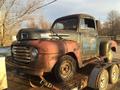
The truck I just picked up has a mish mash of wheels on it, one is a 16, and the other three are 15's
See pictures below, they are in order PS-Rear, PS- Front, DS-Front, DS-Rear
The PS-Rear tire is the only 16, and doesn't have the same double ridge as the others.
Are any of these originals?
Thanx,
Kirk
The truck I just picked up has a mish mash of wheels on it, one is a 16, and the other three are 15's
See pictures below, they are in order PS-Rear, PS- Front, DS-Front, DS-Rear
The PS-Rear tire is the only 16, and doesn't have the same double ridge as the others.
Are any of these originals?
Thanx,
Kirk
Marmon-Herrington Man
Joined: Jul 2005
Posts: 11,986
Likes: 446
From: Central Illinois
The first picture is likely an original. You say it is the passenger side rear and a 16". It has the "innie" hub cap nubs as does an original while the others have "outie" nubs common on later wheels. I used the word "likely" above because there is no real way to visually tell the difference from a picture between the 4.5" wide truck wheel and the 1940s era car wheels that are 4.0" wide. One good hint of original is the absence of pin stripe remnants. The car wheels commonly had pin stripes. Stu
Believe Nothing
Joined: Jun 2004
Posts: 7,519
Likes: 403
From: W. Central FL.

A side note but still Ford. A friend who was a Ford tractor factory rep back in the 1960s tells of having to explain to dealers and to end users that just because that sales literature made a statement, that alone did not make it fact. Some ideas just did not make it into production or to the field.