When you click on links to various merchants on this site and make a purchase, this can result in this site earning a commission. Affiliate programs and affiliations include, but are not limited to, the eBay Partner Network.
Guys - FuzzFace2 and Chris both pointed out that my Fuel System pages were lacking. So, I went to look and was appalled at what I'd left out. I've been working on it all evening and have made what I think is significant progress, but am:
Worn out - it has taken a lot of concentration trying to compare the catalog pages to the web site
Bleary eyed
Lost and confused - I've tried to simplify a really strange assortment of illustrations by grouping them, but I'm not even sure it makes sense to me now that I'm done.
So PLEASE go take a look and let me know if it makes sense to you, and if you can find the "stuff" for your truck(s). If each of you just take a few minutes to look up the pages for your truck we'll know pretty quickly if the right stuff is there.
Dave/FF2 - Let's get the right stuff in there and then we can try to figure out how to do what you were requesting. The problem is that with over 25 pages of illustrations, each having a different set of things shown, the table might have to be huge. But, again, let's get the basics done and then move on to the nice-to-have. Ok?
That is certainly becoming a must view page on the 80 to 86 Ford truck.
I like the menu starting from your main page. The link you supplied in your post seems to work a little differently.
On content, if you are looking for EFI info or the dreaded feedback carburetor, there is really not much mention. I know it's a huge subject, maybe a link to some archive of the oldfuelinjection.com site would help?
Whisler - Thanks! But, I'm not fishing for compliments. I really need help in reviewing those pages.
NET2014 - Thanks as well, especially for the suggestions. But first, what do you mean "the link works a little differently"? Is it that when you first go into the Fuel Systems section you have a smaller menu than when you get into the sub-sections? If so, I'm trying to keep things neater/shorter. But if you like the full section showing up in the menu please say so.
As for EFI or the feed-back carb, the section is far from done and will eventually have a page for each of those below Carburetors - although that needs to change as EFI isn't a carb. So, I'll put placeholders in there so at least y'all see where they'll go and know I'm not shunning them.
Further, the 460's had a problem where the fuel got hot and vaporized, so they added in-tank pumps and a hot-fuel handling modification to those trucks. But, the in-tank pumps are larger in diameter than the sending units that went in the early tanks, so the later tanks had a larger diameter hole in them for the pumps. Obviously the larger hole in the tank required a different fuel level sending unit, even for the trucks that still had a carburetor.
First thing that jumps out me is, this can be confusing to the reader as it is true for all engines, not just the 460.
There exist the "small hole" sending units (9275? I forget) that have something like a 2.75" diameter hole, this was installed on virtually all non-in-tank-pump tanks.
This is a sending unit only, two-wire connection, no pump, hole is "small."
Then there's the in-tank-pump system - 9H307 or somesuch - these all use the "larger" hole which is ~5" IIRC.
The 460 is an odd beast; some had mechanical fuel pumps, others had electric (even though they had nothing remotely close to EFI, not even a feedback carb).
This applies only to the F100/350 series trucks with steel tanks; Chassis & Cab and anything with a plastic tank is TBD.
BTW I am referring to the small-hole and large-hole tanks and associated sending-unit-only or sending-unit-plus-pump applying to all engines, not the Hot Fuel Handling stuff.
Quite honestly, all this fuel stuff is confusing and it can be really difficult if not impossible to determine which sending unit is needed when the only thing you're looking at is the parts catalog - even for Bill/ND. The book can be confusing, ambiguous and incomplete, just go look at the Text section of those 9275(?) things.
For example, guy comes here saying he has a 1984 F250 with a straight-6 engine (made-up example, I don't remember the explicit variants that have caused me problems). the book will list things applicable to ALL 80/86 models with no text clarifying exact variants; there are some for models with EVAP (lighter GVWR variants had EVAP but not the heavier ones), with a fuel return line and without, and/or possibly some other venting mechanism, I forget for certain.
But relying on the book is fruitless for some variants, I guess what they wanted you to do is show the old part to the counter guy who would then locate various possibilities and you'd use the one that fits.
Ok, I understand what you are saying. Over time I'll edit the confusing words, but will probably put in other confusing words as this is, as you said, a confusing area.
As for the diagrams, parts lists, etc, I don't know what else to do beyond giving people the catalog entries and then capturing the one-off solutions we find. Do you have a better approach? I'm all eyes.
In any event, I'm going mostly off-line for a few days as my grandtwins are due to arrive any moment. So, please keep the comments coming and I can work them from time to time.
I've updated things a bit. First, I realized that Air Cleaners are really part of the fuel system, so moved the description there - although the previous links should still be good. And, I added a page in Fuel System Illustrations that shows all the various Air Cleaner Illustrations.
But, the previous comments are still valid, so there's lots of work to be done in this section.
Guys - FuzzFace2 and Chris both pointed out that my Fuel System pages were lacking. So, I went to look and was appalled at what I'd left out. I've been working on it all evening and have made what I think is significant progress, but am:
Worn out - it has taken a lot of concentration trying to compare the catalog pages to the web site
Bleary eyed
Lost and confused - I've tried to simplify a really strange assortment of illustrations by grouping them, but I'm not even sure it makes sense to me now that I'm done.
So PLEASE go take a look and let me know if it makes sense to you, and if you can find the "stuff" for your truck(s). If each of you just take a few minutes to look up the pages for your truck we'll know pretty quickly if the right stuff is there.
Dave/FF2 - Let's get the right stuff in there and then we can try to figure out how to do what you were requesting. The problem is that with over 25 pages of illustrations, each having a different set of things shown, the table might have to be huge. But, again, let's get the basics done and then move on to the nice-to-have. Ok?
Did I miss it or could you include info on the gaskets and spacer plates??
I am interested in the 2150 info.
EGR base plate gasket numbers, stacking, etc...
Lot of work there!
Thank you!
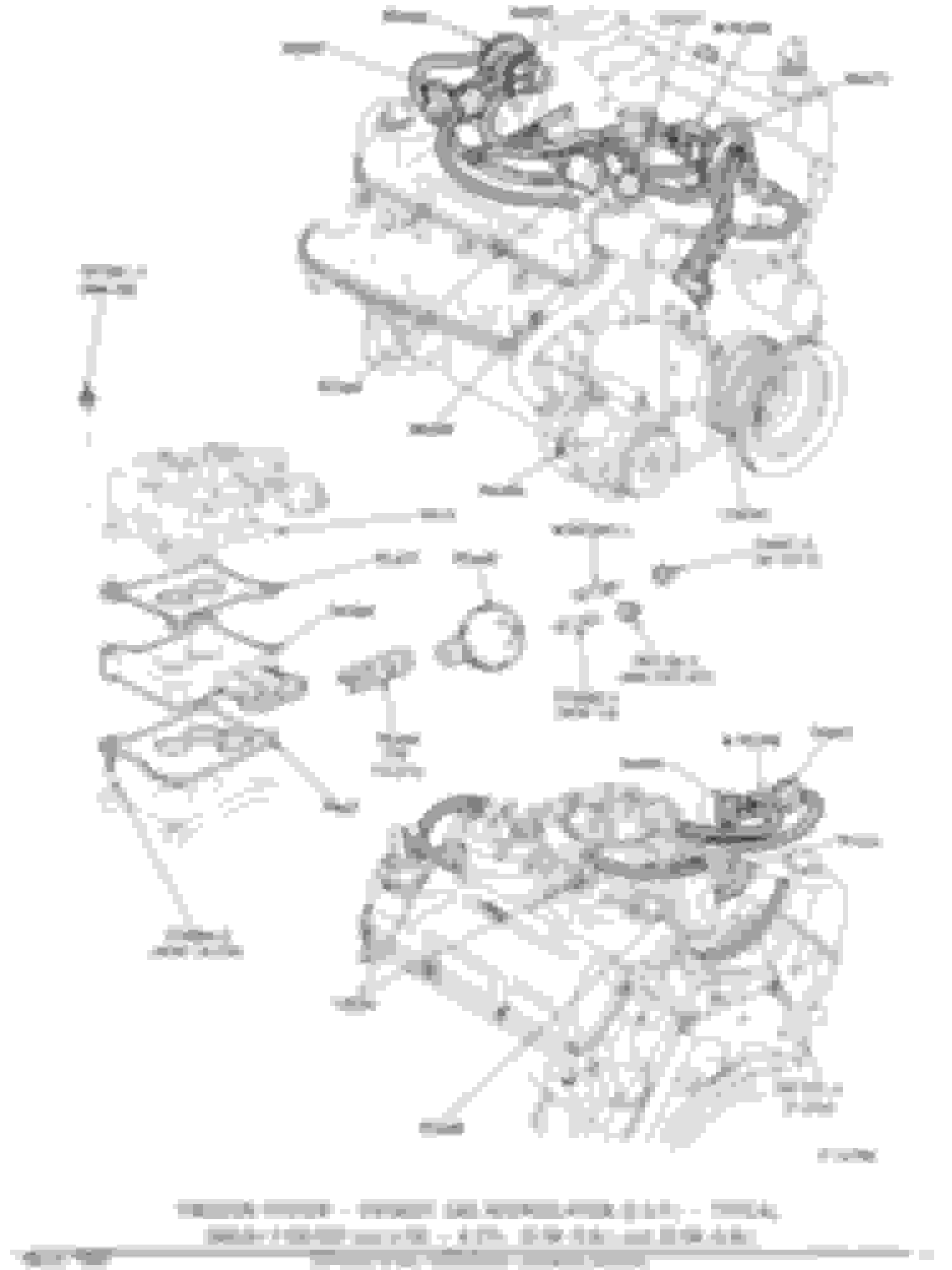
Do you mean the illustrations, like this one, or the part numbers, or both? You are right, it is a lot of work and I just want to make sure I do what is wanted, not what I think is wanted.
I ask because I have a page that shows the EGR valves, and many other things, here: Manifolds, EGR, Heat Valves, etc - Gary's Garagemahal. But, it isn't specific to EGR valves. And, I don't have part numbers for any of the parts shown in those illustrations as there are many, many parts shown.
I could put up the part #'s for the gaskets if there is a need, but I haven't thought the need was very great since you can get the part #'s from the web site of most auto parts stores. And, there's very little advantage to buying the gaskets from Ford, so few people want Ford's part #.
However, the trick might be in knowing what Ford calls the part. So, would a translate table at the top of the page linked to above suffice? Something like:
9447 GASKET (CARBURETOR)
9D475 VALVE ASSY. (EXHAUST GAS RECIRCULATION)
9C477 GASKET (CARBURETOR TO INTAKE MANIFOLD SPACER)
I ask because I have a page that shows the EGR valves, and many other things, here: Manifolds, EGR, Heat Valves, etc - Gary's Garagemahal. But, it isn't specific to EGR valves. And, I don't have part numbers for any of the parts shown in those illustrations as there are many, many parts shown.
I could put up the part #'s for the gaskets if there is a need, but I haven't thought the need was very great since you can get the part #'s from the web site of most auto parts stores. And, there's very little advantage to buying the gaskets from Ford, so few people want Ford's part #.
However, the trick might be in knowing what Ford calls the part. So, would a translate table at the top of the page linked to above suffice? Something like:
9447 GASKET (SPACER TO MANIFOLD)
9D475 VALVE ASSY. (EXHAUST GAS RECIRCULATION)
9C477 GASKET (CARBURETOR TO INTAKE MANIFOLD SPACER)
9A589 SPACER (CARBURETOR TO INTAKE MANIFOLD)
9D448 is the basic number (not shown in pic) for integral EGR and backpressure control valve.
The thing is, there are no parts catalog applications for either the 9D475 & 9D448 valves.
The only way to get the part numbers is with the ID number from the original or by the Calibration Code.
Lotsa luck if the Calibration Code is unknown, as there are 100's of different codes, I kid you not!
This Hennessey Takes the Expedition Tremor's Off-Roading Capability to the Next Level
Slideshow: The VelociRaptor Expedition gains a lift, upgraded suspension, Brembo brakes, and trail-ready equipment while retaining the stock 440-horsepower EcoBoost V6.
Rezvani's Latest Post-Apocalyptic Monster Is a Ford F-150 Raptor Underneath
Slideshow: Called the Fortress, the 850-horsepower pickup combines Raptor underpinnings with military-inspired features, survival equipment, and a starting price of $285,000.