When you click on links to various merchants on this site and make a purchase, this can result in this site earning a commission. Affiliate programs and affiliations include, but are not limited to, the eBay Partner Network.
OK guys I plan on putting a hanging brake peday in my truck possibly from a 90s jeep Cherokee or early 90s mustang. Can I use the clutch pedal also and is there a company that makes the linkage or has anybody use the hanging clutch pedal how did u hook it up.
Thanks Dan
Easiest linkage solution is to use a hydraulic throwout or slave. be aware the pedals will need more spacing between than used in most late model sedans to straddle the steering column. You might want consider separate mount aftermarket pedals if you don't want have to do a lot of fab/modifications.
Thanks ax, I have no problem extending or moving the pedals. Since my wife will be driving it to would like it to be semi normal position. How would I hook up the slave and master, the Trans is still attached to the engine and is in the truck. The fork is sticking out of the bell. Do I have to remove the Trans to get to the throw out bearing to change it if I want to put a clutch master, do I have to pull the Trans.
I bought the complete master cylinder, brake booster kit from Mid Fifties for mounting under the hood that includes a bracket for under the dash with the swinging petal, it was a breeze to install but unfortunately it doesn`t come with a clutch petal set up. Search Results - Mid Fifty F-100 Parts
I bought the complete master cylinder, brake booster kit from Mid Fifties for mounting under the hood that includes a bracket for under the dash with the swinging petal, it was a breeze to install but unfortunately it doesn`t come with a clutch petal set up. Search Results - Mid Fifty F-100 Parts
That kit works great, but of course the only way to get a clutch pedal with it is to fabricate your own. What I did was find a longer bolt that the pedal arms pivot on and just used that to add my clutch arm and pedal. I also welded on a support plate so that the firewall wouldn't flex under pressure.
How would I hook up the slave and master, the Trans is still attached to the engine and is in the truck. The fork is sticking out of the bell. Do I have to remove the Trans to get to the throw out bearing to change it if I want to put a clutch master, do I have to pull the Trans.
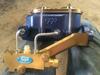
I don't know what type of transmission you have. But speaking generically you could use a hydraulic thrown out bearing. You would need to separate the engine / trans as it mounts inside your transmission like pic below.
Or use an external slave cylinder which would mount on the exterior of the transmission like in the pic below. You would have to make up a bracket to mount it and some way for the cylinder to connect to the fork. If you have a popular trans chances are someone make a direct fit kit.
I may have stated the issue clear enough. On most late models with hanging pedals the steering column is much more horizontal and goes thru the firewall above the pedal mount. This allows the pedal arms and pedals to be close together. on a narrow mount. In our trucks, the steering column is at a steep angle and goes thru the floor between the pedals, so the two pedals need to have enough space between them so they can operate without the pedals or your feet hitting the column. This means a wider spaced pedal mount/pivot. One thing you might do is to look for a set of pedals from a 70s - 80s or so era stub nosed van where the steering column was angled between the pedals?
Thanks for the pictures that is what I plan on doing. How did u set up the linkage?
Well first off I made the clutch pedal arm from scratch. That allowed me to place my master cylinder pretty much wherever I wanted it. In the first pic if you look closely you can see that the master cylinder has a plunger that bolts straight onto my fabricated pedal arm.
I used a set of Foxbody Mustang pedals with an Ididit column in my F1. The pedals are offset to the left (closer to the driver side door) and the column is moved over about 1/2 to the left as well. I did this as a clearance modification for myself. Everything feels correct as far as controls go. I was dead set on using only Ford parts (no GM or Mopar) during the build. If you dont mind using other parts you have more options. As AX said, the column goes thru the pedals due to the design of the cab so it makes choices harder. You might benefit by going with a single clutch pedal and single brake pedal.
On my 56 the clutch for the T56 uses an external slave cylinder. To insure compatibility with the leverage arms and throw lengths for the master cylinders I decided to use the pedals and MCs from the same donor year and model as the engine and tranny, 93 Camaro. The Camaro clutch uses a uniquely shaped and mounted filled resin MC. Using an original mount allowed that MC to bolt up and function as originally designed with all OEM parts. I discovered that the pedal arms were too close together for the pedals to straddle the steering column, so I reworked the mount to move the pedals apart a suitable distance.
The pedal mount position was determined by pedal pad placement so the pad was under upper ball of foot with heel resting on floor so that in an emergency the foot would not go under/miss pedal. Note: the gas pedal shown in picture was on the truck from the PO, it was not retained. The Camaro hanging spoon style gas pedal was reworked to fit. Note also that I removed the "locomotive" handbrake handle and mechanism and replaced it with a hanging foot operated pedal and under dash pull release from a Jeep Cherokee.
As always guys thanks for the tips and answering all my questions, talked to my loving wife and she decided that she wants a stock setup..go figure. So looks like I will have a stock setup with the exception of a powered brake booster. Thand for all your time and energy you have given me....there will be plenty more questions when I get to that point
Dan, has she driven one with stock pedals? It's usually the women that complain about the type of pressure/motion required for their operation. It requires a lot of effort with/strength in the thigh muscles and body weight to stay in the seat (origin of term "standing on the brakes"). This may be especially noticeable with a stiff clutch in traffic or stopped on a hill. They are also not conducive to driving in women's dress shoes, especially heels.