


Frame shorting help!
Thread Starter
|
Senior User
Joined: Jun 2011
Posts: 162
Likes: 0
From: Central WI
Frame shorting help!
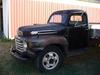
I have a 1948 F6 I am going to shorten the frame for a 10' bed. What is the "best" method for doing this? Rolling the axel up and drilling new holes or cutting the frame and taking some metal out?
Thanks for the help!
Thanks for the help!

Lead Driver


Joined: Apr 2002
Posts: 8,813
Likes: 13
From: Littleton, New Hampshire
My guess is you will may have to do something similar with the F-6 but since there is no frame kick up (as I remember) in the rear you may be able to just move the rear suspension forward and cut off the overhang.
The big truck guys will be probably along shortly on this and give you some more definitive advise...

Cargo Master

Joined: Oct 2013
Posts: 2,580
Likes: 29
From: in a barn
Above info is right on. If there is a kick up in the frame for rear axle suspension travel then cut the frame in the middle and shorten there, if the rails are flat then move the rear suspension forward and cut off the overhang.

Lead Driver
Joined: Jul 2011
Posts: 6,599
Likes: 34
From: Rockingham, VA
This is on the F4 single walled frame. I'm just guessing F5 and F6 double walled frames are shaped the same.

Hotshot


Joined: Oct 2009
Posts: 16,188
Likes: 4,796
From: Burbank, WA
It's harder than it sounds to move the suspension forward. To do it correctly, you'd have to remove all the rivets for the spring hangers and crossmembers, move everything forward accordingly, and drill and bolt everything back together. The part where you could run into problems is keeping the frame rails in the correct position as you take apart all the structure, and hope it goes back together the right way.
Thread Starter
|
Senior User
Joined: Jun 2011
Posts: 162
Likes: 0
From: Central WI
Trending Topics
FTE Chapter Leader
Joined: Dec 2001
Posts: 3,636
Likes: 11
From: Crossville, Tn

That depends, what wheelbase is the truck?
FTE Stories
Ford Trucks for Ford Truck Enthusiasts

3 Best / 3 Worst Parts of Modern Ford Ownership
Brett Foote
10 Amazing Upgrades That Solve Common Ford Truck Owner Headaches
Pouria Savadkouei
Every 2026 Ford Engine Explained
Brett Foote
10 Ugly Ford Trucks That We Still Kinda Love
Joe Kucinski
10 Things Every Truck Owner NEEDS (2026 Edition)
Michael S. Palmer
Rezvani's Latest Post-Apocalyptic Monster Is a Ford F-150 Raptor Underneath
Verdad Gallardo
Top 10 Most Expensive Ford Trucks Ever Sold on Bring a Trailer
Joe Kucinski
2027 Ford Super Duty Buyer's Guide (Every Model, Engine, & Package)
Brett Foote
Top 10 Ford Truck Tragedies
Joe Kucinski
FTE Chapter Leader
Joined: Dec 2001
Posts: 3,636
Likes: 11
From: Crossville, Tn
Well, your rear spring shackles are more than 10' from the back of the cab (126"). So if you cut the back frame off at the very back edge of the rear shackle, you are over 10'. This would not even allow you room to attach mudflaps
The only way to do that right would be to move the rear axle forward more than 2'. My F5 is 158" WB and I could probably have squeezed a 10' bed on it, put it would have looked goofy.
The only way to do that right would be to move the rear axle forward more than 2'. My F5 is 158" WB and I could probably have squeezed a 10' bed on it, put it would have looked goofy.

Welder User
Joined: Feb 2009
Posts: 5,269
Likes: 50
From: northwest MT
If your F6 frame is double walled(I think they all are) that will add to the headache. Also there is a good chance of rust between the inner and outer rails.
Because the frame height changes as you go back, sliding the springs forward that far may not work.
Will the truck be used for heavy hauling?
Because the frame height changes as you go back, sliding the springs forward that far may not work.
Will the truck be used for heavy hauling?

Hotshot
Joined: Oct 2004
Posts: 15,882
Likes: 88
From: Durham NC
IMHO yes, less work, better chance of good outcome. Double frame is the snake in the woodpile tho.
If it were mine, I'd likely just find another right length frame from a smaller truck tho.
If it were mine, I'd likely just find another right length frame from a smaller truck tho.
Hotshot
Joined: Oct 2004
Posts: 15,882
Likes: 88
From: Durham NC
You would want to fish plate both sides of the splice. Difficult to do without separating the layers. If you could remove a section of the doubled frame at the splice, it would be possible to splice the two layers in such a way as to each provide the function of a fish plate for the other. I've never worked with one of these big job doubled frames, so I don't know what's involved with separating even a portion them. You really don't need the extra strength of that frame for use as a trailer tow vehicle, even the 1/2T frame is strong enough.