When you click on links to various merchants on this site and make a purchase, this can result in this site earning a commission. Affiliate programs and affiliations include, but are not limited to, the eBay Partner Network.
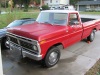
Ok so I'm attempting to clean up/fix all of the vacuum and electrical on my 75 f250 with 360 and np 4 speed.
Here's the run down. Was initially a CA compliant truck but egr and smog pump were both majorly defective so since no emmissions checks will be done anymore, egr and smog pump were removed.
Now a few quick questions I'm hoping somebody can help me with. First what is this part in following post and how must/should it be hooked up.
Secondly any diagrams or basic vacuum help is greatly appreciated there is so much tangled vacuum lines and unhooked lines from PO that it's proving very difficult.
If it's a normally-open solenoid valve (i.e., you can blow through it when it's disconnected, but when you apply 12V it closes), then that's probably what it is. It would connect between the external carb bowl vent and the charcoal canister, to prevent pressure build-up when a hot vehicle is parked. Wire to switched 12V power so it closes when the engine's running but is open otherwise.
Different application, but this thread at a Mustang forum has good info: Fuel Bowl Solenoid Valve
If you have de smogged the truck Than I am pretty sure you can live without that.
Just plum the vacuum to give you the bare essentials. Like spark advance and
power brakes. There really isn't much more to if anything to make it run fine.
It won't be any more fuel friendly. But she wasn't to start with. After you get all
the smog/vacuum stuff deleted don't forget the retune the carb (maybe even re jet
it) and set the timing. At this point I use a vacuum gauge and my ear.
Agreed. If you're not trying to maintain evaporative emissions, etc., all you'd really need to run the engine are:
-Spark advance getting either manifold or ported vacuum through a ported vacuum switch (i.e., keeps timing retarded until the engine warms up - you could eliminate the ported vacuum switch and just always run manifold vacuum in a pinch, though it might get a little more cold-blooded).
-Manifold vacuum to brake booster (if applicable) and HVAC controls (if applicable)
-Manifold vacuum to automatic transmission modulator (if applicable)
Beyond that, the EGR valve was vacuum actuated (also via a ported vacuum switch so it was only active once the engine was warmed up), and the canister purge system would have vacuum-controlled valves in it and feed into some of the carb ports. But if you don't want to clean it up and recover that functionality, you can just cap off any spare ports and run just the essentials.
I have two vacuum trees on front of manifold.
One in rear of manifold that had brake booster and one to inside cab (hvac?)
One on tstat housing with three going all over
Then I've got lines going to each fuel tank then to some canister on frame?
If I was doing it like I used to. I would unplug and cap everything
But the vacuum advance. The trans module (that you don't have)
The heater/AC And brakes. I can't think of anything else I would
use. Or need to. But it will run like crap till ya tune it for sure.
Prolly all ready does and is why your doing this. DUHH
The canister on the frame is the charcoal canister. The lines from the tank should run to it. Then, for canister purge, there would usually be vacuum-actuated valves between the canisters and one of the ports on the bottom of the carburetor; typically, the vacuum to the canister purge valves would come from the same place as the EGR vacuum - that is, a ported vacuum switch to only purge once the engine's warmed up. A complete setup would also run the bowl vents to the canisters, with solenoid valves as described previously that close when the engine is on.
If you want to eliminate all that and just pollute rather than recovering your fuel vapors, you'd remove the canisters and the vent lines from the tanks, cap the lines at the tanks, and switch to vented gas caps that will relieve pressure there. Then, you could do as arctic y block suggests and just plumb the bowl vent back to the inside of the air cleaner.
Rezvani's Latest Post-Apocalyptic Monster Is a Ford F-150 Raptor Underneath
Slideshow: Called the Fortress, the 850-horsepower pickup combines Raptor underpinnings with military-inspired features, survival equipment, and a starting price of $285,000.