


Fuel boiling -- why?
Thread Starter
|
Senior User
Joined: May 2013
Posts: 327
Likes: 0
From: Flaherty, KY
Fuel boiling -- why?
I have this annoying issue with my carb [Holley 4180C] after I shut down the truck when it's good and warmed up.
The fuel boils and you can smell gas vapors for a good 30 minutes until the truck starts cooling down. This is especially evident in summer when it's good and hot, but does it in the cold too. Carb is bulletproof other than this issue, it was rebuilt over the summer.
I preserved the EVAP emissions stuff (following the vacuum diagram label on my radiator support), the only emissions stuff I've tossed are the two air pumps and all the thermactor tubing. I replaced all vacuum hoses with new over the summer, there are no vacuum leaks.
I don't know how to check the charcoal canisters or any of that other EVAP gadgetry, but I know it's all there.
Where do I start?
The fuel boils and you can smell gas vapors for a good 30 minutes until the truck starts cooling down. This is especially evident in summer when it's good and hot, but does it in the cold too. Carb is bulletproof other than this issue, it was rebuilt over the summer.
I preserved the EVAP emissions stuff (following the vacuum diagram label on my radiator support), the only emissions stuff I've tossed are the two air pumps and all the thermactor tubing. I replaced all vacuum hoses with new over the summer, there are no vacuum leaks.
I don't know how to check the charcoal canisters or any of that other EVAP gadgetry, but I know it's all there.
Where do I start?

Moderator


Joined: Nov 2007
Posts: 22,415
Likes: 92
From: Denver Metro Area, CO

I got this from Summit Racing:
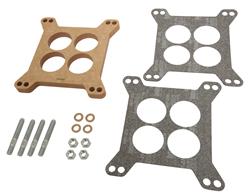
It's made of wood and is a great insulator.
http://www.summitracing.com/parts/edl-8723/overview/
It's made of wood and is a great insulator.
http://www.summitracing.com/parts/edl-8723/overview/
Thread Starter
|
Senior User
Joined: May 2013
Posts: 327
Likes: 0
From: Flaherty, KY
I used the new thick (1/4") spacer along with all new gaskets that came with my carb rebuild kit (Motorcraft brand). Is a thicker spacer the answer?
I fail to see why most trucks get by with the stock spacer, yet mine won't...?
I fail to see why most trucks get by with the stock spacer, yet mine won't...?
Thread Starter
|
Senior User
Joined: May 2013
Posts: 327
Likes: 0
From: Flaherty, KY
No fuel leaks.. When the fuel is boiling, I can sorta hear it, but I also see fuel dribbling through some holes in the side of the venturi, coating the throttle plates and draining into the intake. Just little dribbles, not much at all. I also see vapor wafting out of that long horn that gets in the way of putting the air cleaner on. I don't know what it's called.
Trending Topics

Laughing Gas


Joined: Apr 2013
Posts: 1,049
Likes: 65
Interesting.
I wonder if it's really boiling or if:
Floats are set too high?
Fuel is leaking past the front inlet needle valve after shut off? If you have an electric fuel pump I think you're running about 8 psi fuel pressure. When you shut down you still have residual fuel pressure and the float has to hold the inlet needle valve shut against this residual pressure. If the valve leaks the fuel is going to flood.
Possible internal metering block gasket leak?
I wonder if it's really boiling or if:
Floats are set too high?
Fuel is leaking past the front inlet needle valve after shut off? If you have an electric fuel pump I think you're running about 8 psi fuel pressure. When you shut down you still have residual fuel pressure and the float has to hold the inlet needle valve shut against this residual pressure. If the valve leaks the fuel is going to flood.
Possible internal metering block gasket leak?
FTE Stories
Ford Trucks for Ford Truck Enthusiasts

Top 10 Fords at 2026 Carlisle Ford Nationals
Joe Kucinski
3 Best / 3 Worst Parts of Modern Ford Ownership
Brett Foote
10 Amazing Upgrades That Solve Common Ford Truck Owner Headaches
Pouria Savadkouei
Every 2026 Ford Engine Explained
Brett Foote
10 Ugly Ford Trucks That We Still Kinda Love
Joe Kucinski
10 Things Every Truck Owner NEEDS (2026 Edition)
Michael S. Palmer
Rezvani's Latest Post-Apocalyptic Monster Is a Ford F-150 Raptor Underneath
Verdad Gallardo
Top 10 Most Expensive Ford Trucks Ever Sold on Bring a Trailer
Joe Kucinski
2027 Ford Super Duty Buyer's Guide (Every Model, Engine, & Package)
Brett Foote
Moderator


Joined: Jan 2001
Posts: 56,999
Likes: 2,747
From: Virginia
Look at your exhaust manifolds. You might have a valve in the outlet of one of them called the heat riser valve, or there may be another name for it. It was temp controlled, and it blocked the exhaust manifold when the engine is cold, to force the exhaust through the center port in the cylinder head, through the passage in the intake under the carb, over to the port on the other head and then out the other exhaust manifold. This made the intake and carb heat up really quick, giving you good performance in cold weather. When the truck warmed up some, this valve opened, letting the exhaust through the pipe like normal.
If your valve is stuck shut, or if it's vacuum controlled and something is not right with the controls, it may be stuck shut all the time, and this would overheat the carb area. It leads a rough life down there in all the heat from the exhaust system.
If your valve is stuck shut, or if it's vacuum controlled and something is not right with the controls, it may be stuck shut all the time, and this would overheat the carb area. It leads a rough life down there in all the heat from the exhaust system.

Posting Guru
Joined: May 2013
Posts: 1,122
Likes: 0
From: Haysville, KS
Just my two cents, and it may not apply in your specific case. but EVAP systems were created to deal with similar issues.
The engine of course gets hot when it's running, but while it's running the vapors more or less get burned off. Once you shut off the engine, it actually starts to get a little hotter for a bit.
This is because there is no more coolant circulating, so the block heat rises for a bit and then starts to cool on it's own. During that time, the carburetor bowl is creating gas fumes. The EVAP system was designed to vent those fumes during that specific time frame.
That all said, I'm not familiar with your carburetor, but does it have a bowl vent? And if so, do you have a functioning EVAP system?
The engine of course gets hot when it's running, but while it's running the vapors more or less get burned off. Once you shut off the engine, it actually starts to get a little hotter for a bit.
This is because there is no more coolant circulating, so the block heat rises for a bit and then starts to cool on it's own. During that time, the carburetor bowl is creating gas fumes. The EVAP system was designed to vent those fumes during that specific time frame.
That all said, I'm not familiar with your carburetor, but does it have a bowl vent? And if so, do you have a functioning EVAP system?

Thread
Thread Starter
Forum
Replies
Last Post
Cprofit
1973 - 1979 F-100 & Larger F-Series Trucks
4
Dec 14, 2018 09:57 AM
AbandonedBronco
Ford Inline Six, 200, 250, 4.9L / 300
18
Oct 20, 2010 11:25 PM
masseysbronco
1980 - 1986 Bullnose F100, F150 & Larger F-Series Trucks
30
May 19, 2010 01:36 PM