





Trailer hitch

Thread Starter
|
Laughing Gas

Joined: Apr 2009
Posts: 751
Likes: 1
From: orange county, ca.
Trailer hitch
I found a cheap hitch that has the bolt on sides, but it's a little too narrow. I was going to make 1" spacers for each side and was wondering if aluminum would be ok as steel will add some weight. Keep in mind that the spacers will be sandwiched in between the center section and the end plates. It will have three 1/2 grade 8 bolts going through on each side to hold it together.
So, to sum up my question......spacers aluminum or steel.
This is an example of the style I have.
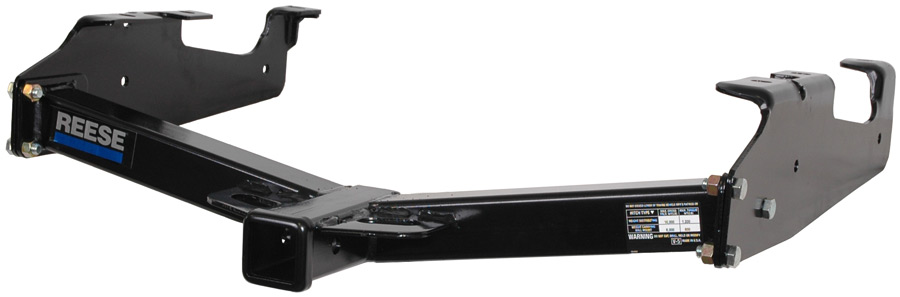
So, to sum up my question......spacers aluminum or steel.
This is an example of the style I have.
Thread Starter
|
Laughing Gas
Joined: Apr 2009
Posts: 751
Likes: 1
From: orange county, ca.
I checked it's too wide with the end plates swapped.
Cargo Master


Joined: Sep 2010
Posts: 3,427
Likes: 48
From: Hot AZ (Phoenix Valley)

If you wanted to bolt it together still, I would make two solid blocks, drilled, tapped, use 6-bolts & 6-lock washers per side.
If I was going to weld it, I would take the sides and put them on the opposite side, cut the same amount off of the two ends of the receiver bars and weld it in place.
If I was going to weld it, I would take the sides and put them on the opposite side, cut the same amount off of the two ends of the receiver bars and weld it in place.
Elder User
Joined: Aug 2012
Posts: 751
Likes: 0
From: Cuba, AL (NO internet)
That's exactly what I did with a junkyard hitch I found and modified for my '49.
Trending Topics

Senior User
Joined: Nov 2005
Posts: 307
Likes: 0
From: central texas
don't use aluminum spacers. you will regret it... do it right, make new end plates with the proper offset so that they will bolt up... even spacers between the end plates and the frame will weaken the hitch attachment... don't cut and extend the hitch, unless you replace the entire length of the bar from the center weld to the end plate flange... current hitches are made as light as possible to handle the weight specified in their rating... if you modify a hitch, you may end up with a very bad day...
cl the hitch and get one that fits....
one thing that is not included with current hitches. is a plate for the outside of the frame. so that the hitch end plate and the extra plate sandwich the frame between them. this acts like a boxed frame for strength. up to the point the hitch and outside plates stop, at that point is the weak spot... if your over loading your truck, the frame will crack in that location..
cl the hitch and get one that fits....
one thing that is not included with current hitches. is a plate for the outside of the frame. so that the hitch end plate and the extra plate sandwich the frame between them. this acts like a boxed frame for strength. up to the point the hitch and outside plates stop, at that point is the weak spot... if your over loading your truck, the frame will crack in that location..
FTE Stories
Ford Trucks for Ford Truck Enthusiasts

Top 10 Fords at 2026 Carlisle Ford Nationals
Joe Kucinski
3 Best / 3 Worst Parts of Modern Ford Ownership
Brett Foote
10 Amazing Upgrades That Solve Common Ford Truck Owner Headaches
Pouria Savadkouei
Every 2026 Ford Engine Explained
Brett Foote
10 Ugly Ford Trucks That We Still Kinda Love
Joe Kucinski
10 Things Every Truck Owner NEEDS (2026 Edition)
Michael S. Palmer
Rezvani's Latest Post-Apocalyptic Monster Is a Ford F-150 Raptor Underneath
Verdad Gallardo
Top 10 Most Expensive Ford Trucks Ever Sold on Bring a Trailer
Joe Kucinski
2027 Ford Super Duty Buyer's Guide (Every Model, Engine, & Package)
Brett Foote
Thread Starter
|
Laughing Gas
Joined: Apr 2009
Posts: 751
Likes: 1
From: orange county, ca.
The one I have is a straight single bar, not the "V" one I have pictured. It's for a F350, it was made in 1996 and is HEAVY. It's for a 32" or a 37.5" frame. Now I'm thinking of cutting off the welded ends, cutting square holes in the side plate, swapping sides, sticking the bar through the holes and welding it or steel spacer, bolt it and weld it.
Kind of like this example:
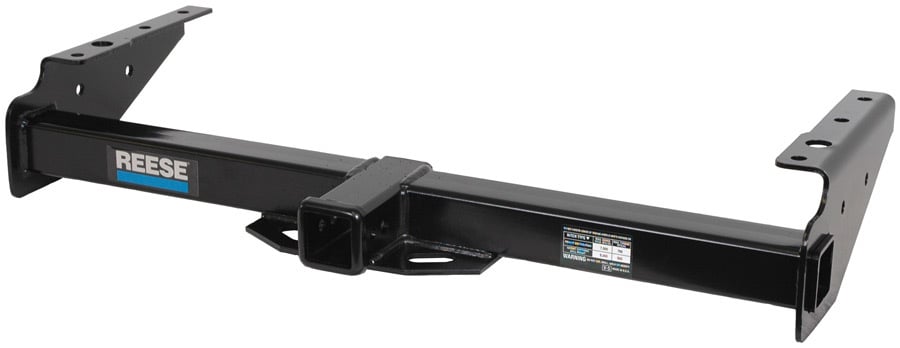
This is the same part number of the one I bought.


Keep in mind that it will most likely be towing a small vintage trailer and maybe a rented flatbed with a car on it......not sure if I want to tow anything heavier without boxing the frame.
Kind of like this example:
This is the same part number of the one I bought.
Keep in mind that it will most likely be towing a small vintage trailer and maybe a rented flatbed with a car on it......not sure if I want to tow anything heavier without boxing the frame.

Postmaster
Joined: Sep 2006
Posts: 4,525
Likes: 1
From: oh
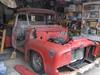
awesome....and do you have a pic of the 56f250 pulling the dozer?
I am going to pull a trailer with my 56 f250 this summer,and wife thinks it would not be a good idea.
Logistics Pro


Joined: Jun 2010
Posts: 4,965
Likes: 261
From: East KY

You pulled approximately 8 tons (16,000 lbs.) with a 1956 F-250? Wow! I own a modern Super Duty F-250 diesel truck, and I also own a JD 450D. There's no way that I would attempt that.
Elder User
Joined: Jan 2011
Posts: 859
Likes: 3
From: Newberg, OR
I'm also making a hitch for my 54. I'd like to pull my 24 ft. camp trailer some day. It's 4000 lbs. I boxed the frame all the way to the rear but am concerned about the C notch so I calculated the static load moment at the C notch for several load combinations. I'm pretty sure I can beef up the C notch by adding a 2x6x1/4 plate on the top of the frame rail. The piece of pipe I used to make the bottom of the C notch was 1/2" w.t. so that's ok. I also show some calculations at the bottom of the page for shear loads on the hitch side plates. The way I'm making mine it bolts to the inside web face of the boxed rail, not the bottom flange. The maximum shear load is 1385 lbs. for 4 bolts and more than a 7x factor of safety for 5/8 inch bolts.

Elder User
Joined: Jan 2011
Posts: 859
Likes: 3
From: Newberg, OR
+1 this and then some. At work we have a 5 yard dump truck and we used to haul our backhoe with a 3 axle trailer with electric brakes. That was a accident waiting to happen. Now we have a double axle with duals and air brakes. Much better.