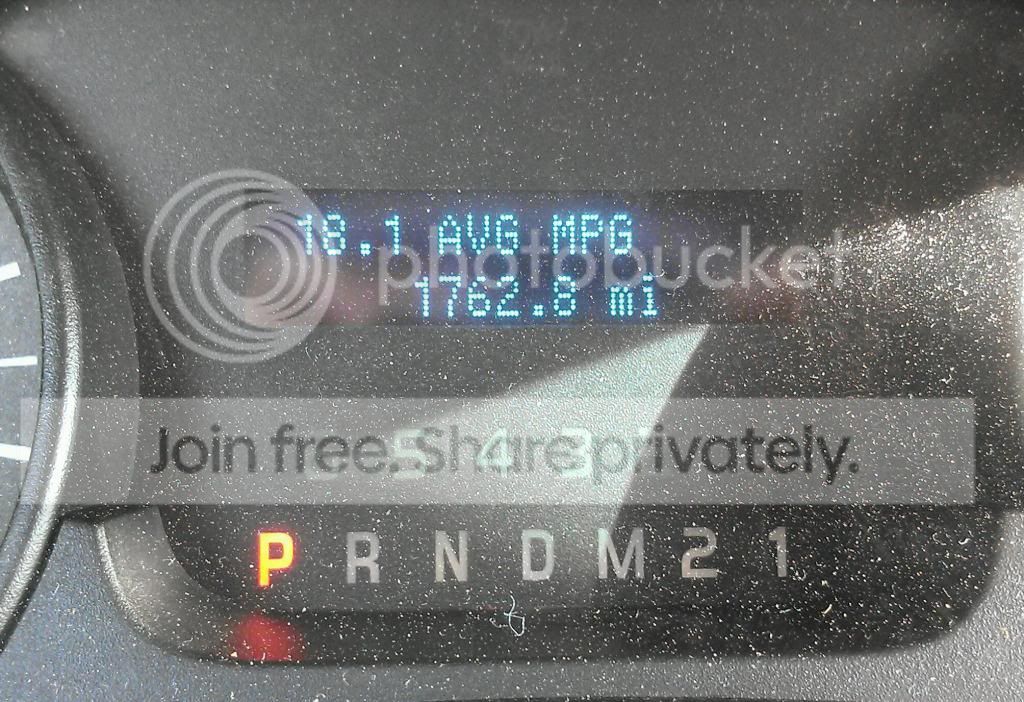
Break in for Ecoboost
Super Moderator


Joined: Aug 2003
Posts: 25,479
Likes: 742
From: Isanti, MN

First of all, remember that the upper limit for "normal" oil consumption is one quart in 900 miles. So if for some reason your rings never seat well and you burn a quart every thousand miles your truck will be "operating as designed" and no repair will be necessary.
And secondly I thought I read somewhere in the past that much of the reason for a break-in period had to do with the proper wearing in of the ring and pinion more than the engine. Not sure though, and I don't have time to look it up right now.
And secondly I thought I read somewhere in the past that much of the reason for a break-in period had to do with the proper wearing in of the ring and pinion more than the engine. Not sure though, and I don't have time to look it up right now.
Elder User
Joined: Oct 2011
Posts: 722
Likes: 6
First of all, remember that the upper limit for "normal" oil consumption is one quart in 900 miles. So if for some reason your rings never seat well and you burn a quart every thousand miles your truck will be "operating as designed" and no repair will be necessary.
And secondly I thought I read somewhere in the past that much of the reason for a break-in period had to do with the proper wearing in of the ring and pinion more than the engine. Not sure though, and I don't have time to look it up right now.
And secondly I thought I read somewhere in the past that much of the reason for a break-in period had to do with the proper wearing in of the ring and pinion more than the engine. Not sure though, and I don't have time to look it up right now.
With the modern tolerances in motor building and design I think and believe the real reason for the 1k mile break-in suggestions are because of the drive-train componants. Componants like the rear diff, ring & pinion set and driveshaft. Many engineers believe transmission itself is a much more sophisticated and complex than the motor itself.
Knowing that alone is enough to take care and concern for a proper break in. Like I mentioned earlier in this post. I had my 5.0L, Scab loaded up and working from day one. I have not had one lick of an issue with the 5.0L after 25k of use, but at 3k miles you guys may recall my post about needing a new driveshaft for sloppy slip-yoke play. Was it from hauling heavy payloads and trailers to soon? Hard to say but could have been.

Elder User
Joined: Jul 2010
Posts: 501
Likes: 1
From: Pacific NW
Super Moderator
Joined: Aug 2003
Posts: 25,479
Likes: 742
From: Isanti, MN
Even with the ring and pinion seating, I wonder if it's really necessary. Ford uses a photo-based system to match the ring and pinion gears on the assembly line and have extremely tight tolerances
Source
Source

Logistics Pro
Joined: Oct 2004
Posts: 4,738
Likes: 103
From: FL
Even with the ring and pinion seating, I wonder if it's really necessary. Ford uses a photo-based system to match the ring and pinion gears on the assembly line and have extremely tight tolerances
Source
Source

Cargo Master

Joined: Nov 2011
Posts: 2,946
Likes: 11
From: Northern California
Very cool, thanks for sharing! I did some more digging and found this video to support the article:
Ford Makes F-Series Trucks Even Tougher - YouTube
Ford Makes F-Series Trucks Even Tougher - YouTube


Moderator
Joined: Dec 2001
Posts: 22,436
Likes: 17
From: Louisville,Ky.
They still have to wear in together regardless of how they are paired. Kinda like starting an engine with a new flat tappet cam and lifters and letting it idle. Odds are, your going to end up with a flat camshaft and mushroom lifters. The metals really needs to mesh together and get a good wear pattern. It almost seems that it acts as a hardening process to prevent future wear. I'm no metallurgist, but it works and sounds right to me.
Pulled the rear gears out of my Mustang after about 160K miles and they had virtually no wear. I broke them in about 500 miles when I had them installed back in 1989. (that wasn't easy to do with my lead foot)
Pulled the rear gears out of my Mustang after about 160K miles and they had virtually no wear. I broke them in about 500 miles when I had them installed back in 1989. (that wasn't easy to do with my lead foot)

Fleet Mechanic
Joined: Jan 2007
Posts: 1,741
Likes: 3
+1 on the gears needing to mate. Both rear end (and maybe front-end) and transmission.
Will add: transmission (and engine) need to learn driving habits. Brakes need to bed in.
And YOU, the DRIVER, need time to learn the vehicle. Even if you've driven one just like it before, each one is different. Stuff like where the AC controls are. Where the volume **** is. Getting used to a new gauge layout. etc...
I know industrial engines are "run in" at the factory before they're ever installed in an application, and I suspect modern gasoline engines are also done this way. "Engine break in" is no longer part of the modern vehicle lexicon because of this.
Ships and airplanes get shakedown cruises. Other systems get systems-integration testing. A vehicle should be no different.
-blaine
Will add: transmission (and engine) need to learn driving habits. Brakes need to bed in.
And YOU, the DRIVER, need time to learn the vehicle. Even if you've driven one just like it before, each one is different. Stuff like where the AC controls are. Where the volume **** is. Getting used to a new gauge layout. etc...
I know industrial engines are "run in" at the factory before they're ever installed in an application, and I suspect modern gasoline engines are also done this way. "Engine break in" is no longer part of the modern vehicle lexicon because of this.
Ships and airplanes get shakedown cruises. Other systems get systems-integration testing. A vehicle should be no different.
-blaine
FTE Stories
Ford Trucks for Ford Truck Enthusiasts

2027 Ford Super Duty Buyer's Guide (Every Model, Engine, & Package)
Brett Foote
Top 10 Ford Truck Tragedies
Joe Kucinski
AEV FXL Super Duty - the Super Duty Raptor Ford Doesn't Make
Brett Foote
Lobo Vs Lobo: Proof the F-150 Lobo Should Be Even Lower!
Michael S. Palmer
Ford's 2001 Explorer Sportsman Concept Looks For a New Home
Verdad Gallardo
10 Best Ford Truck Engines We Miss the Most!
Joe Kucinski
2026 Shelby F-150 Off-Road: Better Than a Raptor R?
Brett Foote
2027 Super Duty Carhartt Package First Look: 12 Things You NEED to Know!
Michael S. Palmer
10 Most Surprising 2026 Ford Truck Features!
Joe Kucinski
Cargo Master
Joined: Nov 2011
Posts: 2,946
Likes: 11
From: Northern California
Here is a wrrite up from Popular Mechanics:
New Car Care – How to Take Care of a New Car - Popular Mechanics
Pay particular attention to the OIL and BEARING sections!!
The transmission section was one I didn't think about but makes sense.
Happy reading
New Car Care – How to Take Care of a New Car - Popular Mechanics
Pay particular attention to the OIL and BEARING sections!!
The transmission section was one I didn't think about but makes sense.
Happy reading
Super Moderator
Joined: Aug 2003
Posts: 25,479
Likes: 742
From: Isanti, MN
I don't agree with lots of things in that article, but it does give us something to think about. I'd be happy to post the oil analysis I had done on my '11 Mustang's factory fill at 9,953 miles. No reason to change the oil after 20 miles.
Unless this engine didn't have an oil filter I'm not sure how this is possible. Waving the BS flag here. 
Popular Mechanics]That 20-mile oil, you would think, would look pretty much like fresh oil right out of the bottle. Wrong. It usually looks more like metal-flake paint, iridescent with tiny particles of metal worn off rubbing surfaces inside the new engines.
Cargo Master
Joined: Nov 2011
Posts: 2,946
Likes: 11
From: Northern California
I think what he meant was in the oil pan? I am a firm believer that some metal fragments do not find their way to the filter.
Laughing Gas
Joined: Oct 2005
Posts: 1,058
Likes: 1
From: South Jersey
I've noticed that when a trailer is hitched up and the power cord is plugged into the 7 pin plug, it then shows up on the info screen on the dash as towing miles (for those trucks with the in dash trailer brake controller). If their is some kind of engine damage, like rings not properly seated or whatever and the service tech sees that their is towing miles on the truck under 1000 miles, there may be a denied warranty repair. However, that being said, I doubt their will be an issue towing with a new truck, but one never knows for sure.

Super Moderator


Joined: Jan 2008
Posts: 40,019
Likes: 1,518
From: Maine, Virginia
^^^^^^^
IIRC, the XL models don't have the info screen and interactive technology that the XLT's and higher get so I'm not sure if the system can distinguish between which type of miles have been driven. But, I'm sure there is a way for the tech to figure it out.
IIRC, the XL models don't have the info screen and interactive technology that the XLT's and higher get so I'm not sure if the system can distinguish between which type of miles have been driven. But, I'm sure there is a way for the tech to figure it out.
Super Moderator
Joined: Aug 2003
Posts: 25,479
Likes: 742
From: Isanti, MN
I really don't think this has any bearing on warranty.
Logistics Pro
Joined: Oct 2004
Posts: 4,738
Likes: 103
From: FL