


HPFP Life expectancy?

Logistics Pro


Joined: Mar 2005
Posts: 3,555
Likes: 2,512
From: West Michigan
Refer to Bosch's chart. US diesel is 520HFRR. Add some good lubricity additives and you might end up at 470HFRR (I use a 50/50 mix off Stanadyne lubricity formula and Performance formula, 3 Oz per 20 gallons gets 460 HFRR + / -. Best we do under ideal conditions is 2000 hours with a little wear. So drain your DFCM, add good additives that increase lubricity, then pray.
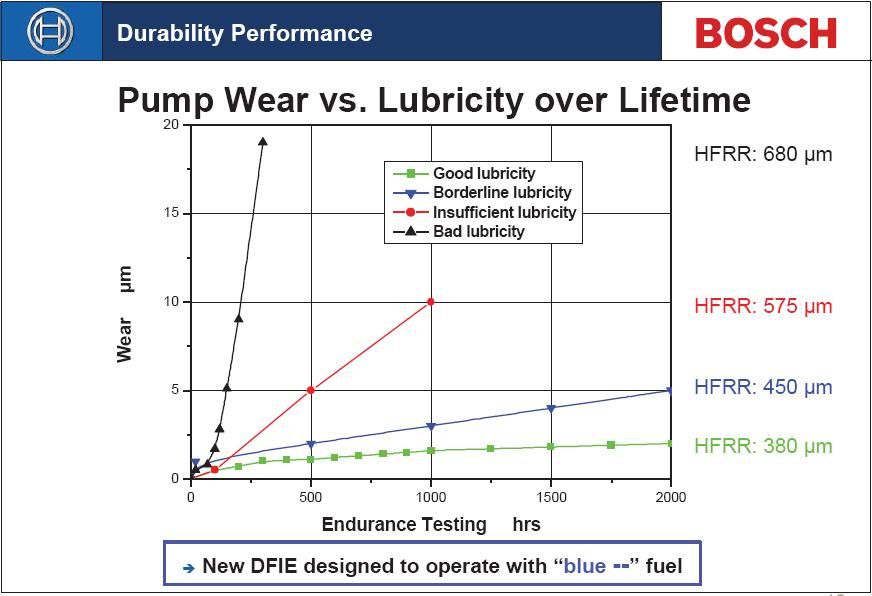
The Bosch CP4.2 is used on so many European vehicles where fuel is of good quality, they also pay $5.82 a gallon on average. The Duramax uses the same pump we have. So Bosch put a "Diamond Like Coating" on the fuel pump cam and valves for US fuel. Have seen speculation here and elsewhere that additives might destroy the DLC. Remember the Army ran JP8 through the 6.7 for their test at 800 + HFRR and it showed little wear. It is futile to worry about what part will fail when. But preforming routine maint extends the life of stuff. There is no shortage of articles and pictures of the bosch pump. After reading most of that and distilling down, if I asked the designer of the pump what could I do to get the most life out of it, the reply would be to use European or Canadian fuel, or drain the DFCM, use a good lubricity additive in each tank (only pennies per gallon) etc. Mike
I know that you have paid close attention to Ricks problem over the last year or so. Along with all the research. I'm only calling out apparent conflicting statements you make in this thread, especially the 2000 hrs one that tend to get people "worked up". If we knew 2000 hrs was the magic number then folks and/or Ford would be going out replacing the HPFP wholesale just before that because for most, 2000 hours is less miles than the 100K engine warranty. I like your latter statements however, though about performing routine maintenance. That's the key to all of this.

Senior User
Joined: Feb 2007
Posts: 474
Likes: 0
From: Colorado
Heck there are all manner of charts specs expert testimony etc to get worked about concerning the fuel pump out there on the web. Most of us come here for answers to problems we want to solve ourselves or modify and make better. One thing that I believe was interesting in the heated debate on fuel pump was I was completely ignorant of diesel fuel specs or hfrr or emulsifier demulsifier so it was a fun ride of the educational variety for me. But in the end I really know in my heart that I made huge investment in my truck and need it to tow safely and last a long time. So I learned a lot and any input I could pass on without writing a book is the suggestions in my previous post.....but I don't pray over my truck...was just kidding there. Mike

Thread Starter
|
Post Fiend
Joined: Jun 2003
Posts: 5,983
Likes: 2
Lots of good info here and my question remains: drive it until it breaks and then what? Drop 10K on a 6K truck? Throw it out? There has to be some form of longer term solution to this.
Or trade it before it happens? If this is the conventional wisdom, aren't we admitting to owning trucks whose residual value decreases rapidly around 100K miles?
I'll admit to being a diesel newbie but I've seen where these trucks (brand independent) have sold for good money with over 100K miles. In other words has Ford invented the first disposable truck?
Or trade it before it happens? If this is the conventional wisdom, aren't we admitting to owning trucks whose residual value decreases rapidly around 100K miles?
I'll admit to being a diesel newbie but I've seen where these trucks (brand independent) have sold for good money with over 100K miles. In other words has Ford invented the first disposable truck?
Super Moderator
Joined: Aug 2003
Posts: 25,479
Likes: 742
From: Isanti, MN

Lots of good info here and my question remains: drive it until it breaks and then what? Drop 10K on a 6K truck? Throw it out? There has to be some form of longer term solution to this.
Or trade it before it happens? If this is the conventional wisdom, aren't we admitting to owning trucks whose residual value decreases rapidly around 100K miles?
I'll admit to being a diesel newbie but I've seen where these trucks (brand independent) have sold for good money with over 100K miles. In other words has Ford invented the first disposable truck?
Or trade it before it happens? If this is the conventional wisdom, aren't we admitting to owning trucks whose residual value decreases rapidly around 100K miles?
I'll admit to being a diesel newbie but I've seen where these trucks (brand independent) have sold for good money with over 100K miles. In other words has Ford invented the first disposable truck?
My point is that this technology isn't brand-new, but like anything man made it can break. I've seen a few high mileage failures of 6.7L engines, but only one of them that I can remember has been a HPFP. I'm confident that ruschejj, NEMOTORCARS, and numerous more high mileage users who don't regularly use fuel additive and have survived past 2,000 hours aren't the exception to the rule. That chart that's been making it's way around the internet was produced years ago in attempt to institute higher standards for fuel here in the US. This was before the CP4 pump was ever put to use on Ford engines, and obviously there have been revisions since then.
My opinion is to drive the truck and don't worry about it. Follow the maintenance schedule, use a good fuel additive, and enjoy the truck. Constantly stressing about an HPFP failure is like being terrified of a fatal car accident every time you leave the house. Could it happen? Sure. Is it likely? Not really.

Posting Guru
Joined: Nov 2010
Posts: 1,783
Likes: 1
From: WY
Ford has invented nothing that the competition hasn't had out for years. GM introduced Bosch high pressure direct injection in 1999, and Dodge did in 2003. Ford trucks got high pressure common rail injection in 2007 with the introduction of the 6.4L Powerstroke which had a Siemens injection system. The 2011+ Duramax uses the same pump that your 6.7L Powerstroke does.
My point is that this technology isn't brand-new, but like anything man made it can break. I've seen a few high mileage failures of 6.7L engines, but only one of them that I can remember has been a HPFP. I'm confident that ruschejj, NEMOTORCARS, and numerous more high mileage users who don't regularly use fuel additive and have survived past 2,000 hours aren't the exception to the rule. That chart that's been making it's way around the internet was produced years ago in attempt to institute higher standards for fuel here in the US. This was before the CP4 pump was ever put to use on Ford engines, and obviously there have been revisions since then.
My opinion is to drive the truck and don't worry about it. Follow the maintenance schedule, use a good fuel additive, and enjoy the truck. Constantly stressing about an HPFP failure is like being terrified of a fatal car accident every time you leave the house. Could it happen? Sure. Is it likely? Not really.
My point is that this technology isn't brand-new, but like anything man made it can break. I've seen a few high mileage failures of 6.7L engines, but only one of them that I can remember has been a HPFP. I'm confident that ruschejj, NEMOTORCARS, and numerous more high mileage users who don't regularly use fuel additive and have survived past 2,000 hours aren't the exception to the rule. That chart that's been making it's way around the internet was produced years ago in attempt to institute higher standards for fuel here in the US. This was before the CP4 pump was ever put to use on Ford engines, and obviously there have been revisions since then.
My opinion is to drive the truck and don't worry about it. Follow the maintenance schedule, use a good fuel additive, and enjoy the truck. Constantly stressing about an HPFP failure is like being terrified of a fatal car accident every time you leave the house. Could it happen? Sure. Is it likely? Not really.

Senior User
Joined: Feb 2007
Posts: 474
Likes: 0
From: Colorado
If we didn't worry about our ford vehicles, there would be no FTE. The concerns of the good folks here, generate discussion threads. The debates draw us in and are interesting. I am amazed how much of a mix the participants are here. If we just drove and didn't worry, the only thread here would prolly be that thread. Keep asking questions and throwing out theories and ideas. FTE Herman, Tom said the same fuel pump is in a Chebby, Dodge, also a VW, and other vehicles. So those other companies have disposable vehicles as well following your logic. Maybe the engineers looked at the data out there on the pump and chose it for its reliability no? If you traded it on another Ford, or Dodge or Chebby truck with a diesel powered by a Bosch CP4, your chances of a failure would be the same, whatever that number is. I just think these high tech trucks require more effort to maintain and even reading and understanding how engine, transmission, even the entertainment system, are affected by maintaining them properly or improperly. Knowing for example, that getting fuel from a busy station that has a high diesel turn over rate probably has fresh fuel in the storage tank, or if you see the tanker about to fill up the tanks you decide to hit another station which may decrease your chances of getting bad fuel sitting at the bottom of the tank. What if your on the road at night your WIF light comes on after filling up at a mom and pop station in the last small town, what do you do? This scenario has played out here. Do you drain and drive? Do you pull over and call a tow truck? or do you wait till you get home and crack open the manual to figure out what the WIF light means? The correct choice may mean saving yourself a 10K repair bill.

Post Fiend
Joined: Jan 2009
Posts: 6,521
Likes: 11
From: Greenwood, SC
Yes, I'm probably over 3500 hours and my fuel pump has been mounted onto its second block. 157,000 miles and going still.
I mean, I stress more about trailer tires.....heck, I haven't had a flat tire on my truck in years...
I mean, I stress more about trailer tires.....heck, I haven't had a flat tire on my truck in years...
Super Moderator
Joined: Aug 2003
Posts: 25,479
Likes: 742
From: Isanti, MN
If we didn't worry about our ford vehicles, there would be no FTE. The concerns of the good folks here, generate discussion threads. The debates draw us in and are interesting. I am amazed how much of a mix the participants are here. If we just drove and didn't worry, the only thread here would prolly be that thread. Keep asking questions and throwing out theories and ideas.
ruschejjYes, I'm probably over 3500 hours and my fuel pump has been mounted onto its second block. 157,000 miles and going still.
FTE Stories
Ford Trucks for Ford Truck Enthusiasts

Top 6 Best Deals Available on New Fords & Lincolns Right Now
Brett Foote
This Hennessey Takes the Expedition Tremor's Off-Roading Capability to the Next Level
Verdad Gallardo
Top 10 Fords at 2026 Carlisle Ford Nationals
Joe Kucinski
3 Best / 3 Worst Parts of Modern Ford Ownership
Brett Foote
10 Amazing Upgrades That Solve Common Ford Truck Owner Headaches
Pouria Savadkouei
Every 2026 Ford Engine Explained
Brett Foote
10 Ugly Ford Trucks That We Still Kinda Love
Joe Kucinski
10 Things Every Truck Owner NEEDS (2026 Edition)
Michael S. Palmer
Rezvani's Latest Post-Apocalyptic Monster Is a Ford F-150 Raptor Underneath
Verdad Gallardo
Thread
Thread Starter
Forum
Replies
Last Post
touchofgrey
1999 - 2003 7.3L Power Stroke Diesel
6
Aug 5, 2005 04:01 PM
TLAM
1997 - 2006 Expedition & Navigator
5
Aug 14, 2003 08:24 AM
youngster
Ford Inline Six, 200, 250, 4.9L / 300
7
Dec 23, 2001 10:22 PM