





Electrical Help: fried solonoid?

Thread Starter
|
New User
Joined: Jan 2013
Posts: 7
Likes: 0
 Electrical Help: fried solonoid?
This is my first post and i can tell ya this much, im generally not proud that it is about this topic.
Ill be the first to admit that i screwed up bad. I went yesterday to start my 1977 F150 knowing that i had a dead battery in it. I wasent thinking and put the battery cables on wrong, positive from solonoid to the negative battery end and vise versa. I then preseded to hook up jumper cables to my already running truck. as soon as i completed the circuit on the running truck the starter solonoid started smoking BAD so i immediatly removed the jumper leads. With little effort i realized my mistake and changed the cables back around but needles to say the damage is done. When i turn the key nothing happens. there is no lights, radio, power etc she is completly dead. I can crossover the solonoid and the motor turns over but will not fire.
I just want to know from you guys what you think i wrecked and where do i start on the journey to undo my stupidity lol.
Much thanks in advance.
Ill be the first to admit that i screwed up bad. I went yesterday to start my 1977 F150 knowing that i had a dead battery in it. I wasent thinking and put the battery cables on wrong, positive from solonoid to the negative battery end and vise versa. I then preseded to hook up jumper cables to my already running truck. as soon as i completed the circuit on the running truck the starter solonoid started smoking BAD so i immediatly removed the jumper leads. With little effort i realized my mistake and changed the cables back around but needles to say the damage is done. When i turn the key nothing happens. there is no lights, radio, power etc she is completly dead. I can crossover the solonoid and the motor turns over but will not fire.
I just want to know from you guys what you think i wrecked and where do i start on the journey to undo my stupidity lol.
Much thanks in advance.

MSEE
Joined: Apr 2004
Posts: 10,386
Likes: 35
From: Austin, TX

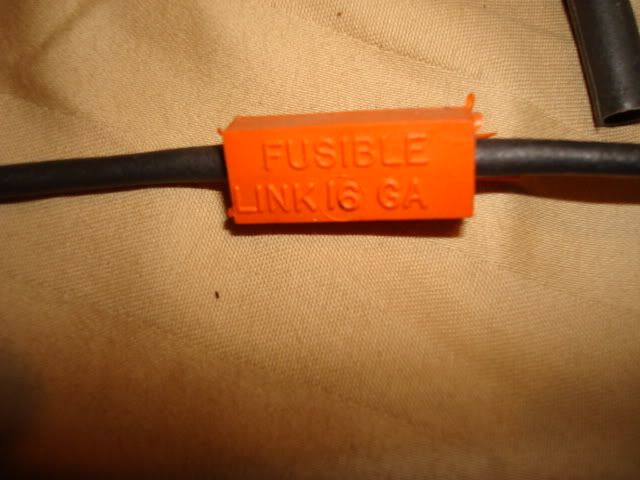
You blew the fusible link. The fusible link is what smoked, not the starter solenoid. The fusible link will need to be replaced.
I might just not be thinking it through enough, but it's not immediately clear why this fusible link would have blown. That tells me there must have been something else about how you hooked it up that you're not mentioning. At any rate, you'll want to give everything a once over. It's also common for a diode in the alternator and the fusible link at the output of the alternator to blow when people do this; you'll want to check those as well.
I might just not be thinking it through enough, but it's not immediately clear why this fusible link would have blown. That tells me there must have been something else about how you hooked it up that you're not mentioning. At any rate, you'll want to give everything a once over. It's also common for a diode in the alternator and the fusible link at the output of the alternator to blow when people do this; you'll want to check those as well.

Lead Driver


Joined: Nov 2006
Posts: 5,217
Likes: 506
From: Pa.
You do plan on replacing the fusible link, right?

Cargo Master
Joined: Apr 2009
Posts: 3,038
Likes: 4
From: South west Idaho

I don't want to start any 'heated discussions ' but how did we keep all of the old vehicles from catching on fire before that fusible link was installed ? I have a 64 falcon i bought new and i haven't seen one on it . Then there's the 56 ford passenger car i have had for 30 years and none on it . They have had shorts in the wiring in the past but never caught on fire yet. Just an inquiry , i am not disputing they don't need it.__
__________________________________________________ ______________________________________
P.S. would there be any benefit to my cars if i added in a 16 ga. fuse link ? I'm always for doing some thing that helps my cars, even if i do like them original.
__________________________________________________ _______________________________________
__________________________________________________ ______________________________________
P.S. would there be any benefit to my cars if i added in a 16 ga. fuse link ? I'm always for doing some thing that helps my cars, even if i do like them original.
__________________________________________________ _______________________________________
Last edited by jim collins; Mar 17, 2013 at 10:49 AM. Reason: added more
Trending Topics
Lead Driver
Joined: Nov 2006
Posts: 5,217
Likes: 506
From: Pa.
I don't want to start any 'heated discussions ' but how did we keep all of the old vehicles from catching on fire before that fusible link was installed ? I have a 64 falcon i bought new and i haven't seen one on it . Then there's the 56 ford passenger car i have had for 30 years and none on it . They have had shorts in the wiring in the past but never caught on fire yet. Just an inquiry , i am not disputing they don't need it.__
__________________________________________________ ______________________________________
P.S. would there be any benefit to my cars if i added in a 16 ga. fuse link ? I'm always for doing some thing that helps my cars, even if i do like them original.
__________________________________________________ _______________________________________
__________________________________________________ ______________________________________
P.S. would there be any benefit to my cars if i added in a 16 ga. fuse link ? I'm always for doing some thing that helps my cars, even if i do like them original.
__________________________________________________ _______________________________________
FTE Stories
Ford Trucks for Ford Truck Enthusiasts

Top 10 Fords at 2026 Carlisle Ford Nationals
Joe Kucinski
3 Best / 3 Worst Parts of Modern Ford Ownership
Brett Foote
10 Amazing Upgrades That Solve Common Ford Truck Owner Headaches
Pouria Savadkouei
Every 2026 Ford Engine Explained
Brett Foote
10 Ugly Ford Trucks That We Still Kinda Love
Joe Kucinski
10 Things Every Truck Owner NEEDS (2026 Edition)
Michael S. Palmer
Rezvani's Latest Post-Apocalyptic Monster Is a Ford F-150 Raptor Underneath
Verdad Gallardo
Top 10 Most Expensive Ford Trucks Ever Sold on Bring a Trailer
Joe Kucinski
2027 Ford Super Duty Buyer's Guide (Every Model, Engine, & Package)
Brett Foote
MSEE
Joined: Apr 2004
Posts: 10,386
Likes: 35
From: Austin, TX
Fusible links are really only meant to protect the heavy-gauge wire into and out of the ignition switch. They cannot protect against common forms of user error, such as wrapping blown fuses in tin foil. For example, smaller 18-gauge and 16-gauge wiring can short and get so hot that the insulation melts right off, and the fusible link will be none the wiser. Current that makes 18-gauge wire smoke may be tolerable for 10-gauge wire. In summary, the scope of a fusible link's protection is fairly limited, although I feel they are absolutely necessary. You do not want 10-gauge wiring getting so hot that it melts its insulation. That's an electrical fire waiting to happen.
To Jim's point, early vehicles had little circuit protection. Even in this generation of trucks, the circuit protection is rather rudimentary. There are actually a lot of unprotected circuits that people don't realize. Circuit protection has also come along way; even if you compare a '73 fuse panel to a '79 fuse panel, you will see a lot of differences.
To answer Jim's question directly: they didn't protect them. At the end of the day, though, 95% of wiring fires are caused by operator error: wrapping fuses in tin foil, working on the charging system without disconnecting the battery, adding loads to the ignition system, and "custom" wiring. The reality of it is, if you leave the electrical system alone, there will almost never be any sort of catastrophic issue. Fuses and fusible links are meant to protect against events that are out of the driver's control.
To Jim's point, early vehicles had little circuit protection. Even in this generation of trucks, the circuit protection is rather rudimentary. There are actually a lot of unprotected circuits that people don't realize. Circuit protection has also come along way; even if you compare a '73 fuse panel to a '79 fuse panel, you will see a lot of differences.
To answer Jim's question directly: they didn't protect them. At the end of the day, though, 95% of wiring fires are caused by operator error: wrapping fuses in tin foil, working on the charging system without disconnecting the battery, adding loads to the ignition system, and "custom" wiring. The reality of it is, if you leave the electrical system alone, there will almost never be any sort of catastrophic issue. Fuses and fusible links are meant to protect against events that are out of the driver's control.
Cargo Master
Joined: Apr 2009
Posts: 3,038
Likes: 4
From: South west Idaho
If you like to do rewiring and potentially a great deal of wiring then leave your entire wiring harness unprotected by a fusible link .. The conditions that caused the fusible link to burn if repeated without it can cause the same thing to happen to your wiring harness down stream when the ignition is on .. smaller gauge wires and electrical devices (not fuse protected) will be the first to go and the potential for real fire is there .. It's your call 
You missed the point of my question. I have not been messing around with the wiring ,using tin foil ect. I was just asking about the original wiring that ford put in and is there a benefit if i added in a fuse link. You should read these questions closer before you answer back. Big grin was not needed ,
 .
.
MSEE
Joined: Apr 2004
Posts: 10,386
Likes: 35
From: Austin, TX
I think there's definitely a benefit; personally I would not feel comfortable having a vehicle sitting in my garage that didn't have some sort of protection in front of the heavy-gauge wiring.
However, I have a long list of "should do's" that I'm not getting done anytime soon; I also don't like changing things that would otherwise be original. And fixing something that isn't already broken always seems to bring bad luck...you know the saying, "no good deed goes unpunished."
But strictly speaking, yes, there is a benefit in adding an extra layer of protection if not there already. The rule of thumb is that a fusible link should be sized two gauges below the wiring it protects. For example, 10-gauge wiring would need a 14-gauge fusible link up front.
However, I have a long list of "should do's" that I'm not getting done anytime soon; I also don't like changing things that would otherwise be original. And fixing something that isn't already broken always seems to bring bad luck...you know the saying, "no good deed goes unpunished."
But strictly speaking, yes, there is a benefit in adding an extra layer of protection if not there already. The rule of thumb is that a fusible link should be sized two gauges below the wiring it protects. For example, 10-gauge wiring would need a 14-gauge fusible link up front.
Cargo Master
Joined: Apr 2009
Posts: 3,038
Likes: 4
From: South west Idaho
I think there's definitely a benefit; personally I would not feel comfortable having a vehicle sitting in my garage that didn't have some sort of protection in front of the heavy-gauge wiring.
However, I have a long list of "should do's" that I'm not getting done anytime soon; I also don't like changing things that would otherwise be original. And fixing something that isn't already broken always seems to bring bad luck...you know the saying, "no good deed goes unpunished."
But strictly speaking, yes, there is a benefit in adding an extra layer of protection if not there already. The rule of thumb is that a fusible link should be sized two gauges below the wiring it protects. For example, 10-gauge wiring would need a 14-gauge fusible link up front.
However, I have a long list of "should do's" that I'm not getting done anytime soon; I also don't like changing things that would otherwise be original. And fixing something that isn't already broken always seems to bring bad luck...you know the saying, "no good deed goes unpunished."
But strictly speaking, yes, there is a benefit in adding an extra layer of protection if not there already. The rule of thumb is that a fusible link should be sized two gauges below the wiring it protects. For example, 10-gauge wiring would need a 14-gauge fusible link up front.
 Yeah they both have the same solenoid as my 73 truck but the wire coming of of the truck solenoid has the fuse link and the one for the cars don't . Wiring after the fuse link is the same gauge as the one coming off for the cars . I think i can add it in and not hurt the value of the classic cars and it would be easy to change back if some body later never wanted it. The 56 i put all new original harness in it about 15 years ago due to the old one being patched up to much before i got it. Thanks for the information, since this is a truck forum I'm not going to hijack it any more .
Lead Driver
Joined: Nov 2006
Posts: 5,217
Likes: 506
From: Pa.
You missed the point of my question. I have not been messing around with the wiring ,using tin foil ect. I was just asking about the original wiring that ford put in and is there a benefit if i added in a fuse link. You should read these questions closer before you answer back. Big grin was not needed , .
." removed .. I believe I answered your question and left it up to you to determine from my answer whether it was of benefit to your situation .. Seriously the last thing I want is for you to feel disrespected in any way .. I'm sorry if it came across that way because it was not my intention ..
Cargo Master
Joined: Apr 2009
Posts: 3,038
Likes: 4
From: South west Idaho
Ok Jim "" removed .. I believe I answered your question and left it up to you to determine from my answer whether it was of benefit to your situation .. Seriously the last thing I want is for you to feel disrespected in any way .. I'm sorry if it came across that way because it was not my intention ..
" removed .. I believe I answered your question and left it up to you to determine from my answer whether it was of benefit to your situation .. Seriously the last thing I want is for you to feel disrespected in any way .. I'm sorry if it came across that way because it was not my intention .._Okay, we can let it go. I may be a newbe working on this old stuff but i don't think so since i started in about 1957 , __. I was concerned about doing some thing to my classic cars that would hurt there value.__
Lead Driver
Joined: Nov 2006
Posts: 5,217
Likes: 506
From: Pa.
What hurts their value but on a scale of 1 to 10 fun factor = 10
