


What shuts off the engine?

Laughing Gas
Joined: Mar 2010
Posts: 1,028
Likes: 5
From: San Francisco East Bay
Replacing the entire wiring harness is something I've done (for industrial instrumentation), but only on rare occasions (such as major upgrades).
Bringing back failed parts of an automotive system is best done with a modular approach. Replacing the entire harness may clear an undiagnosed fault (or several faults), but it may also introduce a host of new problems.
I recall one old truck that had suffered two engine fires. The owner was a Deadhead and had been following the band around on tour. When I met him in 1987, the cab was entirely burned out, no upholstry (the bench seat was bare springs), no headliner, no instrument panel, etc. He was still driving it, and had replaced the wiring a little at a time, in order to do the minimum neccessary to get it running. That truck was a good candidate for a new wiring harness, but he couldn't afford it. Interesting to note that when I met him again later, he told me he hadn't been able to get a shop to work on it in California because there was no way to write the odometer reading on their paperwork -- there was no odometer!
One of my big complaints is that electrical schematics show how the systems interconnect, but they don't show where the wires run... and the converse is also true, the cabling diagrams may show where the wires run, but don't show what systems are being interconnected. Even if you have both, there's something lost in the translation between one and the other.

Hotshot


Joined: Mar 2013
Posts: 14,255
Likes: 199
From: Phoenix, Az.
[quote=Thipdar;14067681]There's almost always a logical approach to diagnosing and repairing electrical faults.
Bringing back failed parts of an automotive system is best done with a modular approach. Replacing the entire harness may clear an undiagnosed fault (or several faults), but it may also introduce a host of new problems.
/quote]
2 X Thipdar
1st. If it's not logical it's USUALLY a ground problem.
2nd. While I am not affraid of electrical issues, I would want a clean start before I were to do a major fix like a complete harness. All problems already diagnosed. In my best Charles Emmerson Winchester III voice........I solve a problem, do it very well, then move on.

Bringing back failed parts of an automotive system is best done with a modular approach. Replacing the entire harness may clear an undiagnosed fault (or several faults), but it may also introduce a host of new problems.
/quote]
2 X Thipdar
1st. If it's not logical it's USUALLY a ground problem.
2nd. While I am not affraid of electrical issues, I would want a clean start before I were to do a major fix like a complete harness. All problems already diagnosed. In my best Charles Emmerson Winchester III voice........I solve a problem, do it very well, then move on.
Thread Starter
|
Senior User
Joined: Dec 2007
Posts: 178
Likes: 0
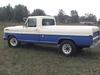
Some of the highlights of this truck besides the Cadillac steering column.
The title and the fenders say F100, the frame and running gear are heavy duty F250 including the "bigger brakes" offered at the time.
It has a 460 engine, those were not put in trucks until '75 (I think). I also don't think the engine is stock.
It has intermittent wipers (not available untill 1978 I think. Aftermarket under dash air conditioning that matches the contour of the Dash.
The title and the fenders say F100, the frame and running gear are heavy duty F250 including the "bigger brakes" offered at the time.
It has a 460 engine, those were not put in trucks until '75 (I think). I also don't think the engine is stock.
It has intermittent wipers (not available untill 1978 I think. Aftermarket under dash air conditioning that matches the contour of the Dash.
Laughing Gas
Joined: Mar 2010
Posts: 1,028
Likes: 5
From: San Francisco East Bay
Is it possible that you got a F-100 Camper Special? That could explain why you got some of the "heavy duty" parts on it.
Thread Starter
|
Senior User
Joined: Dec 2007
Posts: 178
Likes: 0
The Vin is F100. It has 8 lug wheels and the wider brake drums. It has the toolbox in the passenger side bed side. It has 6 leaves in the rear springs, I don't know what the half ton has.
Laughing Gas
Joined: Mar 2010
Posts: 1,028
Likes: 5
From: San Francisco East Bay
I bet you have the large capacity radiator as well.
These are all indicators that you've got a Camper Special.
The 8-lug hubs, now... I thought that wasn't available on the F-100.
One possibility is that a PO had an F-250 Camper Special and wrecked it, then brought it back to life with parts donated from an F-100 (including swapping out the driver's side door and VIN plate).
Thread Starter
|
Senior User
Joined: Dec 2007
Posts: 178
Likes: 0
Does your power steering pump have a U-shaped tube with cooling fins on it?
I bet you have the large capacity radiator as well.
These are all indicators that you've got a Camper Special.
The 8-lug hubs, now... I thought that wasn't available on the F-100.
One possibility is that a PO had an F-250 Camper Special and wrecked it, then brought it back to life with parts donated from an F-100 (including swapping out the driver's side door and VIN plate).
I bet you have the large capacity radiator as well.
These are all indicators that you've got a Camper Special.
The 8-lug hubs, now... I thought that wasn't available on the F-100.
One possibility is that a PO had an F-250 Camper Special and wrecked it, then brought it back to life with parts donated from an F-100 (including swapping out the driver's side door and VIN plate).
I think this truck was built out of a couple others. I seems to me they built to be what they wanted rather than original.
In addition to the things I already mentioned, it had a 75 gallon saddle tank mounted in the bed and plumbed into the fuel system. An aftermarket 3 bucket style seat (uncomfortable as hell). A J.C. Penny cruise control/monitoring system called a "Travel Data 44".
The air conditioning system hoses use radiator type clamps to hold them on the fittings. It works well but I can't keep Freon in it for more than a week.
Laughing Gas
Joined: Mar 2010
Posts: 1,028
Likes: 5
From: San Francisco East Bay
It has the power steering cooler, and the big radiator.
I think this truck was built out of a couple others. I seems to me they built to be what they wanted rather than original.
In addition to the things I already mentioned, it had a 75 gallon saddle tank mounted in the bed and plumbed into the fuel system.
I think this truck was built out of a couple others. I seems to me they built to be what they wanted rather than original.
In addition to the things I already mentioned, it had a 75 gallon saddle tank mounted in the bed and plumbed into the fuel system.
The more I hear about your truck, the more I believe it was an F-250 Camper Special that got into a wreck & was brought back to life with parts from an F-100 donor truck.
FTE Stories
Ford Trucks for Ford Truck Enthusiasts

2027 Ford Super Duty Buyer's Guide (Every Model, Engine, & Package)
Brett Foote
Top 10 Ford Truck Tragedies
Joe Kucinski
AEV FXL Super Duty - the Super Duty Raptor Ford Doesn't Make
Brett Foote
Lobo Vs Lobo: Proof the F-150 Lobo Should Be Even Lower!
Michael S. Palmer
Ford's 2001 Explorer Sportsman Concept Looks For a New Home
Verdad Gallardo
10 Best Ford Truck Engines We Miss the Most!
Joe Kucinski
2026 Shelby F-150 Off-Road: Better Than a Raptor R?
Brett Foote
2027 Super Duty Carhartt Package First Look: 12 Things You NEED to Know!
Michael S. Palmer
10 Most Surprising 2026 Ford Truck Features!
Joe Kucinski
Thread Starter
|
Senior User
Joined: Dec 2007
Posts: 178
Likes: 0
It has a tank under the bed that might be 22 never been able to get more than 16 or 17 into it, the gas gauge only goes up to a little above 3/4s when gas is just about overflowing. I took the big tank out of the bed so I just have the one. I assume it originally had one behind the seat too. If it did they did a good job of closing the hole in the cab side. The filler for the one under the bed is in front of the rear wheel below the bump. Selector valve is still there the tank in the bed was connected to it.
The AC I am not too worried about right now, kinda like blasting down the road with the windows down and the stereo blasting. Sorta reminds me of my youth. In time I will upgrade the compressor and the hoses to make the ac reliable but it isn't a priority now.
I paid $1500 for it on ebay and have been driving it for 6 years now. The problem that started this thread is the first real problem I have had with it. It was a time consuming but inexpensive fix.
It is 2wd so it doesn't go out in the winter much or in the snow at all. With the 460 it just spins in any amount of snow and half the time just on wet pavement.
I have a 40 mile round trip commute to work so it doesn't get driven much during the week, but on weekends between March and November it is all I drive. (Well if it is really hot I will take the car to church on Sunday).
The AC I am not too worried about right now, kinda like blasting down the road with the windows down and the stereo blasting. Sorta reminds me of my youth. In time I will upgrade the compressor and the hoses to make the ac reliable but it isn't a priority now.
I paid $1500 for it on ebay and have been driving it for 6 years now. The problem that started this thread is the first real problem I have had with it. It was a time consuming but inexpensive fix.
It is 2wd so it doesn't go out in the winter much or in the snow at all. With the 460 it just spins in any amount of snow and half the time just on wet pavement.
I have a 40 mile round trip commute to work so it doesn't get driven much during the week, but on weekends between March and November it is all I drive. (Well if it is really hot I will take the car to church on Sunday).

Thread
Thread Starter
Forum
Replies
Last Post
kavman
1980 - 1986 Bullnose F100, F150 & Larger F-Series Trucks
9
Dec 5, 2018 08:01 PM
bradphx
1973 - 1979 F-100 & Larger F-Series Trucks
4
Dec 22, 2016 05:17 PM
SMOKINREK
1980 - 1986 Bullnose F100, F150 & Larger F-Series Trucks
3
Jul 7, 2012 06:56 PM
steve benson
1961 - 1966 F-100 & Larger F-Series Trucks
1
Apr 17, 2006 11:51 AM