




Fuel additive recommendations

Thread Starter
|
New User
Joined: Nov 2011
Posts: 5
Likes: 0
Fuel additive recommendations
Hello all. As I have stated before, I am very novice at this power stroke diesel business and am trying to learn on the fly. I have been reading about the fuel additives and the benefits of them, sounds like a good idea to me. My questions is this, are they all similar or are the some that are good, better, and best and if so, which ones are best and why? I recently purchased a 04 excursion and absolutely love it. I know the 6.0 has some difficulties and am starting to encounter a few. I would just like to do all I can to prolong the life of this family truckster. Any other useful information about routine maintence or other tips would also be greatly appreciated....thanks for any helpful tips.
Laughing Gas

Joined: Feb 2008
Posts: 754
Likes: 2
From: AB,Can
Here's what I run;
Performance Formula - Stanadyne
I notice better throttle response and the truck seems to run a little quieter/smoother when I run it. I try to put it in every second fill-up in the summer and every fillup in the winter. My truck takes about 200ml per full tank or almost a full cup.
Performance Formula - Stanadyne
I notice better throttle response and the truck seems to run a little quieter/smoother when I run it. I try to put it in every second fill-up in the summer and every fillup in the winter. My truck takes about 200ml per full tank or almost a full cup.

Logistics Pro
Joined: Mar 2007
Posts: 4,604
Likes: 4
From: Claremore, OK
The Ford cetane booster is really good stuff, but limited on where you can pick it up...dealership and certain part stores. (the one on the right has anti-gel)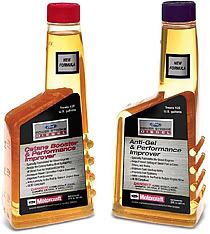
Personally I really like Diesel Kleen's Power Service products. Very easy to find at WM, truck stops, farm & ranch stores and pretty much every part store out there. The grey bottle (cetane booster) is for warm weather (above 40F) and white bottle has anti-gel and is for anything below that.
I tried OptiLube for awhile to see if it would help/make an difference for my truck. Other than smelling horrible, if there was an improvement...it was very little and I'm not convinced it's the best choice. Add to that you have to mail order and isn't widely available...I doubt I'll run that stuff again. Now biodiesel...even though Ford only recommends up to B5 (5% biodiesel, 95% dino diesel blended) I can assure you the 6.0L will burn B50 with no issue and minimal power loss (I lost about 0.5 mpg when burning it); you more than likely won't feel it in the seat of your pants. If you can get B2 to B5 locally, that's what I'd burn through the truck. The lubrication value is there for the fuel system; and some fuel lubrication studies ranked B2 up there among the best additives for diesel engines on ULSD. One of the other downsides to burning biodiesel...especially if your truck has allot of miles on it (over 100k miles), you may clog fuel filters since the biodiesel has been known to clean out fuel systems. I've never had an issue with clogged filters and I've been using B20 off & on for the last 5 years.
Personally I really like Diesel Kleen's Power Service products. Very easy to find at WM, truck stops, farm & ranch stores and pretty much every part store out there. The grey bottle (cetane booster) is for warm weather (above 40F) and white bottle has anti-gel and is for anything below that.
I tried OptiLube for awhile to see if it would help/make an difference for my truck. Other than smelling horrible, if there was an improvement...it was very little and I'm not convinced it's the best choice. Add to that you have to mail order and isn't widely available...I doubt I'll run that stuff again. Now biodiesel...even though Ford only recommends up to B5 (5% biodiesel, 95% dino diesel blended) I can assure you the 6.0L will burn B50 with no issue and minimal power loss (I lost about 0.5 mpg when burning it); you more than likely won't feel it in the seat of your pants. If you can get B2 to B5 locally, that's what I'd burn through the truck. The lubrication value is there for the fuel system; and some fuel lubrication studies ranked B2 up there among the best additives for diesel engines on ULSD. One of the other downsides to burning biodiesel...especially if your truck has allot of miles on it (over 100k miles), you may clog fuel filters since the biodiesel has been known to clean out fuel systems. I've never had an issue with clogged filters and I've been using B20 off & on for the last 5 years.

Posting Guru

Joined: May 2003
Posts: 1,990
Likes: 1
From: Middleburg, FL

It depends on what you're looking for. If you're looking for mainly a cetane boost, then Power Service or Ford's Cetane boost are good choices. If you're looking for lubricity improvement, Bio-Diesel is the best followed closely by Optilube (based on studies). I would recommend at minimum a cetane boost since most ULSD coming out of the pump doesn't meet the min cetane rating for the 6.0 and the better the cetane the better a diesel engine performs (up to a point). I've used Power Service and had no complaints. I've been using opti lube for several years as lubricity is my bigger concern (I can't get bio-diesel in my area). Yes, opti lube is harder to get and more expensive. But they're manageable. I look at it as insurance and I've got 125k on my original injectors.

Posting Guru
Joined: Nov 2008
Posts: 1,458
Likes: 2
From: CA Sacramento
What would be better?
1. Diesel kleen white with .5 oz per gallon of 2-stroke?
2. Or optilube XDP or opti winter blend?
1. Diesel kleen white with .5 oz per gallon of 2-stroke?
2. Or optilube XDP or opti winter blend?
Trending Topics

Laughing Gas


Joined: Mar 2012
Posts: 1,052
Likes: 28
From: Portal, AZ

I have seen better miliage with the ford stuff, but better performance with the stanadyne. Over the diesel kleen. I am in the desert in cali so an anti gel solution isn't really one of my concerns.
FTE Stories
Ford Trucks for Ford Truck Enthusiasts

Top 10 Fords at 2026 Carlisle Ford Nationals
Joe Kucinski
3 Best / 3 Worst Parts of Modern Ford Ownership
Brett Foote
10 Amazing Upgrades That Solve Common Ford Truck Owner Headaches
Pouria Savadkouei
Every 2026 Ford Engine Explained
Brett Foote
10 Ugly Ford Trucks That We Still Kinda Love
Joe Kucinski
10 Things Every Truck Owner NEEDS (2026 Edition)
Michael S. Palmer
Rezvani's Latest Post-Apocalyptic Monster Is a Ford F-150 Raptor Underneath
Verdad Gallardo
Top 10 Most Expensive Ford Trucks Ever Sold on Bring a Trailer
Joe Kucinski
2027 Ford Super Duty Buyer's Guide (Every Model, Engine, & Package)
Brett Foote
Logistics Pro
Joined: Mar 2007
Posts: 4,604
Likes: 4
From: Claremore, OK
To get back to the question...
Warm weather (above 40F) Grey bottle DK or Ford's Cetane booster if B5 isn't available.
Cool weather (below 40F) white bottle DK or Ford's Anti-gel are about as good as it's going to get IMO.
Last summer I tried running DK grey (12oz) with OptiLube (2oz) to see what effects that would have on the fuel mileage. It was the same if I was burning just DK grey at the same measured amount. I realize this started as strictly an additives thread...but improving the lubcrity of the fuel means there is more "oil" in the fuel. Something a diesel engine's fuel system needs. And with fuel going for $4 a gallon, an oilier fuel can also improve the mileage of any diesel engine.
Logistics Pro
Joined: Mar 2007
Posts: 4,604
Likes: 4
From: Claremore, OK
This is how I look at it, using anti-gel year around is sort of like plugging the block heater in on a 90F day. Yeah, the engine is up to operating temperature faster...but why waste the electricity? Again, it won't harm anything...but why do it?

Senior User
Joined: Dec 2003
Posts: 410
Likes: 0
None. My previous employer budgeted $1.5 million annually for diesel. All of those trucks, tractors, combines and sprayers had two things in common last year: No fuel additives and no fuel-related injection issues. One company offered to "treat" and "test" the fuel monthly for $30k per year. But at that rate, it was cheaper to fix whatever went wrong. And nothing went wrong. So, contrary to previous posts, I recommend that you save your money. An additive will not save you from bad fuel. And if you do not have bad fuel, you do not need an additive.
And by the way: News flash. Fuel does not jell at 39 degrees. If you do not know when it jells, you do not need to worry about it unless you are traveling north sometime after Dec 1 with untreated diesel. I have had tractors jell with straight #2 during a Minnesota winter- but never with a winter blend and never in a PSD with any kind of fuel. -Mike
And by the way: News flash. Fuel does not jell at 39 degrees. If you do not know when it jells, you do not need to worry about it unless you are traveling north sometime after Dec 1 with untreated diesel. I have had tractors jell with straight #2 during a Minnesota winter- but never with a winter blend and never in a PSD with any kind of fuel. -Mike
Logistics Pro
Joined: Mar 2007
Posts: 4,604
Likes: 4
From: Claremore, OK
And by the way: News flash. Fuel does not jell at 39 degrees. If you do not know when it jells, you do not need to worry about it unless you are traveling north sometime after Dec 1 with untreated diesel. I have had tractors jell with straight #2 during a Minnesota winter- but never with a winter blend and never in a PSD with any kind of fuel.
And another news flash, you don't have to wait until after the 1st of December to worry about gelling fuel, cold fronts do move south before then.



Lead Driver
Joined: Feb 2011
Posts: 8,241
Likes: 155
From: L.A. (Lower Alabama)
None. My previous employer budgeted $1.5 million annually for diesel. All of those trucks, tractors, combines and sprayers had two things in common last year: No fuel additives and no fuel-related injection issues. One company offered to "treat" and "test" the fuel monthly for $30k per year. But at that rate, it was cheaper to fix whatever went wrong. And nothing went wrong. So, contrary to previous posts, I recommend that you save your money. An additive will not save you from bad fuel. And if you do not have bad fuel, you do not need an additive.
..............
..............
The fuel pumps in my area say the fuel is ULSD designed for 2007 and later vehicles. My truck is an '06 so it would appear it was designed for higher sulphur fuel? You guys think that makes much of a difference?