


BODYWORK, RUST, WELDING??????

Thread Starter
|
Senior User
Joined: May 2010
Posts: 280
Likes: 0
From: ROCKVILLE, CT.
 BODYWORK, RUST, WELDING??????
I finally decided to get serious this past weekend on my prep to get my girl painted before the snow flies. I started on my driver side rear be panel from the wheel well to the tail light/bumper area. The previous owner had primered the area. I think to cover up the start of what I am finding .
.
First, the panel is solid overall from what I can feel and hear and there is no bondo work on her ( truck is from Nevada ). What I have found so far is not swiss cheese by any stretch but it is something I want to " nip in the bud " as they say.
I started by wire wheeling down obvious " rust pimples " that were showing through the primered areas and taking the area down to bare metal where holes started appearing. The lip area of the fender wells appear very solid ( feel / sound ). There is no bondo anywhere that I can tell and I can see the whole area inside and out from tail light/bumper to front of bed panel. I basically found about a dozen holes ranging in size from 3 mm - 2cm x 1cm ( in bottom area at end of bed panel and over wheel well ).
The **** part of me says to take the whole panel down to bare metal ( where there's smoke there's fire ) but the frugal part of me says to go with my original plan and just clean inner surfaces and use the rust bullet and then just sand down and proceed with dealing with any obvious rust spots which show with rough prep sanding.
Should I take it down to bare metal where the likely rust out places are or will I be safe by going with my plan? ie., will the rust bullet halt progression of existing spots not yet showing as pimples?
Second question.
Looking at these holes I was wondering if theree is a welding technique that is used to " fill " spots like this? Considering how solid the panels appear to be and the closest hole to the wheel well lip is about an inch above it I really don't want to go with sheet metal replacement. I also don't want to use bondo.
I know that back in the day they used a process called " leading "? but I only have heard the term. I don't know the process but I am led to believe it is a process of filling the holes with metal?
Since I know next to zip about metal work I thought maybe using a heavy gauge sheet metal as a backing and then filling using a welding process?
.First, the panel is solid overall from what I can feel and hear and there is no bondo work on her ( truck is from Nevada ). What I have found so far is not swiss cheese by any stretch but it is something I want to " nip in the bud " as they say.
I started by wire wheeling down obvious " rust pimples " that were showing through the primered areas and taking the area down to bare metal where holes started appearing. The lip area of the fender wells appear very solid ( feel / sound ). There is no bondo anywhere that I can tell and I can see the whole area inside and out from tail light/bumper to front of bed panel. I basically found about a dozen holes ranging in size from 3 mm - 2cm x 1cm ( in bottom area at end of bed panel and over wheel well ).
The **** part of me says to take the whole panel down to bare metal ( where there's smoke there's fire ) but the frugal part of me says to go with my original plan and just clean inner surfaces and use the rust bullet and then just sand down and proceed with dealing with any obvious rust spots which show with rough prep sanding.
Should I take it down to bare metal where the likely rust out places are or will I be safe by going with my plan? ie., will the rust bullet halt progression of existing spots not yet showing as pimples?
Second question.
Looking at these holes I was wondering if theree is a welding technique that is used to " fill " spots like this? Considering how solid the panels appear to be and the closest hole to the wheel well lip is about an inch above it I really don't want to go with sheet metal replacement. I also don't want to use bondo.
I know that back in the day they used a process called " leading "? but I only have heard the term. I don't know the process but I am led to believe it is a process of filling the holes with metal?
Since I know next to zip about metal work I thought maybe using a heavy gauge sheet metal as a backing and then filling using a welding process?

Cranky Old Guy
Joined: Mar 2008
Posts: 3,562
Likes: 6
From: Raphine, Virginia
Holes as in drilled or as in rust thru? Rust thru needs cut out and replaced. Holes from trim etc, can be welded shut by using a copper/aluminum backing plate. The weld won't stick to them.
Thread Starter
|
Senior User
Joined: May 2010
Posts: 280
Likes: 0
From: ROCKVILLE, CT.
Is this what is termed old school " leading "? Or actual welding? I looked up leading and couldn't find too much. What I did find sounds like it was used to fill small dents which couldn't be worked out with a hammer and dolly and it sounds as if it actually is a soldering process using the same materials used for soldering pipes.
Thread Starter
|
Senior User
Joined: May 2010
Posts: 280
Likes: 0
From: ROCKVILLE, CT.
WELDING TECHNIQUE
What's the largest hole size recommended for using the fill in technique with welding?
I'm guessing that the largest one I have will probably be about a square inch once I take away all the compromised metal.
I'm guessing that the largest one I have will probably be about a square inch once I take away all the compromised metal.

Tuned


Joined: Aug 2007
Posts: 459
Likes: 123
From: Maryland
Trending Topics
Cargo Master
Joined: Apr 2010
Posts: 2,936
Likes: 9
From: Acworth, GA
First off I want to say that I am not wanting to hijack this thread, only gain more knowledge in this type of repair.
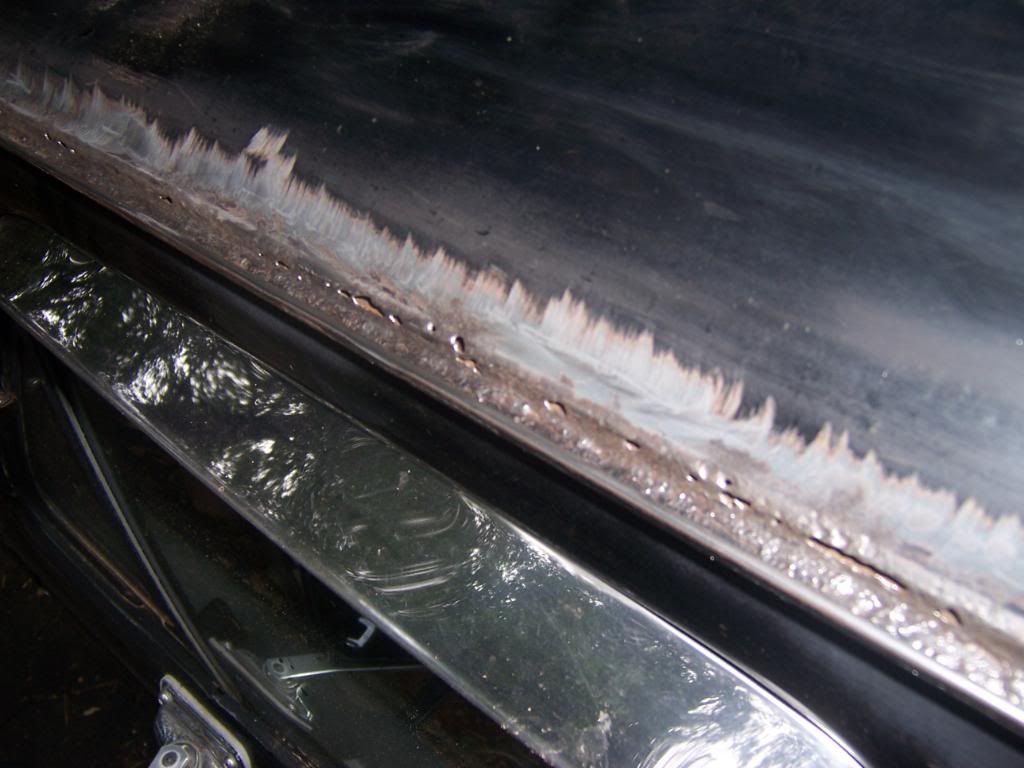
What about holes like this? I would like to just fill in the holes, as cutting and patching is not something that I have done before. I would not be adverse to learning how, if I had someone to walk me through it so that I could do it the correct way.
FTE Stories
Ford Trucks for Ford Truck Enthusiasts

3 Best / 3 Worst Parts of Modern Ford Ownership
Brett Foote
10 Amazing Upgrades That Solve Common Ford Truck Owner Headaches
Pouria Savadkouei
Every 2026 Ford Engine Explained
Brett Foote
10 Ugly Ford Trucks That We Still Kinda Love
Joe Kucinski
10 Things Every Truck Owner NEEDS (2026 Edition)
Michael S. Palmer
Rezvani's Latest Post-Apocalyptic Monster Is a Ford F-150 Raptor Underneath
Verdad Gallardo
Top 10 Most Expensive Ford Trucks Ever Sold on Bring a Trailer
Joe Kucinski
2027 Ford Super Duty Buyer's Guide (Every Model, Engine, & Package)
Brett Foote
Top 10 Ford Truck Tragedies
Joe Kucinski
Thread
Thread Starter
Forum
Replies
Last Post
AXracer
1948 - 1956 F1, F100 & Larger F-Series Trucks
109
Aug 21, 2020 02:41 PM
pi653
1987 - 1996 F150 & Larger F-Series Trucks
20
Jun 7, 2019 05:04 AM
EAK69
1948 - 1956 F1, F100 & Larger F-Series Trucks
5
Sep 17, 2016 02:46 PM
Superman_ManOfSteel
1978 - 1996 Big Bronco
6
Apr 14, 2004 12:04 AM
