


EEC interchange

Thread Starter
|
Junior User
Joined: Dec 2009
Posts: 58
Likes: 0
From: western Kentucky
EEC interchange
I have a 1988 F250, srw 460 efi with a ZF5 speed 4x4 . I bought this truck with a bad engine. I replaced the engine with another 460 from a 1994 F250 (everything the same as my truck, srw ZF5 speed 4x4) Well after the motor install I realize my truck also has a bad ecu so I call up the man I bought the engine from and he gives me the ecu from the same truck I got the engine out of. Install his ecu in my truck and everything works great. (before installing the ecu I did compare the ecu wiring schematics of both the 88 and 94, they were identical) That was over a year ago.
Now to the point. I am needing another ecu for this truck as the one from the 94 has developed the never ending fuel pump prime. When the truck does finally start it runs ok then will just run very rough and dumps fuel out the exhaust. This goes on for a bit then will clear up. My question is this, is there any difference between the 88 and 94 ecu? I know in 92 the 460 got some improvements that upped the power a little and I do not know if the later ecu's have any improvements that complimented the upped horsepower. The reason I ask this is the 94 ecu is about $140 more than the 88. I have no problems spending the extra cash if the 94 ecu is indeed better suited for the later engine, but if not I could save a lot of money. Thank you all for any help.
Steve
Now to the point. I am needing another ecu for this truck as the one from the 94 has developed the never ending fuel pump prime. When the truck does finally start it runs ok then will just run very rough and dumps fuel out the exhaust. This goes on for a bit then will clear up. My question is this, is there any difference between the 88 and 94 ecu? I know in 92 the 460 got some improvements that upped the power a little and I do not know if the later ecu's have any improvements that complimented the upped horsepower. The reason I ask this is the 94 ecu is about $140 more than the 88. I have no problems spending the extra cash if the 94 ecu is indeed better suited for the later engine, but if not I could save a lot of money. Thank you all for any help.
Steve

Post Fiend
Joined: Oct 2003
Posts: 6,214
Likes: 13
From: New Jersey
Before you dump the ECU do note if the fuel pump stays on continuously the fuel pressure regulator at the end of the U-shaped fuel rail should relieve the pressure by allowing excess fuel to escape back into the tank - thus at all times, the injectors have the right pressure and can inject the right amount of fuel for a given RPM/load.
I'm suggesting this because you might have more than one problem here.
The later ECU's for the 5.8L and the 7.5L do have better timing curves in my opinion for towing, accelerating, and so on. My 93 F350 crewcab (5.8L) has a 94 E350 Ambulance EEC in it - and the timing curve is far more aggressive. Pepped up the very tired engine quite noticably. I know this is true for the 460's as well - I've played with those as well - at least comparing 92 and 94, manual trans, 7.5L EEC's.
I would go hunting in a junkyard, maybe use a junkyard part locater service (most junkyards have this), or even ebay because I myself have never spent more than $75 on an EEC and most of them I've bought over the years for experimentation I've paid far, far, less.
Also, your fuel pump might be stuck on because of a shorted relay. As you know that would be a $5 fix. It's at least worth checking out ;-)
I'm suggesting this because you might have more than one problem here.
The later ECU's for the 5.8L and the 7.5L do have better timing curves in my opinion for towing, accelerating, and so on. My 93 F350 crewcab (5.8L) has a 94 E350 Ambulance EEC in it - and the timing curve is far more aggressive. Pepped up the very tired engine quite noticably. I know this is true for the 460's as well - I've played with those as well - at least comparing 92 and 94, manual trans, 7.5L EEC's.
I would go hunting in a junkyard, maybe use a junkyard part locater service (most junkyards have this), or even ebay because I myself have never spent more than $75 on an EEC and most of them I've bought over the years for experimentation I've paid far, far, less.
Also, your fuel pump might be stuck on because of a shorted relay. As you know that would be a $5 fix. It's at least worth checking out ;-)
Thread Starter
|
Junior User
Joined: Dec 2009
Posts: 58
Likes: 0
From: western Kentucky
Frederic,
Thanks for the quick reply. I understand what you are talking about, but the ecu does have any clue what the fuel pressure is. It is programed to prime the fuel pump for 1sec when the key is first turned to run, then shut off untill a signal from the tfi is recieved. My problem is when the key is turned to run the fuel pump will prime anywhere from 45 sec to 30 minutes. While the pump is priming, if you try to crank the motor over there is no spark and thus the truck will not start. Once the ecu is done with it's fuel pump prime, the truck will start. You also can not check any eec codes untill the pump is done priming. I have seen this several times on the Ford trucks and all diagnosis lead to the EEC being replaced and problems solved. I am hoping someone here may know what if any difference there is between the 88 EEC and the 94 EEC. Both are readily available but the 88 EEC is $96 and the 94 EEC is $246.
Thanks for the quick reply. I understand what you are talking about, but the ecu does have any clue what the fuel pressure is. It is programed to prime the fuel pump for 1sec when the key is first turned to run, then shut off untill a signal from the tfi is recieved. My problem is when the key is turned to run the fuel pump will prime anywhere from 45 sec to 30 minutes. While the pump is priming, if you try to crank the motor over there is no spark and thus the truck will not start. Once the ecu is done with it's fuel pump prime, the truck will start. You also can not check any eec codes untill the pump is done priming. I have seen this several times on the Ford trucks and all diagnosis lead to the EEC being replaced and problems solved. I am hoping someone here may know what if any difference there is between the 88 EEC and the 94 EEC. Both are readily available but the 88 EEC is $96 and the 94 EEC is $246.
Elder User
Joined: Feb 2008
Posts: 797
Likes: 1
From: ohio
Eec or fuel relays stuck? Wiring in the connectors at the relays tight and clean? If when you hook the battery up and you hear the pump prime,check the eec relay wire,especially the red wire that runs to a fusable link. I had issues with my battery goin dead randomly,and then a no start. I found a po put a drywall screw in for better connection
Post Fiend
Joined: Oct 2003
Posts: 6,214
Likes: 13
From: New Jersey
The EEC's assume the fuel pressure to be 42psi or 45psi, but I forget which.
Whatever the actual figure it, must be maintained by the fuel pressure regulator at all times. You're might be stuck open or closed, which will make strange pressures which the EEC is not aware of, except that if too much or too little fuel goes into the engine the o2 sensor will determine that off the exhaust, and try to adust accordingly as it does with every exhaust pulse.
Under certain situations, the EEC cannot compensate enough and you can get some really strange results, even if the vehicle is driveable.
What I would do first, before replacing anything expensive, is test the relays - it's very simple to do.
If you flip them over, there are four numbers on them and they are wired like so:
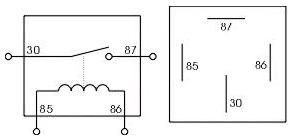
Attach an ohm meter (or a continuity tester) to terminals 87 and 30. The meter should register infinity.
Apply 12V to pins 85 and 86 and the relay should "click" and the ohm meter should now display 0 ohms.
Remove 12V from 85 and 86 and the relay should "click" again and the ohm meter should now display infinity.
If the above doesn't happen, the relay is bad and should be replaced.
The relays in question are located on the driver's side fender in a plastic box labeled "EEC Relays". One is for the EEC itself, one is for the fuel pump. Test them both if you're not sure which is which.
What you described is often attributed to a bad EEC and the reason for that is the MOSFET transistor that drive's the fuel pump relay has a bad capacitor behind it leaking voltage into the signal of the transistor which in turn keeps it on longer than the computer tells it to.
However, the same problem is not always caused by the EEC and sometimes a sticking relay is the problem, and I think you'd agree finding that out might be worth the 10 minutes of effort because a $5 relay is far cheaper than a $200 ECM
The 94 EEC is a better choice over the 88 for the timing curve is more aggressive and that peps up the engine a bit under most normal, every day circumstances as well as while under load (towing, hauling, stump pulling, etc).
I noticed on my 5.8L F350 crewcab changing the 93 EEC to a 94 EEC not only had more aggressive timing, but it was good for about 1/2 mile per gallon on average as well - and that's been pretty consistent too.
Doesn't sound like much but when you're driving something that gets 13 mpg like my crewcab, 13.5 is a 4% increase which is a 4% reduction in fuel costs.
4% over an annual 25K of driving is 1000 free miles.
That's the layman's difference that I see. I imagine if someone took the time to reverse engineer the data tables and code inside, they would be very different.
Whatever the actual figure it, must be maintained by the fuel pressure regulator at all times. You're might be stuck open or closed, which will make strange pressures which the EEC is not aware of, except that if too much or too little fuel goes into the engine the o2 sensor will determine that off the exhaust, and try to adust accordingly as it does with every exhaust pulse.
Under certain situations, the EEC cannot compensate enough and you can get some really strange results, even if the vehicle is driveable.
What I would do first, before replacing anything expensive, is test the relays - it's very simple to do.
If you flip them over, there are four numbers on them and they are wired like so:
Attach an ohm meter (or a continuity tester) to terminals 87 and 30. The meter should register infinity.
Apply 12V to pins 85 and 86 and the relay should "click" and the ohm meter should now display 0 ohms.
Remove 12V from 85 and 86 and the relay should "click" again and the ohm meter should now display infinity.
If the above doesn't happen, the relay is bad and should be replaced.
The relays in question are located on the driver's side fender in a plastic box labeled "EEC Relays". One is for the EEC itself, one is for the fuel pump. Test them both if you're not sure which is which.
What you described is often attributed to a bad EEC and the reason for that is the MOSFET transistor that drive's the fuel pump relay has a bad capacitor behind it leaking voltage into the signal of the transistor which in turn keeps it on longer than the computer tells it to.
However, the same problem is not always caused by the EEC and sometimes a sticking relay is the problem, and I think you'd agree finding that out might be worth the 10 minutes of effort because a $5 relay is far cheaper than a $200 ECM
The 94 EEC is a better choice over the 88 for the timing curve is more aggressive and that peps up the engine a bit under most normal, every day circumstances as well as while under load (towing, hauling, stump pulling, etc).
I noticed on my 5.8L F350 crewcab changing the 93 EEC to a 94 EEC not only had more aggressive timing, but it was good for about 1/2 mile per gallon on average as well - and that's been pretty consistent too.
Doesn't sound like much but when you're driving something that gets 13 mpg like my crewcab, 13.5 is a 4% increase which is a 4% reduction in fuel costs.
4% over an annual 25K of driving is 1000 free miles.
That's the layman's difference that I see. I imagine if someone took the time to reverse engineer the data tables and code inside, they would be very different.
Thread Starter
|
Junior User
Joined: Dec 2009
Posts: 58
Likes: 0
From: western Kentucky
Thank you both for your response. I did check and verify both the EEC and fuel pump relays were working correctly. I have no doubt this is a bad ecu, seen it too many times. I was just no sure what differences if any there was between the 2 ecu's.
But let me ask this for future reference. If I did have a sticking fuel pump relay, why would I not have any spark during cranking?
But let me ask this for future reference. If I did have a sticking fuel pump relay, why would I not have any spark during cranking?

Senior User
Joined: Sep 2010
Posts: 385
Likes: 0
From: Oregon
Thank you both for your response. I did check and verify both the EEC and fuel pump relays were working correctly. I have no doubt this is a bad ecu, seen it too many times. I was just no sure what differences if any there was between the 2 ecu's.
But let me ask this for future reference. If I did have a sticking fuel pump relay, why would I not have any spark during cranking?
But let me ask this for future reference. If I did have a sticking fuel pump relay, why would I not have any spark during cranking?
As far as the no spark while cranking?
My bad eec caused that too but when I pulled a wire and checked for spark, the increased resistance increased the vlotage somehow and the sucker would throw spark and start (a few times). The eec controls the fuel pumps and if it sees the distributor spin a certain rpm but no run, it disallows spark or something equally stupid BUT you hafta realize, the eec computer is acting intermittently and cannot be trusted to do anything normally.
Pull the cover off your eec
and look at the capacitors.
They look like pencil erasers standing up on 2 thin wire legs.
Just make sure you observe the polarity when putting the new ones in.
Trending Topics
Thread Starter
|
Junior User
Joined: Dec 2009
Posts: 58
Likes: 0
From: western Kentucky
I used to know that answer but let me start by saying, almost anyone with a cool soldering iron already set up can replace the capacitor(s) in your eec for under 10 min work. and 50 cents in parts. like a tv or serious computer repair guy.
As far as the no spark while cranking?
My bad eec caused that too but when I pulled a wire and checked for spark, the increased resistance increased the vlotage somehow and the sucker would throw spark and start (a few times). The eec controls the fuel pumps and if it sees the distributor spin a certain rpm but no run, it disallows spark or something equally stupid BUT you hafta realize, the eec computer is acting intermittently and cannot be trusted to do anything normally.
Pull the cover off your eec
and look at the capacitors.
They look like pencil erasers standing up on 2 thin wire legs.
Just make sure you observe the polarity when putting the new ones in.
As far as the no spark while cranking?
My bad eec caused that too but when I pulled a wire and checked for spark, the increased resistance increased the vlotage somehow and the sucker would throw spark and start (a few times). The eec controls the fuel pumps and if it sees the distributor spin a certain rpm but no run, it disallows spark or something equally stupid BUT you hafta realize, the eec computer is acting intermittently and cannot be trusted to do anything normally.
Pull the cover off your eec
and look at the capacitors.
They look like pencil erasers standing up on 2 thin wire legs.
Just make sure you observe the polarity when putting the new ones in.
FTE Stories
Ford Trucks for Ford Truck Enthusiasts

3 Best / 3 Worst Parts of Modern Ford Ownership
Brett Foote
10 Amazing Upgrades That Solve Common Ford Truck Owner Headaches
Pouria Savadkouei
Every 2026 Ford Engine Explained
Brett Foote
10 Ugly Ford Trucks That We Still Kinda Love
Joe Kucinski
10 Things Every Truck Owner NEEDS (2026 Edition)
Michael S. Palmer
Rezvani's Latest Post-Apocalyptic Monster Is a Ford F-150 Raptor Underneath
Verdad Gallardo
Top 10 Most Expensive Ford Trucks Ever Sold on Bring a Trailer
Joe Kucinski
2027 Ford Super Duty Buyer's Guide (Every Model, Engine, & Package)
Brett Foote
Top 10 Ford Truck Tragedies
Joe Kucinski
Fleet Owner


Joined: Aug 2005
Posts: 23,667
Likes: 301
From: Easton,Ks
The no spark is related to the bad Caps in the EEC.
As you know the fuel pump running at the same time is a dead giveaway.
As for the difference in the EEC (PCM) computers other than timing is the A.I.R system and if it is an E4OD or not.
The signal for turning the fuel pumps back on comes from the PIP sensor in the distributor and not the ICM (TIF) after the turn on timeout.
The attached pdf is for a GM computer so the cap values are different but how to do the repair are the same.
As you know the fuel pump running at the same time is a dead giveaway.
As for the difference in the EEC (PCM) computers other than timing is the A.I.R system and if it is an E4OD or not.
The signal for turning the fuel pumps back on comes from the PIP sensor in the distributor and not the ICM (TIF) after the turn on timeout.
The attached pdf is for a GM computer so the cap values are different but how to do the repair are the same.
Senior User
Joined: Sep 2010
Posts: 385
Likes: 0
From: Oregon
Most throw electrical smell strongly inside the cab and some will drip onto the board and could ruin the tracings but for 10 bucks to change caps, or at least the obvious bad one, it's got better odds than the lottery.
Just be careful with that 10mm bolt that holds the 60(?) pin connector.
Mine had spun the threaded insert in the case and was almost impossible to get apart without breaking the connector.
They say to clean the pins with some of the Delicate computer connector cleaner NOT electramotive greasy motor cleaner and then some dielectric grease.
Dielectric grease is non conductive but prob prevents crosstalk if water gets in there.
I was so paranoid I marked how deep the connector was in and tightened it down ever so gently till it stopped and that was it.
I have since found eec units for anywhere from free to over 400$
Thanks to subford for finishing the details on the spark/pip sensor timeout concept.
Thread Starter
|
Junior User
Joined: Dec 2009
Posts: 58
Likes: 0
From: western Kentucky
The no spark is related to the bad Caps in the EEC.
As you know the fuel pump running at the same time is a dead giveaway.
As for the difference in the EEC (PCM) computers other than timing is the A.I.R system and if it is an E4OD or not.
The signal for turning the fuel pumps back on comes from the PIP sensor in the distributor and not the ICM (TIF) after the turn on timeout.
The attached pdf is for a GM computer so the cap values are different but how to do the repair are the same.
As you know the fuel pump running at the same time is a dead giveaway.
As for the difference in the EEC (PCM) computers other than timing is the A.I.R system and if it is an E4OD or not.
The signal for turning the fuel pumps back on comes from the PIP sensor in the distributor and not the ICM (TIF) after the turn on timeout.
The attached pdf is for a GM computer so the cap values are different but how to do the repair are the same.

New User
Joined: Dec 2012
Posts: 1
Likes: 0
Thank you both for your response. I did check and verify both the EEC and fuel pump relays were working correctly. I have no doubt this is a bad ecu, seen it too many times. I was just no sure what differences if any there was between the 2 ecu's.
But let me ask this for future reference. If I did have a sticking fuel pump relay, why would I not have any spark during cranking?
But let me ask this for future reference. If I did have a sticking fuel pump relay, why would I not have any spark during cranking?
Because your capacitors in your computer have leaked. I dont know the answer to your question though.
Senior User


Joined: Aug 2017
Posts: 360
Likes: 1
From: Havelock
The later ECU's for the 5.8L and the 7.5L do have better timing curves in my opinion for towing, accelerating, and so on. My 93 F350 crewcab (5.8L) has a 94 E350 Ambulance EEC in it - and the timing curve is far more aggressive. Pepped up the very tired engine quite noticably. I know this is true for the 460's as well - I've played with those as well - at least comparing 92 and 94, manual trans, 7.5L EEC's.
Fleet Owner
Joined: Aug 2005
Posts: 23,667
Likes: 301
From: Easton,Ks
The 1988 uses a "Push-Start" EEC (Computer/Brain) and the 1994 uses a "CCD" PCM (Computer/Brain).
So that will not work unless you rewire the Ignition system and change also the ICM to a Black one.
So that will not work unless you rewire the Ignition system and change also the ICM to a Black one.