


5.0L Interchangability

Thread Starter
|
Freshman User
Joined: Jan 2011
Posts: 41
Likes: 0
From: Aberdeen, SK, Canada
5.0L Interchangability
I have a fairly fresh rebuilt '87ish 5.0l truck short block with no heads or valve train except for the cam and lifters (flat tappet hydraulic if I recall correctly). Will the roller cam and lifters, heads etc. from a '90 mustang 5.0l work on this engine? If so, which intake/engine management option would work if any?
FTE Legend


Joined: Jun 2006
Posts: 31,930
Likes: 1,499
From: Ottawa, Ontario
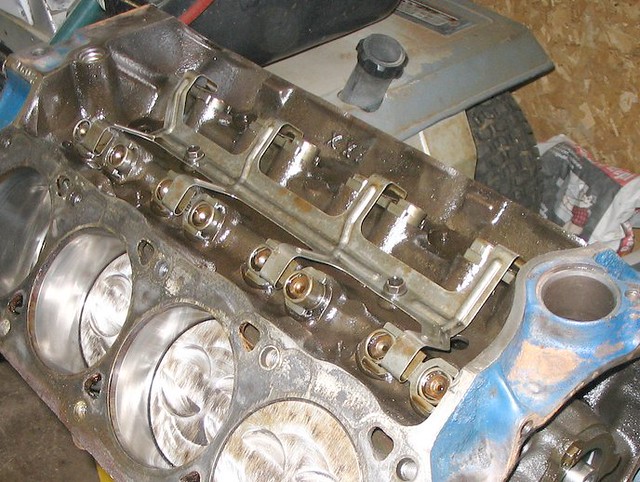
The 5.0 roller cam assembly will transfer if your block has a pair of raised bosses in the lifter valley. In some cases these bosses exist but are not drilled and tapped so you would have to do that, and the cam bearings have to be remove to do this work.

The complete roller assembly looks like this once installed in the block..
All 302/5.0 blocks, heads, and intakes are interchangable so many combinations are possible, the one best suited to your application depends what vehicle it's going in.
The complete roller assembly looks like this once installed in the block..
All 302/5.0 blocks, heads, and intakes are interchangable so many combinations are possible, the one best suited to your application depends what vehicle it's going in.
Thread Starter
|
Freshman User
Joined: Jan 2011
Posts: 41
Likes: 0
From: Aberdeen, SK, Canada
Thanks for the info and pictures. I think the block has the bosses but I don't recall if they were drilled and tapped. It's in a shed at my parents so I can't look right now. The application is a f-150 super cab 4x4. It currently has a 5.0l E4OD, manual shift BW transfer case and 3.55 gears. I was wondering if any one has played with the roller HO motor and truck intake and engine management or any other combination of the stock (ish) parts and what their results were.
FTE Legend
Joined: Jun 2006
Posts: 31,930
Likes: 1,499
From: Ottawa, Ontario
I have the same truck with a roller 5.0 that I converted from flat tappet with a Comp XE264HR cam, longtube headers and a 3" single exhaust, stock intake and heads. It hauls pretty good when the rpms are up but it's not enough motor for cruising on the highway, I had a similarly equipped 5.8 in the truck previously that made this motor look like a 90lb weakling in those conditions. If you don't make this a 347 stroker or swap in a 5.8 you'll need 4.10 gears, and that is assuming nothing bigger than 30" tires.
The HO cams put more power into the mid and high rpms but even with a better suited cam the 5.0 won't generate enough low rpm TQ to push a 5000lb truck up an incline without downshifting, that takes more displacement, and that is why I'm going back to a 5.8 as soon as possible. It got better milage than this 5.0 did too.
The HO cams put more power into the mid and high rpms but even with a better suited cam the 5.0 won't generate enough low rpm TQ to push a 5000lb truck up an incline without downshifting, that takes more displacement, and that is why I'm going back to a 5.8 as soon as possible. It got better milage than this 5.0 did too.
Thread Starter
|
Freshman User
Joined: Jan 2011
Posts: 41
Likes: 0
From: Aberdeen, SK, Canada
What milage are you getting with your current 5.0l, and what did you get with the 5.8? My last two tank combined average was 550km for 109l. About 14.25 miles per canadian gallon. This is 5 days of cold weather start, warm up combined highway and city commuting to work. I'm also wondering if any one has milage numbers (real world not advertised) for a stock 5.0l e4od 4x4 supercab shortbox with 3.55 gears and 235-75 r15 tires.
FTE Legend
Joined: Jun 2006
Posts: 31,930
Likes: 1,499
From: Ottawa, Ontario
The truck currently gets about 13mpg US everywhere all the time, while the 5.8 managed 13city and close to 18mph highway cruising at 70mph on mostly flat highways(750kms from about 110L). This are summer numbers too, the winter gas really kills milage.

Cargo Master


Joined: May 2007
Posts: 2,071
Likes: 36
From: British Columbia
Summer vs. Winter mileage
Conanski, you mentioned that winter gas kills mileage. Do you think the gasoline is different in wintertime, causing worse mileage beyond that from extra warm up time?
I thought with the advent of fuel injection that there was less reason to have summer and winter gasoline formulations.
It might be worthwhile filling up all the jerry cans with fuel in late summer if winter gasoline is actually lower in BTUs.
I thought with the advent of fuel injection that there was less reason to have summer and winter gasoline formulations.
It might be worthwhile filling up all the jerry cans with fuel in late summer if winter gasoline is actually lower in BTUs.
Trending Topics

Lead Driver

Joined: Sep 2003
Posts: 7,018
Likes: 210
From: SoCal

I think it's some federal mandate that colder climates are required to use oxygenated fuels during the winter. The idea is that it is supposed to help reduce emissions during the warm up period, and help the car warm up faster due to the leaner fuel. The fallacy is, as you say, all EFI engines today use oxygen sensors that constantly adjust fuel mixture to correct the ratio. So a leaner fuel will just be adjusted out by the computer spraying more fuel. Since each gallon of gas now contains less energy, you will burn more of it to go the same distance. The other thing is that since the engine is burning more fuel all the time, it is probably producing more total emissions; certainly more than the tiny amount that might have been saved during the warm-up period.
If it wasn't for all those older cars that do not make this mixture compensation, we could do away with this requirement.
But the oxygenated fuel is only part of the cause of reduced fuel mileage. The big one is, that it's simply much colder in winter than summer. The engine loses heat much faster, so it will naturally need to burn more fuel to generate the same amount of usable energy. I experienced this in Detroit winters some 30 years ago, before the advent of mandatory oxygenated fuels.
If it wasn't for all those older cars that do not make this mixture compensation, we could do away with this requirement.
But the oxygenated fuel is only part of the cause of reduced fuel mileage. The big one is, that it's simply much colder in winter than summer. The engine loses heat much faster, so it will naturally need to burn more fuel to generate the same amount of usable energy. I experienced this in Detroit winters some 30 years ago, before the advent of mandatory oxygenated fuels.
FTE Stories
Ford Trucks for Ford Truck Enthusiasts

Top 10 Fords at 2026 Carlisle Ford Nationals
Joe Kucinski
3 Best / 3 Worst Parts of Modern Ford Ownership
Brett Foote
10 Amazing Upgrades That Solve Common Ford Truck Owner Headaches
Pouria Savadkouei
Every 2026 Ford Engine Explained
Brett Foote
10 Ugly Ford Trucks That We Still Kinda Love
Joe Kucinski
10 Things Every Truck Owner NEEDS (2026 Edition)
Michael S. Palmer
Rezvani's Latest Post-Apocalyptic Monster Is a Ford F-150 Raptor Underneath
Verdad Gallardo
Top 10 Most Expensive Ford Trucks Ever Sold on Bring a Trailer
Joe Kucinski
2027 Ford Super Duty Buyer's Guide (Every Model, Engine, & Package)
Brett Foote
FTE Legend
Joined: Jun 2006
Posts: 31,930
Likes: 1,499
From: Ottawa, Ontario
Winter gas is the norm here in Canada from about october to march.. has been for many years now. I do notice more of a rich exhaust smell from all our vehicles in the winter, even from my '05 Subaru that has a much more advanced engine than the truck, it too won't go as far on a tank of gas. A vehicle is going to be harder on gas in winter for many reasons, longer warmups for sure but there is also increased drag from all those thick drivetrain lubricants that take much longer to reach operating temp.
