
Daily Slideshow: Trump Tariffs and Aluminum F-150s
With aluminum prices up and fuel prices down, is the Ford F-150 cruisin' for a bruisin'?



The Other Metal
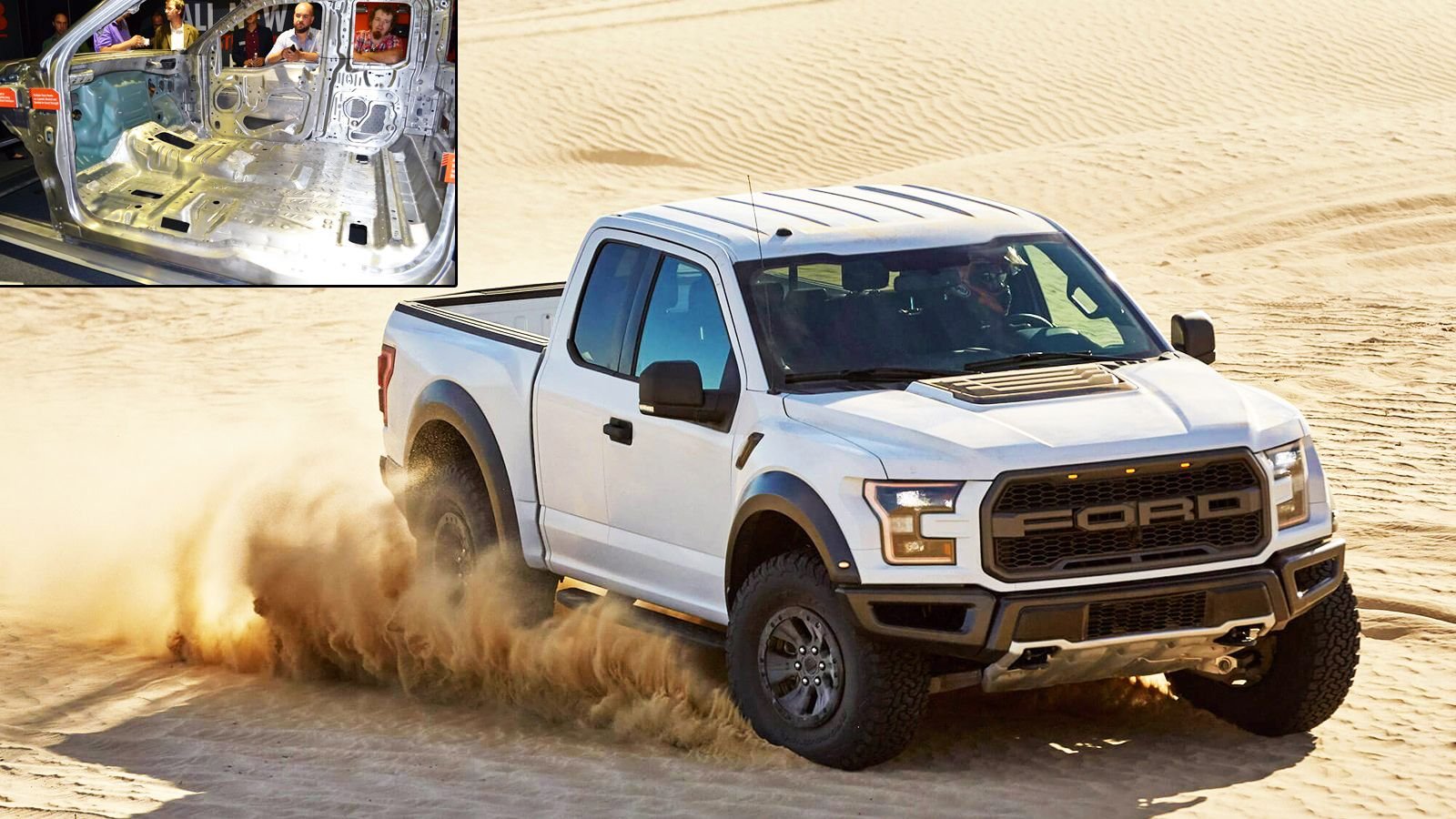
"It is not the biggest issue, but it is an issue," Ford’s president of global operations, Joe Hinrichs, admitted, about the rising cost of aluminum. His comments, as reported by the New York Times, were made while touring a Louisville plant that makes aluminum-bodied SUVs for Ford. Aluminum prices have increased over 20 percent in the last three years, and will undoubtedly jump further if the 10 percent tariff proposed by the Trump administration takes effect. News of the administration's plans sent Ford's share price down 3 percent, compounding fears after a drop in the company's income last year of 17 percent.
>>Join the conversation about Trump Tariffs and Aluminum F-150s right here in the forum.
The Path
Despite the losses and climbing costs, Hinrichs says Ford has was happy with its decision to make the F-150 from aluminum and stressed that "Aluminum also allowed us to have a lot more capability in a truck, and that’s what people buy for." It wasn't capability alone that spurred the creation of an aluminum truck. At 700 pounds lighter than the previous steel model, the new F-150 was able to tow loads with a V-6 that before would have required a thirstier V-8. "[Ford] thought gas prices were going to go to $6 or $8 gallon, and therefore having a couple miles per gallon more would be a big market-share mover that consumers would pay for," explained Barclays Capital financial analyst Brian Johnson in an interview with the New York Times. "It’s one of those managerial decisions that, if you had a crystal ball on the future, you might make differently."
>>Join the conversation about Trump Tariffs and Aluminum F-150s right here in the forum.
Duking it Out
With increasingly stringent fuel-economy standards on the way, Ford felt the advantages offered by aluminum would give their truck a competitive edge over offerings from General Motors and Fiat Chrysler. They believed consumers would be willing to pay a premium for those advantages, enough of a premium that the vehicle would become even more profitable than it already was. Things haven't gone exactly as Ford had hoped. Fuel prices went down and so has the company's share of the market—it's two percent below the level it was at in 2013. That said, the F-Series is still the best-selling line of vehicles in the U.S.—one of every three vehicles Ford makes in North America is an F-series—and leads all truck sales with a 37.4 percent market share. On top of that, in 2017 Ford sold the largest number of F-Series trucks since 2005, with the sale prices of those units up as well—an increase of $6000 per truck since 2014.
>>Join the conversation about Trump Tariffs and Aluminum F-150s right here in the forum.
Profits
Higher sale prices are a good thing for Ford, and market analysts estimate the company's profit to be in the neighborhood of $10,000 on each full-sized truck sold. Ford doesn't release per-vehicle profit figures but the chief financial officer Robert L. Shanks said F-series trucks were "not a contributor to the decline in profitability at all," and names new model R&D, exchange rates, and rising manufacturing costs as contributing factors. The decline he is addressing is a drop in Ford's North American pretax profit from $9 billion in 2016, down to $7.5 billion for 2017—a profit margin slump from 9.7 percent down to 8 percent. G.M.'s North American profits for 2017, on the other hand, totaled $11.9 billion for a margin of 10.7 percent.
>>Join the conversation about Trump Tariffs and Aluminum F-150s right here in the forum.
Concerns Remain
To assuage fears, Ford’s new chief executive Jim Hackett has pledged to reduce costs in order to improve the company's "fitness." Reports from dealers have remained characteristically upbeat. Charlie Gilchrist, the owner of three Dallas-area dealerships, says, "The F-Series is doing awesome. I think aluminum is an advantage for us. You can haul more. It’s durable." Jeff Schuster, a market analyst at LMC Automotive, explains that some of the loss in profitability was likely due to Ford's having to develop new technologies for handling and stamping aluminum—since it's not magnetic like steel. Existing equipment for moving steel parts had to be replaced with new suction-based machines for use on aluminum. "All the testing, the tooling—it’s probably those costs, not just the actual commodity costs," Schuster said. So with those costs amortized, is it clearer sailing for Ford from here on out? Not exactly. "Ford will have the oldest truck on the market, so it’s not going to get easier from here," said Deutsche Bank financial analyst Rod Lache. As with all things, time will tell whether the dramatic changes made by Ford will make them look like geniuses down the line, but for now, it's worth noting that both G.M. and Fiat Chrysler have incorporated aluminum into the manufacture of their trucks.
>>Join the conversation about Trump Tariffs and Aluminum F-150s right here in the forum.
For help with your maintenance and repair projects, please visit our how-to section of Ford-trucks.com.