
Ford F-150 Curb Weight Gains Over All 9 Generations
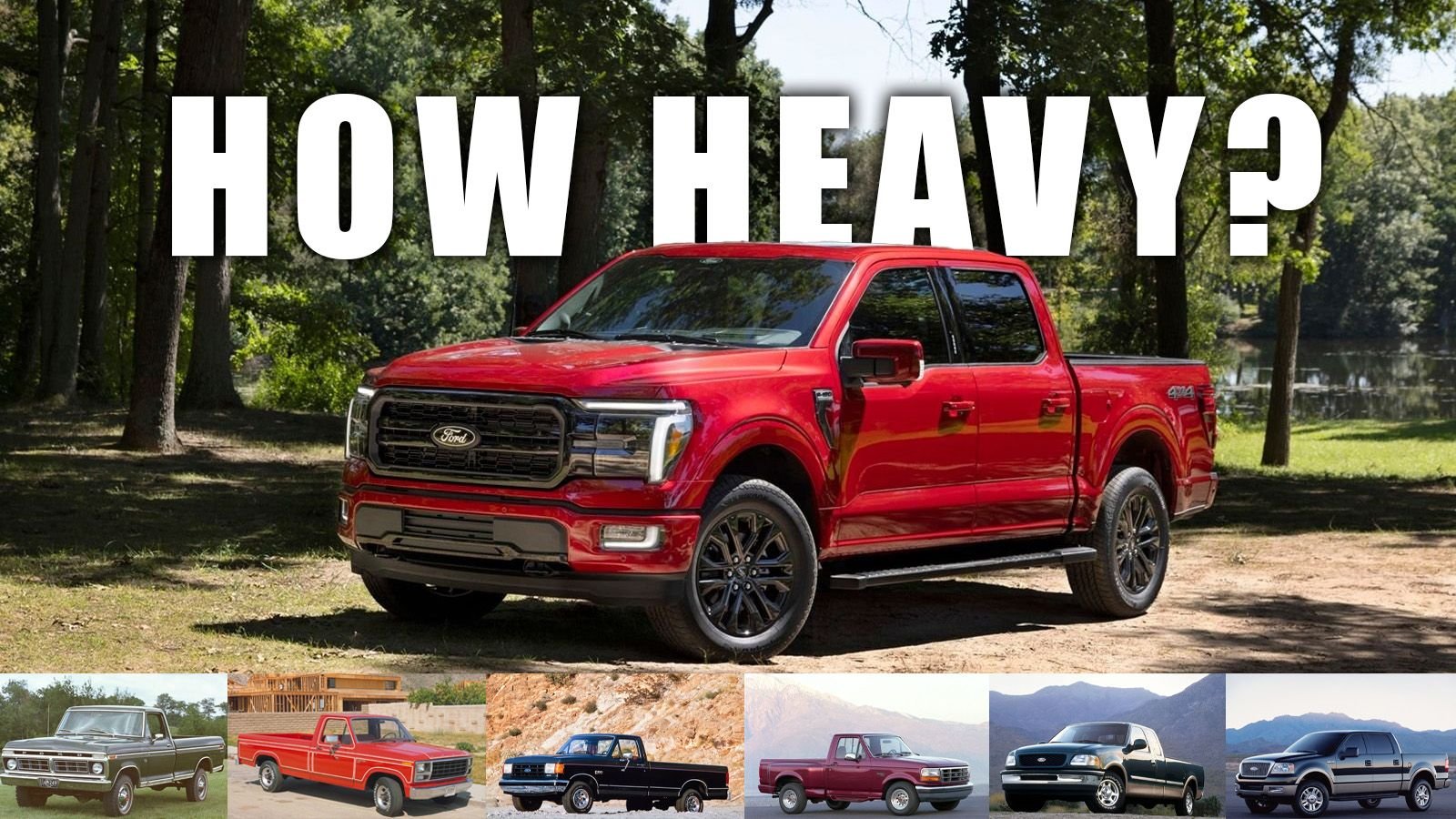
How much heavier is an F-150 today compared to the original 1970s version? Check out this list of every Ford F-150 curb weight across all nine generations!




Intro
Weight is an important metric that we need to pay close attention to. At least that is what my doctor keeps telling me. But this article is not about my struggle to stay away from doughnuts in the office. This is about vehicle weight. Sports car makers obsess over it because weight affects acceleration, braking, handling, fuel consumption, and just about every other metric you can think of. And while Ford trucks are not primarily known for setting lap times, weight matters for them too. Payload and towing capacity are influenced by the curb weight of a truck, and those are metrics that matter very much to owners.
With that in mind, we thought we would take a look at the curb weight of the most popular truck in history, the F-150. The F-150 began in 1975, and we looked back from that first year through today to get an idea of how curb weight has changed over the years. A task that is easier said than done. As important as curb weight is, it's not tracked very closely, especially in those early years. Ford didn’t often publish curb weights for trucks. On top of that, the curb weight can vary greatly depending on configuration. Keep that in mind as you look at the weights we have listed for each generation. They are the best estimates that we could obtain from various sources. So, how did the F-150 gain weight over the years? Let’s take a look.
1. First Generation 1975 - 1979 F-150 (3,000 – 3,800 Pounds)
It should come as no surprise that the oldest F-150 is also the lightest. Things were simpler back in the 1970s. Who needs airbags, right? Even though the F-150 was fitted with a beefier suspension compared to the F-100 of the day, the F-150 models tipped the scales between 3,000 and 3,800 pounds, depending on the configuration.
2. Second Generation 1980 – 1986 F-150 (3,400 – 4,000 Pounds)
The second generation of the F-150 was part of the seventh generation of the F-series, which began in 1980. Fuel economy was high on the priority list, so Ford made the F-150 a little bit shorter and narrower. As a result, the curb weight crept up only slightly for this generation despite additional trim upgrades. However, it was now possible to configure an F-150 that weighed two tons.
3. Third Generation 1987 - 1991 F-150 (3,400 – 4,300 Pounds)
Trucks were starting to go more mainstream by the time we wrapped up the 1980s. The third-generation F-150 gained upgrades such as standard rear anti-lock brakes. Options included skid plates, cruise control, air conditioning, power windows, door locks, and much more. These were all welcome upgrades, and they didn’t make the truck all that much heavier, all things considered.
4. Fourth Generation 1992 – 1996 F-150 (3,900 – 4,300 Pounds)
The base F-150 was starting to get a bit heavier now. The fourth-generation upgrades included a rounder exterior and a more modern interior. The seats were new, as was the dash and most of the interior trim. The beloved F-150 Lightning performance truck was also launched during this generation. As the standard feature list grew to include such things as driver-side airbags, power steering, power brakes, intermittent windshield wipers, and more, the trucks understandably got heavier.
5. Fifth Generation 1997 - 2003 F-150 (3,900 – 4,600 Pounds)
The 1997 F-150 was a whole new truck. More car-like than ever and with more features than ever. Dual airbags and rear anti-lock brakes were now standard. Options included six-way power leather seats and automatic headlights. In 1997, the F-150 was available in Regular or SuperCab configurations with either a short or long Styleside bed. The trucks were getting more advanced but also a bit heavier.
6. Sixth Generation 2004 – 2008 F-150 (4,000 – 4,700 Pounds)
The F-150 got bigger and tougher in 2004, which was, of course, reflected in the curb weight. A fully boxed frame, a bigger passenger compartment, and all cab configurations featured four doors. The lightest F-150 was now tipping the scales at two tons. The top trim models were several hundred pounds heavier thanks to their more extensive standard features list.
7. Seventh Generation 2009 - 2014 F-150 (4,700 – 5,600 Pounds)
By its seventh generation, the F-150 was really starting to pack on the pounds. Part of that was thanks to all the new equipment that was coming on these trucks. The new F-150 offered AdvanceTrac with RSC (Roll Stability Control) and Trailer Sway Control, plus available Rearview Camera Assist as well as Integrated Trailer Brake Controller. The 2009 F-150 SuperCrew was stretched by six inches. And for the first time ever, the F-150 gained a Platinum trim level. Highlights included a satin chrome grille with fine mesh inserts, 10-way captain’s chairs upholstered with leather, tuxedo stitching, and embroidered logos on the seatbacks. 20-inch, 16-spoke polished aluminum wheels were also standard on the Platinum. You can see why these trucks were now closing in on three tons.
8. Eighth Generation 2015 – 2020 F-150 (4,000 – 4,900 Pounds)
The weight of the F-150 was getting a bit out of control, so Ford did something radical. They introduced a high-strength, military-grade aluminum alloy for use in the bed and body of the truck. This move worried many Ford fans as they thought it would weaken their favorite truck. But these trucks have held up well, and they are a shocking 700 pounds lighter than the trucks of the previous generation.
9. Ninth Generation 2021 – Current F-150 (4,400 – 5,600 Pounds)
Now we get to the trucks of today. The weight has crept up a bit, but these trucks are more capable and advanced than ever. And you have to understand that the F-150 Tremor and Raptor models are included in this mix and are largely responsible for the high end 5,600-pound curb weight that you see here. All that off-road equipment is heavy. Still, for as much as the modern F-150 offers, Ford has done a great job of keeping weight in check over the years.
Images: Ford