When you click on links to various merchants on this site and make a purchase, this can result in this site earning a commission. Affiliate programs and affiliations include, but are not limited to, the eBay Partner Network.
My son has a 66 F100 with a 302 and C6 and we are trying to figure out the correct front spring to install. The ones there now - not sure they are even original - are incorrect as the camber is way off and wearing the tires badly on the outside. We got a new pair for a 72 F100 thinking that with the 302 available in that year may get us going in the right direction. They make the camber even worse. We could cut coils and go trail and error but would rather start with something closer to correct. We came across an older post that showed original part numbers for the 66 with different engine configurations (There were three different load rates available: 1055 lbs (I-6's only) * / 1175 lbs. (I-6 or V8) / 1250 lbs. (V8 only).) Clearly the one for the 352 V8 would be too stiff given the weight of that motor compared with the 302. We know these original springs are no longer available, but maybe we could custom order some with the correct spring rate. Would maybe 1055 or 1175 be correct for a 302? Anybody kbow what the correct spring rate and size would be for our setup? Thanks
So, in conjunction with reading some other threads, I just asked a similar question in the thread "I stepped in it now: disk brake conversion" originally posted by @jalls1 .
First, I took a quick look at your beautiful CS, and wow, nice job. I think I have read some of your other posts, but as I often forget what I had for breakfast, I am not sure which ones and or when, so if I write something you already know, please forgive me.
That said, my '66 is largely original, the motor has been replaced but with another FE. The C6, appears to be about the only real upgrade from original and I a not sure the weight difference between the original FXT and C6 would make any real right hight alterations. The reason I am clarifying that, is that my truck has a bit of positive camber, and I was told or read, or both, that Ford build the early trucks that way, in combination with bias ply tires, to help with non power steering trucks being more comfortable to drive, and easier to steer. Assuming that is true, I am curious how your truck rides, and if you also have some degree of positive camber, or if the weight difference from your original motor, to what I can only assume, heavier 460, altered your front end ride height enough to remove the natural positive camber, or if you made any other modifications to your front end?
I also brought up your own F250, because I assume you are satisfied with its ride height, and suspension settings, and if there is in fact a significant difference between what motor was originally in your truck compared to your modifications, and your springs are otherwise original, then that at least would confirm the logic and approach moving forward. ie, Heavier motor and trans = slightly compressing original springs more than original motor and trans = removing slight positive camber = less outside wear on tire.
As to your son's truck, and assuming that your son's F100 is otherwise set correctly for caster and toe, and that it is only the positive camber that is wearing the tires. Positive camber should equate to outside tire wear, negative camber should equate to inner tire wear, (all of which you implied in your OP). I would start by trying to compare the weight difference of his original motor and transmission to the 302/C6 combo. I assume that would put you on the right track as to determining the desired spring load capacity and thus help with narrow down the options.
In my case, I have not noticed any significant wear on my tires despite running radial over bias ply, but as I wrote in the other thread, would still like to level and lower the truck slightly to remove the obvious positive camber and for my height and build, make getting in and out slightly easier. I have thought about full air ride, as I could theoretically adjust my right height slightly without losing any load capacity. Add front and rear positionomiters and a regulator to maintain ride height despite load. While a cool thought and maybe even practical, I can't imagine that it will be within a reasonable budget, nor am I sure I want to make such extreme modifications to my truck for my particular taste.
Lastly, I am still trying to learn the Ford Master parts catalog that so many others make look easy, but below is a chart with what I assume are the correct part numbers relating to the springs you mentioned, and hope it helps. Not sure how to calculate and compare loads from motor and transmission combinations. They too might be in the MPC, but I am a newby, so maybe a general internet search will give an approximation of the various combinations along with some simple math.
Ford MPC 1964-1972 Text Section 53, page 21 (overall page 2105 of 4849)
Last edited by The Dassler; May 13, 2026 at 02:07 AM.
Since the suspension on these trucks imparts constantly changing camber and caster tire wear can be a problem. But since caster and camber aren't a constant the alignment specifications are based on ride height measured between the "I" beam and the frame. If your stance looks OK with the springs, you have then the "I" beams may need to be bent to get the correct alignment. The difference in weight between engines usually doesn't affect the ride height that much. Here is a link to alignment specs. for early trucks Front Wheel Alignment Specifications - FORDification.com
As the years went by Ford realized that even though setting the caster and camber to a 4 inch ride height worked all trucks didn't sit at 4 inches so the later manuals have specifications for differing ride heights. Here are a couple of pictures from a 77-shop manual, my scanner is broken so this is as good as I can do. It also seems the specifications got a little more generous as the years went by.
I need to add a couple of things. First, I would take it to an alignment shop to get the numbers it is at now. But you need to find a shop with an older machine because the new computerized laser type machines have difficulty dealing with the track width difference between the front and rear axles if you have stock backspacing on your wheels.
Thanks Dassler for the response. Sounds like you have a pretty cool F250 as well! You remind me that I need to update my photos since I've done a lot of engine bay work!
My CS 250 has a 79 twin I-beam swap from a previous owner and my guess, but can't be sure, is that he also swapped out the springs from the 79. In any case, it is rock solid and straight. I get zero odd tire wear, though keep in mind that my 10 year old tires looked almost new before I replace them a few years ago and I have only 17000 miles total since I got the truck in late 2012. Based on an alignment I had done in 2013 I have 0.5 to 0.6 positive camber, 4.3 to 5.6 positive caster and toe in of less than 0.11. So everything seems in order there.
On my son's F100 the prior owner had a Chevy 327 in it!!! Yikes! I told my son he couldn't park it in the driveway until he got that fixed . We eventually rebuilt the original 289 out on my 66 Mustang (into a 331 stroker) and added a C6 in place of the Muncie behind the Chevy. The prior owner had already install spring compression clamps to bring the front end down (this was originally a 352 truck). So the springs are a mess and need to be replaced. Like I said, we got a set for a 72 F100 thinking that with the 302 in that year we would be closer on the weight. We have not done an alignment and the truck is currently on the lift for tranny work. We have a QuickTrack alignment kit and plan to use that to see where we are in the next few weeks. As noted, the tires are wearing badly on the outside - so too much camber for sure. Not sure where other specs stand but we'll get an idea on that soon.
Crop Duster, thanks too for the info. Interesting about the variable ride height - yet another variable. We will have to measure that and see where it sets. If the axle does need to be bent, I have no idea where to get that done so that will be another journey. We are in the Phoenix, AZ area.
What is interesting about the springs themselves is that the load ratings seem odd. Number Dummy from an older post showed these options for a 65-66 (There were three different load rates available: 1055 lbs (I-6's only) * / 1175 lbs. (I-6 or V8) / 1250 lbs. (V8 only).). If a supplier gives a spring rate it is in the 400-600 range and not 1000+ so the scale has apparently changed over time. Most supplier don't even give a rating or a coil diameter spec so its just a crap shoot buying new ones it seems. The 1055 rating from above seems about right guessing that a 289 and and I-6 would be closer together than a 289 and a 352. And this 289 have aluminum heads and intake.
As noted, the tires are wearing badly on the outside - so too much camber for sure. Or too much toe in. Unfortunately, that changes along with the camber and caster as the axles move up and down. Here is a link to Eaton a lot of members have used their springs with good results my rear leaves came from them. EATON Detroit Spring - The leading manufacturer of leaf and coil springs for the street rod and restoration automotive industries
As far as ride height changes with different engines here is a picture of some parts trucks I had, the blue one had the heaviest set of factory springs on the back that I have ever seen on a half-ton pickup they were heavier than the ones on the F250 next to it. So I assume the coils were heavy also. It originally had a 352 but someone had rednecked in a 250 I6 as you can see it still has a decent stance even though that 250 had to be 300 lbs. lighter than the 352.
So what you are saying, and said before, is that the engine weight probably plays a small role in the stance and, by connection the alignment. We certainly need to get measurements on all three alignment specs and will do that soon with our Quick Trak setup. It may not be perfect but it'll be close enough to see where we are. My son's F100 already has heavy duty leaf springs in the back and the shock coil-overs from a F250 (just replaced those about 6 months ago as the originals were more than shot! He carries around a lot of solid iron antique gas engines as a collector and shower. Given this, it makes a certain amount of sense to have heavy duty springs in the front as well. In fact, it might be worth measuring the alignment specs loaded and unloaded as I'm sure that will make a difference. We are aware of Eaton and have already checked out their website. Who knows when the last time this thing was ever aligned. I'm guessing it hasn't been touched since new given the difficultly of actually correcting camber and caster on these beasts. My F250 was spot on but its possible that the prior owner who swapped in the 79 front axle had it done - or just got lucky with the "new" parts. Thanks for the continued interest and insight.
BTW, here are a few photos of the old gal. The 289/331 almost completed at the time. Its got a multi-color layered rattle can paint job that should give a nice patina over time.




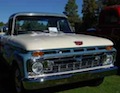








 . We eventually rebuilt the original 289 out on my 66 Mustang (into a 331 stroker) and added a C6 in place of the Muncie behind the Chevy. The prior owner had already install spring compression clamps to bring the front end down (this was originally a 352 truck). So the springs are a mess and need to be replaced. Like I said, we got a set for a 72 F100 thinking that with the 302 in that year we would be closer on the weight. We have not done an alignment and the truck is currently on the lift for tranny work. We have a QuickTrack alignment kit and plan to use that to see where we are in the next few weeks. As noted, the tires are wearing badly on the outside - so too much camber for sure. Not sure where other specs stand but we'll get an idea on that soon.


