When you click on links to various merchants on this site and make a purchase, this can result in this site earning a commission. Affiliate programs and affiliations include, but are not limited to, the eBay Partner Network.
Hello everyone, I’m a long time lurker on this site who finally has something to post about! This will be the first post in my build thread so go easy on me (I’m still trying to figure out how to do all this computer stuff). Here it goes:
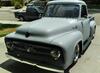
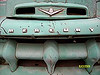
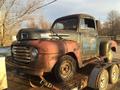
After keeping my eyes peeled for quite a while, I finally found the truck I really wanted. A local guy brings western trucks into Ontario, and late last fall he brought in a 1950 F47 (Canadian version of the F1). My wife and I headed over to look at it, and it took me about 30 seconds to realise that this was the one for me. A deal was struck and a week later it was at my place. The truck is remarkably solid, with just a handful of rusty spots (all simple fixes). The truck was apparently purchased new by a company that used it for working on pipelines or something like that, and it was painted the company colours (white and light green) over top of the original dark green and black. It spent its life in the western sunshine, where the paint eventually burned away to leave this:
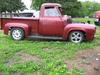
While the truck is relatively rust free (at least by Ontario standards), it has its fair share of dings, dents, scrapes, cracks, and of course the inevitable “farmer fixes”. The character of the patina is however perfect for me, and will be left alone. We live in an area of gravel roads, so driving around in a shiny painted classic truck is not fun. In addition to that, I no longer want to spend endless months (or years) doing a good quality body job. I just want a reliable, comfortable, quiet, safe old truck that I can take to cruises and shows.
With that in mind, I had a mechanic buddy come over to my place and we went over it with a fine toothed comb. After a thorough examination, we determined that pretty much everything was shot (no surprise). The steering, suspension and brake/wheel components were all toast, and the engine was seriously seized (no surprise there either). I spent some time trying to unseize it just for fun, but that was a no-go. I wasn’t disappointed however, as I don’t want originality in any of this stuff. I have owned an original truck from this era before (‘56 Chevy ½ ton), and I’ve reached the age where I am more interested in comfort and safety than originality (especially on the crappy roads here).
I will start to post more stuff shortly, and I’ll try to focus on things that members here may find useful. I have extracted an incredible amount of information from this forum, and now it’s my turn to try to give some back.
Welcome to the Forum! Nice to see another Opa on here!
Keep the faith and pick away at it one item at a time. I know from my own experience that the members on this forum are great resources. They're an incredible wealth of knowledge to provide advice when needed and provide encouragement when you start to wonder "what the heck did I get myself into?".
Your truck looks great. Welcome to the F47 club.
I see your truck is an early 1950 F47. You can tell by the fact the box does not have flat sides. Keep that in mind when ordering any parts. You will want to order as if its a 49, not a 50.
It doesn't sound like you are planning on keeping the flathead, so I won't bother warning you how expensive it is to rebuild one. Hopefully you are looking at a ford power plant though?
Somewhere in the many threads on here, there is a Canadian VIN information thread., Which has some good data on how to decode you VIN.
KirkF: Thanks for the heads up on the fact that it's an early 50 and parts may vary. I didn’t know that. As for the engine, I’m planning on an LS (nothing fancy, completely stock).
After finally getting all the junk out of my shop, I was able to pull the F47 in and get some work done on it. The first thing I did was spend a good 2 days patiently breaking free all the nuts and bolts I could find. I find it much nicer to work on something when I don’t have to constantly stop what I’m doing in order to fight with rusty stuck fasteners, so I did it all ahead of time and got that chore out of the way (well almost). Things went surprisingly well. Here in Ontario our vehicles turn into rusted garbage within 20 years so it amazes me to be able remove fasteners from the underside of a 73 year old truck with just a wrench. The occasional nut required some heat, but the vast majority could simply be turned out with a wrench or a ratchet.
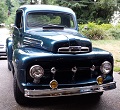
Once I had the fasteners broken free I got to work on disassembly and cataloguing what I had. I made tons of notes, took lots of pics, and labelled everything. I’m not a mechanic, and my memory for how things go together isn’t great so I spent a ton of time making sure I could figure everything out down the line. The disassembly stage is kinda fun, as this is where I started to find weird/cool things. Some stuff I figured out through searches of this forum (like that little toggle switch under the dash to the left of the steering wheel). Other stuff I’m still not so sure of. Like the horns……I found this in front of the radiator on the driver side:
And I found these mounted on the firewall with a bracket that didn’t look like the factory made it:
And of course there were a million little things that had fallen down behind the gas tank, into the cab corners, under the seat, etc etc. It’s like a time travel treasure hunt!
First off, sorry about the bold font on the previous posts. I just figured out how to make that go away!
The disassembly and cataloguing continues……..
From posts on this forum I found out just how ridiculously simple it is to pull off the entire front end in one piece by removing just a handful of bolts. Here’s a shot of the front end coming off in one piece using my engine hoist:
With the front end gone I had better access to the cab and I got to work disassembling and documenting. The glass was all broken, however it was all still there so I covered it in Tuck Tape (really sticky stuff) on both sides. Taping it allowed it to be easily removed without falling apart. This means I now have perfect templates when the time comes to get new glass cut. That's one of the nice things about flat glass. It’s dirt cheap cheap to replace (I am a big fan of dirt cheap). Here’s a couple of the “templates”:
The cowl vent was stuck closed so I hit all the moving surfaces with penetrating oil and went back and forth pushing/pulling/prying/tapping/banging/wiggling and sure enough it eventually came free and actually started working rather well.
The doors were next. The simplest way to remove the doors would be to simply pop out the 2 hinge pins so that’s what I decided to do. Here’s where I ran into my first snag. Those pins absolutely refused to budge. I tried to hammer them out but I was reaching the point where I started to worry about causing damage so I opted for some heat. I love the patina on this truck and I didn’t want to create an ugly mess of burnt paint so I made some metal shields (backed with wet rags between the shields and the door). Here’s the driver side door getting prepped for some heat:
After heating things up I grabbed the hammer and……..nothing! That pin would not budge. If the door was out I could set the hinge on my steel welding table and give it some more serious hammer blows without worrying about damaging anything, so I switched to taking the hinges out of the door pillars instead. I ran into another snag when removing the first hinge when I managed to snap off all 3 bolts even after applying heat. This was 100% inexperience on my part as I figured out that I was not giving the bolts enough time for the heat to work its way down the threads to the retaining plate where the rust was lurking. On subsequent hinges I gave the bolts heat for a far longer time and sure enough they backed out easily. Lesson learned. In order to minimize damage to surrounding paint/patina, I used another shield. For the door hinge bolts I just used a chunk of bent plate with a hole drilled in it. The hole just fits the bolt head, so I can go pretty hard with the torch without destroying the paint/patina in the area. Here is the shield:
Fixing the snapped off bolts in the caged retaining plate was not a big deal. Access to the cage that holds the retaining plate for the door hinges is surprisingly good. It took no effort to get a screwdriver back there to lift the cage up and pull out the plate (another thing I learned on this forum!). Here’s a shot of that caged plate behind the door jamb (I could easily reach in to grab it, so if I have another person helping me I could re-install the door without even having the cage there if necessary). You may notice that square nut on it, indicating that some other person had already boogered things up in here:
The threads on the original plate were a bit of a mess, so I just used that plate as a template to cut a fresh one out of some steel I had lying around. By clamping the new plate onto the door hinge I had a nice guide to mark pilot holes exactly where they needed to be:
Here’s the old and the new :
I lucked out here when I went looking for fasteners to replace the 3 that I snapped. I’m a bit of a packrat, and it turns out that those special screws used to mount the F47 door hinges are identical to the screws used to mount the tailgate of a ‘56 Chevy wagon and I happened to have 3 leftovers from that old car.
The rest of the cab was simple to take apart. The seat needs to be redone as it is in rough shape. I may try to rebuild it myself. I could always put in a wrecking yard seat, but I would like to keep the truck as original looking as possible. My wife and I sat in the truck for a bit and we both found the seat to be fairly comfortable so hopefully I can restore it. The only unpleasant part of cab disassembly was the gas tank. It had a couple of holes in it and still contained maybe a gallon of fluid. I say “fluid” because this stuff is what gasolene turns into when it is exposed to air and allowed to sit for a few decades. Evil smelling stuff and not fun to clean up when it spills.
Once the cab was fully stripped, I used my engine hoist with the fancy wooden gizmo to lift it off and set it onto a stand. Here is the fancy gizmo. It’s not my idea, I copied the design from a pic I found on another forum:
With the cab off and everything out of it I could give it a thorough inspection. The results of this inspection were very good. There are just 2 spots that need rust repair. I’m not sure what this area is called, but on both sides of the cab just forward of the front lower door openings a repair will be needed. These areas are hidden when the truck is assembled and are a simple shape so this will be a quick & easy fix.
There are 2 more spots that need some attention, where cab movement seems to have caused the carriage style bolts to wallow out the holes at the cab mounts inside the cab at the base of the firewall. The area around these holes is actually quite good (not rotten at all), so I’m thinking that this should be a straightforward fix as well. The cab still has lots of original paint (in surprisingly good condition!), but will need a ton of holes welded shut in the firewall. Here’s the cab sitting on a stand:
The box has some issues with rust. The actual box itself is solid, but those crossmembers are in poor shape. I don’t plan on recreating the original bed floor anyhow, so I will just fab up some new crossmembers.
The tail end of the box has seen some serious farmer fixes, but I think I will leave these the way they are. The paint/patina on the tail end matches the rest of the truck and I don’t want to lose this.
There’s no tailgate, and I don’t want one that doesn’t match the rest of the truck. There are channels welded to the ends of the box sides, as if some sort of tailgate thing had been slid downwards between them. I will likely fab up my own “farmer fix” using old materials to fit in these channels so that it all blends together.
With the frame now fully exposed, I had a chance to look it over in detail. When I first bought the truck, I believed the frame to be in very good shape and I confess that I was a little nervous when I first laid the tape measure over it to check for twists and squareness. It was a huge relief when I had diagonal measurements across the length of the frame that were within 1/16 inch of each other. The frame is rust free (other than light surface rust) and has no cracks. There was some minor damage at the front frame horns (easy fix) and something a little bigger at the rear frame crossmember.
At some point, someone had attached a crude towing hook at the very centre of that crossmember. Once they had that, it was only natural to use it to try pulling something that can’t be pulled (probably a giant tree stump or something similar). The result was that the frame crossmember was bowed sharply to the rear (and this of course pulled the rear frame rails inwards). The bending of the crossmember (which is a big C-channel shape) caused the edges of the crossmember to buckle into waves. Fixing it wasn’t all that bad though. I hooked a come-along up between that bent rear crossmember and the much sturdier centre crossmember, and then tightened it up as much as I could. With the come-along exerting a strong pull on that bent rear crossmember, I alternated between 2 things. First I would use a BFH to whack the crossmember back in the direction it needed to bend, then I would attack the buckled steel at the edges of the crossmember. It was a 2 person job, because of those edge buckles. I would hit the high point of a buckle while my son held a big piece of heavy steel plate on the other side so that the energy would go into flattening the buckle. It went quite well. After each round of bashing the crossmember and then flattening the buckles, I was able to tighten up the come-along by another notch or two. Ten minutes later the rear crossmember was pretty much back into shape (I had reached that point where I decided “close enough”). Straightening that crossmember also pushed the rear frame rails outwards to where they were supposed to be. Final rear frame rail width is now just over 33 ⅞ inch (factory spec was 34). Here is how I hooked up the come-along to make this repair (repair was pretty much finished when this pic was taken):
One thing that I noticed about this frame is the amount of flex that it has. My research on this forum tells me that this is on purpose as a way of softening the ride caused by those thick rear spring packs. I plan on switching to the TCI rear leaf kit which only has 2 leafs and is supposed to give a very smooth ride, so it will be interesting to see just how smooth a ride I finally end up with.
More to follow!
P.S. I have no idea why the image below shows up at the end of this post. It simply refused to go where I wanted it to go!
Welcome to the forum Hermit and by now those three words "Now it starts.." have more meaning. Not to worry, these guys can get your ox out of any ditch you get it into. Glad you already know
Pictures and notes are your best friend. Sometimes you will think that something turned itself inside out and nothing is gonna fit... but those picture will save your life.. Enjoy this trip.."It'll be fun" they said.