



Adding up weights to stay legal

Thread Starter
|
Cargo Master


Joined: Jan 2001
Posts: 2,389
Likes: 23
From: Central Texas
Adding up weights to stay legal
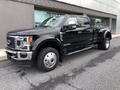
I've been towing recreationally for decades, but now I have a business hauling gravel and machines, building driveways and water systems. I used to have a rule that I wanted my tow vehicle to outweigh the towed vehicle by a substantial margin. Well, that goes out the window when pulling gravel or dirt machines with a dually pickup.
My heaviest trailer is 21,000 lbs fully loaded legally. It's a triple axle gooseneck. (FB group I created to discuss PJ trailers https://www.facebook.com/groups/510567116153442/)
I have a 2018 F-350 dually with the max tow package that Ford says can legally tow up to 32,000 lbs, goose or 5th. No problem there. https://www.fleet.ford.com/towing-guides/
But I want to add an older truck so I don't always take my 2018 to the quarry etc. Older 4x4 F-550s with 4.88 Dana 135 have a GVWR of 17,400, unless they have the "High Capacity Trailer Tow Package" - rather rare. So unless I find one of those unicorns, I'll buy an older F-550 and have 17,400 GVWR.
The big question: How to ensure that I'm legal? With the newer dually, Ford's guidelines assure me that I have 11,000 of safe legal margin over my 21,000 trailer. With an older 550, my trailer is 4k over Ford's guidelines (link above). But the local Deputy who enforces commercial vehicles says he only looks at axle ratings on the truck+trailer, then weighs axles if he thinks you're overweight. He wasn't very specific about how he adds up legal capacity, started talking about the fees I choose to pay when I register a tow vehicle. I didn't want to be pushy and insist on more specifics. He's "the man" we all fear, a real tough cookie.
Can I just add up the pickup's GVWR and the trailer's GVWR then use that sum as a safe max limit? Assuming of course that the load is evenly distributed over axles.
.
My heaviest trailer is 21,000 lbs fully loaded legally. It's a triple axle gooseneck. (FB group I created to discuss PJ trailers https://www.facebook.com/groups/510567116153442/)
I have a 2018 F-350 dually with the max tow package that Ford says can legally tow up to 32,000 lbs, goose or 5th. No problem there. https://www.fleet.ford.com/towing-guides/
But I want to add an older truck so I don't always take my 2018 to the quarry etc. Older 4x4 F-550s with 4.88 Dana 135 have a GVWR of 17,400, unless they have the "High Capacity Trailer Tow Package" - rather rare. So unless I find one of those unicorns, I'll buy an older F-550 and have 17,400 GVWR.
The big question: How to ensure that I'm legal? With the newer dually, Ford's guidelines assure me that I have 11,000 of safe legal margin over my 21,000 trailer. With an older 550, my trailer is 4k over Ford's guidelines (link above). But the local Deputy who enforces commercial vehicles says he only looks at axle ratings on the truck+trailer, then weighs axles if he thinks you're overweight. He wasn't very specific about how he adds up legal capacity, started talking about the fees I choose to pay when I register a tow vehicle. I didn't want to be pushy and insist on more specifics. He's "the man" we all fear, a real tough cookie.
Can I just add up the pickup's GVWR and the trailer's GVWR then use that sum as a safe max limit? Assuming of course that the load is evenly distributed over axles.
.

Mountain Pass

Joined: Sep 2019
Posts: 241
Likes: 12
From: Kansas
You’re in DOT/CDL territory, enjoy.
Start with the max trailer, 21k. At 25% on the tongue, that gives you 5,250 lbs on the tow vehicle. Take that weight off the GVWR of the truck. Now take away your weight and all the tools/crap in the truck. If you have any left, your GVWR of the truck is not an issue. Then, look at axle weights. Generally axle weights add up to more than the GVWR, so be careful with that. If axle weights are good, check tires. The tag must be correct and you need all the DOT/CDL crap. The trailer when uncoupled must never be over it’s GVWR.
I tried to message you, but I guess I can’t do that.
If if you want to call me, I’ll give you my number. It would take ten minutes talking or a long time typing.
Start with the max trailer, 21k. At 25% on the tongue, that gives you 5,250 lbs on the tow vehicle. Take that weight off the GVWR of the truck. Now take away your weight and all the tools/crap in the truck. If you have any left, your GVWR of the truck is not an issue. Then, look at axle weights. Generally axle weights add up to more than the GVWR, so be careful with that. If axle weights are good, check tires. The tag must be correct and you need all the DOT/CDL crap. The trailer when uncoupled must never be over it’s GVWR.
I tried to message you, but I guess I can’t do that.
If if you want to call me, I’ll give you my number. It would take ten minutes talking or a long time typing.
Thread Starter
|
Cargo Master
Joined: Jan 2001
Posts: 2,389
Likes: 23
From: Central Texas
You may not be able to message me because you're relatively new to the forum. But apparently I can message you. So I just did.
Thanks for the info. I have all the DOT safety crap and that sweet $5k/year mandatory insurance.
Thanks for the info. I have all the DOT safety crap and that sweet $5k/year mandatory insurance.
Last edited by krewat; Sep 26, 2019 at 03:52 PM. Reason: Edited AGAIN for political comments

Super Moderator


Joined: Dec 2011
Posts: 13,363
Likes: 6,156

I've been towing recreationally for decades, but now I have a business hauling gravel and machines, building driveways and water systems. I used to have a rule that I wanted my tow vehicle to outweigh the towed vehicle by a substantial margin. Well, that goes out the window when pulling gravel or dirt machines with a dually pickup.
My heaviest trailer is 21,000 lbs fully loaded legally. It's a triple axle gooseneck. (FB group I created to discuss PJ trailers https://www.facebook.com/groups/510567116153442/)
I have a 2018 F-350 dually with the max tow package that Ford says can legally tow up to 32,000 lbs, goose or 5th. No problem there. https://www.fleet.ford.com/towing-guides/
But I want to add an older truck so I don't always take my 2018 to the quarry etc. Older 4x4 F-550s with 4.88 Dana 135 have a GVWR of 17,400, unless they have the "High Capacity Trailer Tow Package" - rather rare. So unless I find one of those unicorns, I'll buy an older F-550 and have 17,400 GVWR.
The big question: How to ensure that I'm legal? With the newer dually, Ford's guidelines assure me that I have 11,000 of safe legal margin over my 21,000 trailer. With an older 550, my trailer is 4k over Ford's guidelines (link above). But the local Deputy who enforces commercial vehicles says he only looks at axle ratings on the truck+trailer, then weighs axles if he thinks you're overweight. He wasn't very specific about how he adds up legal capacity, started talking about the fees I choose to pay when I register a tow vehicle. I didn't want to be pushy and insist on more specifics. He's "the man" we all fear, a real tough cookie.
Can I just add up the pickup's GVWR and the trailer's GVWR then use that sum as a safe max limit? Assuming of course that the load is evenly distributed over axles.
.
My heaviest trailer is 21,000 lbs fully loaded legally. It's a triple axle gooseneck. (FB group I created to discuss PJ trailers https://www.facebook.com/groups/510567116153442/)
I have a 2018 F-350 dually with the max tow package that Ford says can legally tow up to 32,000 lbs, goose or 5th. No problem there. https://www.fleet.ford.com/towing-guides/
But I want to add an older truck so I don't always take my 2018 to the quarry etc. Older 4x4 F-550s with 4.88 Dana 135 have a GVWR of 17,400, unless they have the "High Capacity Trailer Tow Package" - rather rare. So unless I find one of those unicorns, I'll buy an older F-550 and have 17,400 GVWR.
The big question: How to ensure that I'm legal? With the newer dually, Ford's guidelines assure me that I have 11,000 of safe legal margin over my 21,000 trailer. With an older 550, my trailer is 4k over Ford's guidelines (link above). But the local Deputy who enforces commercial vehicles says he only looks at axle ratings on the truck+trailer, then weighs axles if he thinks you're overweight. He wasn't very specific about how he adds up legal capacity, started talking about the fees I choose to pay when I register a tow vehicle. I didn't want to be pushy and insist on more specifics. He's "the man" we all fear, a real tough cookie.
Can I just add up the pickup's GVWR and the trailer's GVWR then use that sum as a safe max limit? Assuming of course that the load is evenly distributed over axles.
.
You'll notice that the Federal Certification ratings labels that are mandated to be on the driver's door jamb do not state any number for GCWR.
Instead, the required "legal" weight numbers of reference are the GVWR, and the GAWR for all axles.
Your idea to add GVWR's is exactly what highway patrol officers do on the side of the road, to determine if an operator is driving out of class. 17,500 lbs GVWR truck plus 21,000 GVWR trailer equals 38,500 lbs "potential" capacity, which means big fat ticket if the operator doesn't have a Class A license (commercial or non commercial). It also means the rig remains where it stands on the side of the road until a properly licenses operator can come move it.
Assuming that driver's license is not an issue for you, let's revisit that enforcement technique... stacking GVWRs. The law enforcement officer (LEO) does not have access to the Ford Towing Guide. The LEO only has access to the legally required weight information on the federally mandated sticker on the door jamb, which only identifies the GVWR, and the GAWRs. The GCWR is not listed, and not a "legal" litmus test for lawful compliance.
Specific to your proposed set up, I have a 17,500 lb GVWR crew cab 4x4 F-550 7.3L... a close relative of the unicorn you are looking for... that when fully loaded with tools can weigh about 11,500 lbs. This still leaves 6,000 lbs additional capacity to potentially carry the pin weight of a 24K lbs trailer, using the 25% pin / 75% trailer axle weight distribution model.
Another example... I am retiring a 19,500 lb GVWR crew cab 4x2 F-550 7.3L... a more distant relative of the unicorn... that when fully loaded with tools and 6 crew men can weigh up to 16,000 lbs. This still leaves 3,500 lbs additional capacity to carry tongue weight on a bumper pull trailer (truck is not set up to pull gooseneck). This truck generally runs at about 15K lbs, and from time to time pulls an 8K lbs piece of equipment on a trailer that weighs 4k lbs and is rated for 14k lbs.
The only issue of legality is the driver's license of the operator. As long as the driver is properly licensed, the weights are within the GVWR and the GAWR ratings, and thus are "legal", irrespective of Ford's GCWR guidelines.
Thread Starter
|
Cargo Master
Joined: Jan 2001
Posts: 2,389
Likes: 23
From: Central Texas
Good stuff, gentlemen. I'm feeling reassured. Reassured enough to look for an F-550 7.3 which is what I wanted when I started this quest. Another tempting field of green grass, as it were, are all the F-650s and F-750s out there with a Cummins 5.9 under the hood, for about the same amount of scratch. But they're not 4x4, and I might get one stuck laying gravel. When it rains in Texas, that hard black soil turns into slippery gook that requires 4x4 and good tires.
Is everyone in this forum but me a mod?
Is everyone in this forum but me a mod?
Cargo Master

Joined: Jul 2008
Posts: 2,586
Likes: 62
Nope.
I have a class A also. I won't reiterate anything above as it's already been hammered out.
Just a note, though - use certified scales and keep tickets. I keep a clipboard with my trip docs at the ready - and a scale ticket is at the top of the stack for 90% of my runs. It has saved me from a ticket before because it proved my attentiveness and preparedness (I was driving an underpowered truck at 77k through a small very hilly town barely able to make 20mph up a hill and ran with my flashers on - I attracted too much attention from a LEO as I was apparently driving "irratically" when in reality I was driving carefully within the limits of the rig).
Ya never know. Be prepared. Just asking the questions means you are working towards that.
I have a class A also. I won't reiterate anything above as it's already been hammered out.
Just a note, though - use certified scales and keep tickets. I keep a clipboard with my trip docs at the ready - and a scale ticket is at the top of the stack for 90% of my runs. It has saved me from a ticket before because it proved my attentiveness and preparedness (I was driving an underpowered truck at 77k through a small very hilly town barely able to make 20mph up a hill and ran with my flashers on - I attracted too much attention from a LEO as I was apparently driving "irratically" when in reality I was driving carefully within the limits of the rig).
Ya never know. Be prepared. Just asking the questions means you are working towards that.
Trending Topics
Thread Starter
|
Cargo Master
Joined: Jan 2001
Posts: 2,389
Likes: 23
From: Central Texas
I had a CDL in France for years, still do aamof. Owned my own truck. Did a 2yr cut and fill on our property, formerly on a hill. Hauled for friends. Drove a fire truck, ran the pump.
Prepared is my middle name. Drives my wife crazy, but that's how I snagged her in the first place.
I'm taking that weight ticket idea to heart. Every quarry ticket goes right on top. Tare and Gross for Deputy Friendly to gander at will.
Prepared is my middle name. Drives my wife crazy, but that's how I snagged her in the first place.
I'm taking that weight ticket idea to heart. Every quarry ticket goes right on top. Tare and Gross for Deputy Friendly to gander at will.
FTE Stories
Ford Trucks for Ford Truck Enthusiasts

10 Fords to Drive Before You Die
Joe Kucinski
3 Best / Worst Features Of The 2025+ Ford Expedition
Brett Foote
10 Ways Ford is LOSING to the Competition
Joe Kucinski
Top 6 Best Deals Available on New Fords & Lincolns Right Now
Brett Foote
This Hennessey Takes the Expedition Tremor's Off-Roading Capability to the Next Level
Verdad Gallardo
Top 10 Fords at 2026 Carlisle Ford Nationals
Joe Kucinski
3 Best / 3 Worst Parts of Modern Ford Ownership
Brett Foote
10 Amazing Upgrades That Solve Common Ford Truck Owner Headaches
Pouria Savadkouei
Every 2026 Ford Engine Explained
Brett Foote
Mountain Pass
Joined: Sep 2019
Posts: 241
Likes: 12
From: Kansas
Y2KW57 made a good post. The only things he was incorrect on aren’t relevant and may not be incorrect, where he works. Solid advice.
If you have proper registration, signage, tread on tires, lighting, a binder of paperwork, the correct DL, and a weight slip, you will almost never get scaled, let alone cited. Unless, you’re driving like a tool. Often, the binder won’t even get opened. Also, have a cheat sheet of the hours of operation, even if you don’t fall under them, a discerning eye will see you try to follow the rules-another boon to your cause.
When end I stop a driver and they hand me that days pre-trip inspection and a binder on a functional rig that isn’t filled with trash, I know it’s going to be quick and painless, for both of us. The best way.
If you have proper registration, signage, tread on tires, lighting, a binder of paperwork, the correct DL, and a weight slip, you will almost never get scaled, let alone cited. Unless, you’re driving like a tool. Often, the binder won’t even get opened. Also, have a cheat sheet of the hours of operation, even if you don’t fall under them, a discerning eye will see you try to follow the rules-another boon to your cause.
When end I stop a driver and they hand me that days pre-trip inspection and a binder on a functional rig that isn’t filled with trash, I know it’s going to be quick and painless, for both of us. The best way.
Thread Starter
|
Cargo Master
Joined: Jan 2001
Posts: 2,389
Likes: 23
From: Central Texas
A trucker buddy told me that we have a 100 mile radius rule here in TX that relaxes most logbook requirements. Most guys in local construction transportation don't keep complete logs like OTR truckers do. I plan to confirm this directly with the Deputy in question when I see him around. My quarry trips are 30 minutes max each way. I don't accept work too far away.
Cargo Master
Joined: Jul 2008
Posts: 2,586
Likes: 62
If one were to get in to an accident and an insurance company were passing judgement on covering the claim or not, first off the legal side of the situation at hand would come in to play, but I suspect the insurance company would have their own investigation, if at least an adjuster, to pick through things "with their own eyes". If I were to bet, the adjuster/insurance side of it is where you would run in to problems - irrespective of the legal side. In simple terms - the legal investigation (as there always is in an an accident) would find no weight issue because, as illustrated in your post - the weights, in theory, add up within the axle ratings, whereas the insurance company would because you are over your GCWR.
Am I wrong in the above? I would hope no one has experience with this, but if you do I would be curious to hear...
Thread Starter
|
Cargo Master
Joined: Jan 2001
Posts: 2,389
Likes: 23
From: Central Texas
Perhaps I've not followed well, but I am on the edge of my proverbial seat.
Cargo Master
Joined: Jul 2008
Posts: 2,586
Likes: 62
I will see if I can find my scale ticket from when I went up north. I want to say I was at 12,200lbs, no trailer - just my 1 ton. It's GVWR is 11,500lbs. I want to say I was within 200lbs of my rear axle rating and well under on my front axle. I am just throwing those numbers out to illustrate. Obviously I knew I was over - it was what it was. The GVWR is most likely well under the axle ratings. So if you combine trailer GVWR and axle ratings (of both truck and trailer) to compare GCWR to axles - my gut tells me you have more headroom on the axles in that combination than you do in combined GVWR's (to give you all up GCWR).
Thread Starter
|
Cargo Master
Joined: Jan 2001
Posts: 2,389
Likes: 23
From: Central Texas
Yep, a gotcha I noticed right away from reading DOT stickers is that adding up the axles on a tow rig gives you a weight that is higher than your GWVR. So follow GVWR as well as axle ratings.
Mountain Pass
Joined: Sep 2019
Posts: 241
Likes: 12
From: Kansas
My apologies for stirring the proverbial pot, but I reread this.
If one were to get in to an accident and an insurance company were passing judgement on covering the claim or not, first off the legal side of the situation at hand would come in to play, but I suspect the insurance company would have their own investigation, if at least an adjuster, to pick through things "with their own eyes". If I were to bet, the adjuster/insurance side of it is where you would run in to problems - irrespective of the legal side. In simple terms - the legal investigation (as there always is in an an accident) would find no weight issue because, as illustrated in your post - the weights, in theory, add up within the axle ratings, whereas the insurance company would because you are over your GCWR.
Am I wrong in the above? I would hope no one has experience with this, but if you do I would be curious to hear...
If one were to get in to an accident and an insurance company were passing judgement on covering the claim or not, first off the legal side of the situation at hand would come in to play, but I suspect the insurance company would have their own investigation, if at least an adjuster, to pick through things "with their own eyes". If I were to bet, the adjuster/insurance side of it is where you would run in to problems - irrespective of the legal side. In simple terms - the legal investigation (as there always is in an an accident) would find no weight issue because, as illustrated in your post - the weights, in theory, add up within the axle ratings, whereas the insurance company would because you are over your GCWR.
Am I wrong in the above? I would hope no one has experience with this, but if you do I would be curious to hear...
Civil court and insurance, they both have their own set of rules. If you want to fortify your position, following the GCWR (this is a manufacturer’s number, not adding the GVWR’s up) and the listed towing capacity (also a number where the manufacturer makes assumptions).
I worry about the the criminal charges and being put out of service. There’s only so much you can do. Don’t drive like a jackass, properly secure cargo and watch the weights, maintain your stuff, and keep the tax man happy.