
trying to start after head removal :(

Hotshot

Joined: Jun 2007
Posts: 10,008
Likes: 7
From: Austin, TX
The MAP hose goes over to the MAP sensor which is mounted on the passenger side on the firewall, above the HVAC box.

Thread Starter
|
Junior User

Joined: Oct 2003
Posts: 87
Likes: 0
hmm, I think I removed it for access and might not have put it back on yet. Would that prevent the truck from starting?
Hotshot
Joined: Jun 2007
Posts: 10,008
Likes: 7
From: Austin, TX
It wouldn't prevent it from starting, but it wouldn't drive very well since you have a big boost leak if that's not connected.
Hotshot
Joined: Jun 2007
Posts: 10,008
Likes: 7
From: Austin, TX
You might want to start a new thread on your problem, but how low was the HPOP rez? Fill it up and see if it will start. If your HPOP rez drained and you haven't touched the injectors or anything dealing with the HPOS, you have a seperate problem causing the HPOP rez to drain down. If it did that while you were driving, it could be a cracked oil pickup tube, LPOP failure, etc. There are also a number of reasons why it could drain back while not running.
Thread Starter
|
Junior User
Joined: Oct 2003
Posts: 87
Likes: 0
update and recap.
With all due respect to you guys, I really don't think it is air in the lines anymore. I have cranked and cranked and cranked (off and on) so much over the past 3 days. Last night I reached the frustration point and we cranked the bejeesus out of it and still wouldn't start.
At this point I am seriously considering whether the burnt VC harnesses were the source of my initial problem? The initial symptom was a major drop in power but still running (felt like it was only running on a few cylinders, not 8). managed to limp home and I did have to shut it down once on the way, and it restarted pretty much right away but still running like crap. Got home and next morning there was no way it was starting. I know now that I was down at least 2 glow plugs due to burnt pins on the harnesses. I replaced those harnesses/VC Gaskets and 2 UVC harnesses. In the process I also removed the passenger side head to get a broken glow plug tip.
Haven't been able to fire it since. HPOP is full, oil comes out the oil gallery, cranks over good and fast, glow plugs are working. It coughs and sputters but won't stay running. I tried with the ICP disconnected, and no change
I checked the fuel pressure at the schrader valve and I get about 10psi after cranking (not while cranking) and it dribbles down to nothing in microseconds.
we removed the fuel filter and cranked, and the fuel bowl does fill up reasonably quickly.
we completely unthreaded the connector at the driver side fuel line at the head but did not remove the line from the head. We cranked and a dribble of fuel came out. If we were getting the required 60psi there it should have pushed the line away and sprayed fuel out - right?
I am tending towards a fuel pressure regulator issue at this point.
Still willing to listen to any input/suggestions...
With all due respect to you guys, I really don't think it is air in the lines anymore. I have cranked and cranked and cranked (off and on) so much over the past 3 days. Last night I reached the frustration point and we cranked the bejeesus out of it and still wouldn't start.
At this point I am seriously considering whether the burnt VC harnesses were the source of my initial problem? The initial symptom was a major drop in power but still running (felt like it was only running on a few cylinders, not 8). managed to limp home and I did have to shut it down once on the way, and it restarted pretty much right away but still running like crap. Got home and next morning there was no way it was starting. I know now that I was down at least 2 glow plugs due to burnt pins on the harnesses. I replaced those harnesses/VC Gaskets and 2 UVC harnesses. In the process I also removed the passenger side head to get a broken glow plug tip.
Haven't been able to fire it since. HPOP is full, oil comes out the oil gallery, cranks over good and fast, glow plugs are working. It coughs and sputters but won't stay running. I tried with the ICP disconnected, and no change
I checked the fuel pressure at the schrader valve and I get about 10psi after cranking (not while cranking) and it dribbles down to nothing in microseconds.
we removed the fuel filter and cranked, and the fuel bowl does fill up reasonably quickly.
we completely unthreaded the connector at the driver side fuel line at the head but did not remove the line from the head. We cranked and a dribble of fuel came out. If we were getting the required 60psi there it should have pushed the line away and sprayed fuel out - right?
I am tending towards a fuel pressure regulator issue at this point.
Still willing to listen to any input/suggestions...
Thread Starter
|
Junior User
Joined: Oct 2003
Posts: 87
Likes: 0
FTE Stories
Ford Trucks for Ford Truck Enthusiasts

3 Best / 3 Worst Parts of Modern Ford Ownership
Brett Foote
10 Amazing Upgrades That Solve Common Ford Truck Owner Headaches
Pouria Savadkouei
Every 2026 Ford Engine Explained
Brett Foote
10 Ugly Ford Trucks That We Still Kinda Love
Joe Kucinski
10 Things Every Truck Owner NEEDS (2026 Edition)
Michael S. Palmer
Rezvani's Latest Post-Apocalyptic Monster Is a Ford F-150 Raptor Underneath
Verdad Gallardo
Top 10 Most Expensive Ford Trucks Ever Sold on Bring a Trailer
Joe Kucinski
2027 Ford Super Duty Buyer's Guide (Every Model, Engine, & Package)
Brett Foote
Top 10 Ford Truck Tragedies
Joe Kucinski
Post Fiend
Joined: Dec 2010
Posts: 10,121
Likes: 3
From: Orrville, Ohio
Did you say that the thing smokes while cranking? Have you tried plugging in the block heater for a couple hours before you try starting it? These things can be a real bugger to get started after the HPO system has been opened up. GP's working as they should? (power through the GPR?)
Typically a FPR issue will not prevent you from starting the truck, but affects fuel economy and driveability. If you can get 20PSI of fuel pressure while cranking the engine, you're doing fine on the FPR. The reading will fall quickly after you quit cranking so if possible you need to try to get the reading while it is being cranked.
Another thing that comes to mind is that if the harnesses went bad and the truck was running poorly, I suppose it is possible that the IDM was damaged in some way. If you have access to another one, you could always swap it inn for no longer than it would take to change it.
If it were mine, I would 1 put in a new (Motorcraft or International) CPS, and 2, swap IDM's with a running truck (try yours in that running truck too) to see if that would rule out a couple easy things.
Typically a FPR issue will not prevent you from starting the truck, but affects fuel economy and driveability. If you can get 20PSI of fuel pressure while cranking the engine, you're doing fine on the FPR. The reading will fall quickly after you quit cranking so if possible you need to try to get the reading while it is being cranked.
Another thing that comes to mind is that if the harnesses went bad and the truck was running poorly, I suppose it is possible that the IDM was damaged in some way. If you have access to another one, you could always swap it inn for no longer than it would take to change it.
If it were mine, I would 1 put in a new (Motorcraft or International) CPS, and 2, swap IDM's with a running truck (try yours in that running truck too) to see if that would rule out a couple easy things.
Thread Starter
|
Junior User
Joined: Oct 2003
Posts: 87
Likes: 0
Thanks for the tip and reminding me to plug it in. I thought of that earlier but never did do it so I will have it plugged in from now on.
Here is my thinking and I may be totally out to lunch on this.....
Let's say my FPR did go out on that trip when I lost power. It kept running, poorly, because there was still fuel in the lines.
Now that I have cracked things open and the fuel drained out of the lines, the low fuel pressure isn't enough to get the air out?
This working for a living during the day really sucks because I can't try these ideas out right away. I'll plug it in at lunch time, then try firing it up again after work and hook up a fuel pressure gauge to the FPR.
Here is my thinking and I may be totally out to lunch on this.....
Let's say my FPR did go out on that trip when I lost power. It kept running, poorly, because there was still fuel in the lines.
Now that I have cracked things open and the fuel drained out of the lines, the low fuel pressure isn't enough to get the air out?
This working for a living during the day really sucks because I can't try these ideas out right away. I'll plug it in at lunch time, then try firing it up again after work and hook up a fuel pressure gauge to the FPR.
Post Fiend
Joined: Dec 2010
Posts: 10,121
Likes: 3
From: Orrville, Ohio
I suppose your theory is a possibility, but if it weren't getting any fuel I don't think it would sputter and cough or smoke out the tailpipe while cranking.
Have you cleaned the FPR screen?
I guess this is all speculation until we see what the fuel pressure looks like when you put a gauge on it.
These guys will probably hang me for saying this but I would be really (I mean REEEEEAAALLY) tempted to unhook the GPR and give it a shot of ether. It would be interesting to see what would happen if it would actually kick off and run. If it dies, I guess you would add that to the list of information. But that's just me... You make the call on that one.
Have you cleaned the FPR screen?
I guess this is all speculation until we see what the fuel pressure looks like when you put a gauge on it.
These guys will probably hang me for saying this but I would be really (I mean REEEEEAAALLY) tempted to unhook the GPR and give it a shot of ether. It would be interesting to see what would happen if it would actually kick off and run. If it dies, I guess you would add that to the list of information. But that's just me... You make the call on that one.
Hotshot
Joined: Jun 2007
Posts: 10,008
Likes: 7
From: Austin, TX
Nate has given you a good start. Check the fuel pressure while cranking and see what it's doing.
Another thing to check is HPO pressure(ICP) while cranking. You need about 600psi of ICP for the injectors to fire. You can do this with a good scan tool, a scan gauge, or build a mechanical gauge. You should have good ICP since you said your getting some smoke out the tailpipe, so at least some injectors are firing.
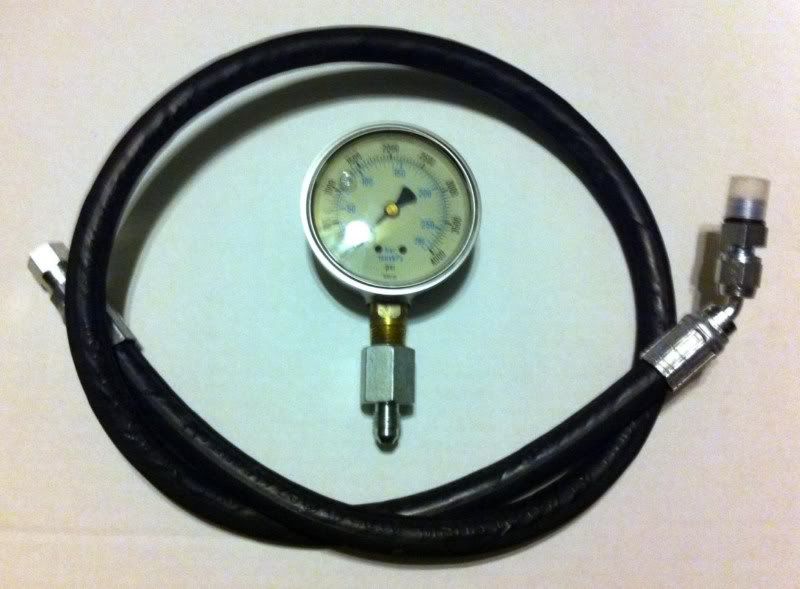
Here is what's needed to build a mechanical gauge(courtesy of Swamps as I lost my list).
You might spend $60 or so on high pressure hose, fittings, and a quality 0-3500psi liquid filled gauge, but having this hose available for future diagnostics will make it worth it.
The hose which you will need will need to be about 40" long, rated for
(minimum) 3000psi working pressure (12k psi burst rating!) with the gauge on
one end, and a #6 female JIC swivel fitting crimped onto the other.
You will also need an individual fitting to screw into the head to go from the
head to the hose. This single fitting will be a 90 degree fitting # 5 "male boss" (sometimes called #5 o-ring) on one end of the 90, and a # 6 male JIC on the other end of the 90.
Using a 5/8" wrench, remove any one of the HPO galley plugs, and install the 90deg fitting into the hole. (save the plug for reinstallation , after testing). The O-rings are reusable, unless brittle, cracked, etc... The single 90deg fitting will have a "jamb nut" on the O-ring side...screw the
fitting into the head, "aiming" the 90 away from the turbo, intercooler pipes,
etc...and then tighten the jamb nut, to "squish" the O-ring also locking the 90
from "spinning" around as you attach the swivel end of the hose to the 90. No
sealants, loctite, or teflon tape are needed on "JIC" or O-ring fittings...and
don't overtighten them...usually about 180degrees with a wrench past finger tight.
The finished mechanical gauge will look something like this.
Another thing to check is HPO pressure(ICP) while cranking. You need about 600psi of ICP for the injectors to fire. You can do this with a good scan tool, a scan gauge, or build a mechanical gauge. You should have good ICP since you said your getting some smoke out the tailpipe, so at least some injectors are firing.
Here is what's needed to build a mechanical gauge(courtesy of Swamps as I lost my list).
You might spend $60 or so on high pressure hose, fittings, and a quality 0-3500psi liquid filled gauge, but having this hose available for future diagnostics will make it worth it.
The hose which you will need will need to be about 40" long, rated for
(minimum) 3000psi working pressure (12k psi burst rating!) with the gauge on
one end, and a #6 female JIC swivel fitting crimped onto the other.
You will also need an individual fitting to screw into the head to go from the
head to the hose. This single fitting will be a 90 degree fitting # 5 "male boss" (sometimes called #5 o-ring) on one end of the 90, and a # 6 male JIC on the other end of the 90.
Using a 5/8" wrench, remove any one of the HPO galley plugs, and install the 90deg fitting into the hole. (save the plug for reinstallation , after testing). The O-rings are reusable, unless brittle, cracked, etc... The single 90deg fitting will have a "jamb nut" on the O-ring side...screw the
fitting into the head, "aiming" the 90 away from the turbo, intercooler pipes,
etc...and then tighten the jamb nut, to "squish" the O-ring also locking the 90
from "spinning" around as you attach the swivel end of the hose to the 90. No
sealants, loctite, or teflon tape are needed on "JIC" or O-ring fittings...and
don't overtighten them...usually about 180degrees with a wrench past finger tight.
The finished mechanical gauge will look something like this.

Laughing Gas
Joined: Jul 2007
Posts: 900
Likes: 1
From: Cross Lanes, WV

OK,,, If you had the head off, did you also remove the little drain plugs under the valve cover? Did you put them back in? I hate to admit it, but after my head rebuild, I left those drain plugs out of one head. Cranked and cranked engine. No start. Saw that little drain plug in my bolt can......... couldn't believe it.... put them in, started right up. It just wasn't getting enough high pressure oil to fire injectors.
Thread Starter
|
Junior User
Joined: Oct 2003
Posts: 87
Likes: 0
Can anyone think of any reason why this wouldn't work on a diesel? Its the only one I can find locally and it does state 'except diesel' on it but I don't see why the tester would care if it is testing gas or diesel pressure. I wonder if they are referring to higher pressure fuel systems like the IDIs?
Equus Products, INC.
91 dually - I never removed any of the plugs in the head when I removed it.
strokin- I will definitely look into building that HPO tester.
DIY - I agree - gotta find out what the fuel pressure is. I've thought of the ether and may go there. My understanding is ether is ok as long as the glow plug system is disconnected.
Weather took a turn for the ugly here tonight so didn't get any checking done, but I did pick up that fuel pressure tester. Hopefully it won't be as wet out tomm night and I can test it. I'll also clean that FPR screen.
Equus Products, INC.
91 dually - I never removed any of the plugs in the head when I removed it.
strokin- I will definitely look into building that HPO tester.
DIY - I agree - gotta find out what the fuel pressure is. I've thought of the ether and may go there. My understanding is ether is ok as long as the glow plug system is disconnected.
Weather took a turn for the ugly here tonight so didn't get any checking done, but I did pick up that fuel pressure tester. Hopefully it won't be as wet out tomm night and I can test it. I'll also clean that FPR screen.