


Why would somebody block the coolant passageways?

Thread Starter
|
Moderator


Joined: Nov 2007
Posts: 22,415
Likes: 92
From: Denver Metro Area, CO

Why would somebody block the coolant passageways?
OK, so I'm tearing into my 1981 400, it's been rebuilt once by a PO but nobody knows
what was done to it. Taking the heads off has revealed something odd to me - the head
gaskets cover up the coolant passageways except for little 1/8" holes. And, these holes
were filled with blue RTV:


I realize there's only one such little stub of RTV remaining by this time but all those
little holes across the top were filled in.
Why would somebody do that? Are those the wrong head gaskets by chance? This
explains how the thing was able to warm up MUCH faster than any other vehicle I've
ever owned - typically, 5-7 min.
On another topic, can anybody identify these pistons? They all have a 30 stamped into
'em which tells me they're .030" oversize:


what was done to it. Taking the heads off has revealed something odd to me - the head
gaskets cover up the coolant passageways except for little 1/8" holes. And, these holes
were filled with blue RTV:
I realize there's only one such little stub of RTV remaining by this time but all those
little holes across the top were filled in.
Why would somebody do that? Are those the wrong head gaskets by chance? This
explains how the thing was able to warm up MUCH faster than any other vehicle I've
ever owned - typically, 5-7 min.
On another topic, can anybody identify these pistons? They all have a 30 stamped into
'em which tells me they're .030" oversize:

Postmaster
Joined: Aug 2001
Posts: 4,270
Likes: 5
From: Delaware
They are stock type replacement dished pistons. The 30 indicates that they are 30 over.
I don't know why anyone would block those coolant passages. Was this vehicle used in Alaska or some other very cold location?
I don't know why anyone would block those coolant passages. Was this vehicle used in Alaska or some other very cold location?
Thread Starter
|
Moderator
Joined: Nov 2007
Posts: 22,415
Likes: 92
From: Denver Metro Area, CO
Ft. Lupton, CO - Front Range of the Rocky Mountains, elev about 5,000 ft. It *sometimes*
gets below zero here but generally not for more than a few weeks straight. Generally; the
winter before last sucked pretty badly, it rarely got over 10F for about a month straight. But,
still, winters are generally pretty mild here. It's an old farm truck
-ct
gets below zero here but generally not for more than a few weeks straight. Generally; the
winter before last sucked pretty badly, it rarely got over 10F for about a month straight. But,
still, winters are generally pretty mild here. It's an old farm truck
-ct
Thread Starter
|
Moderator
Joined: Nov 2007
Posts: 22,415
Likes: 92
From: Denver Metro Area, CO
No, they're what appear to be standard cast iron. Found sumthin' kinda odd here, too;
it looks like the intake valves are what's known as knurled or knarled or something
similar - the guides appear to be 1/8" thick (or so) brass inserts whereas the exhaust
valve guides appear to be stock.
it looks like the intake valves are what's known as knurled or knarled or something
similar - the guides appear to be 1/8" thick (or so) brass inserts whereas the exhaust
valve guides appear to be stock.
Thread Starter
|
Moderator
Joined: Nov 2007
Posts: 22,415
Likes: 92
From: Denver Metro Area, CO
This also explains why the intake manifold always got so damn hot and why the gas in the
float bowl kept boiling away when the engine was shut off (which would explain why it
always took so long to start).
--ct
float bowl kept boiling away when the engine was shut off (which would explain why it
always took so long to start).
--ct

Junior User
Joined: Jul 2007
Posts: 71
Likes: 0
Can you post some general pictures of the block and heads? I am sure there are some guys here who have built a Clevor before and know what exactly is required. Guys taking Cleveland 335 heads and bolt them on a Windsor block. The water passages have to be changed in the heads because the Windsor has a Wet manifold and the Cleveland (400) has a dry manifold. If the guy who rebuilt your motor picked up set of "Clevor" heads by mistake and bolted them on they would have the water passages blocked off.
Without really looking at it...... my 2 cents.
"Bush Performance modifies 351C heads for installation on the 289/302/351W block, eliminating one water passage while creating another. Bush closes off the 351C water passage between the head and the block. Then a passage is bored in the forward-most part of the head at the intake manifold, which allows coolant to flow to the 289/302/351W manifold and thermostat."
Without really looking at it...... my 2 cents.
"Bush Performance modifies 351C heads for installation on the 289/302/351W block, eliminating one water passage while creating another. Bush closes off the 351C water passage between the head and the block. Then a passage is bored in the forward-most part of the head at the intake manifold, which allows coolant to flow to the 289/302/351W manifold and thermostat."
Trending Topics
Postmaster
Joined: Aug 2001
Posts: 4,270
Likes: 5
From: Delaware
The intake manifold gets hot due to the exhaust crossover. There is no water in the intake manifold. The exhaust crossover is there for fast warmup.
They knurl the valve guides to take up some slop due to wear. It is cheaper than replacing the valve guides.
The water passages that get plugged in heads used for cleavor applications are in the front of the heads. They block the water passages to the block and open the expansion plug that mates with the Windsor manifold. A 335 series motor supplies water to the heads through the block, where a Windsor motor suppies water to the heads through the manifold.
The water circulates through the heads to the cylinders. There is no reason to block water to the block, except to gaurantee that water circulates to the rear cylinders. This is a known problem, if the wrong thermostat is used, and water can 'short circuit', leaving the rear cyilinders with reduced circulation and allowing local boiling. This can lead to head gasket failure in the rear of the motor.
FTE Stories
Ford Trucks for Ford Truck Enthusiasts

AEV FXL Super Duty - the Super Duty Raptor Ford Doesn't Make
Brett Foote
Lobo Vs Lobo: Proof the F-150 Lobo Should Be Even Lower!
Michael S. Palmer
Ford's 2001 Explorer Sportsman Concept Looks For a New Home
Verdad Gallardo
10 Best Ford Truck Engines We Miss the Most!
Joe Kucinski
2026 Shelby F-150 Off-Road: Better Than a Raptor R?
Brett Foote
2027 Super Duty Carhartt Package First Look: 12 Things You NEED to Know!
Michael S. Palmer
10 Most Surprising 2026 Ford Truck Features!
Joe Kucinski
Top 10 Ford Trucks Coming to Mecum Indy 2026
Brett Foote
5 Best / 5 Worst Ford Truck Wheels of All Time
Joe Kucinski
MSEE
Joined: Apr 2004
Posts: 10,386
Likes: 35
From: Austin, TX
Honestly, it looks like the PO was trying to RTV around the coolant passages which isn't a good idea on the heads. Because of the large torque required to seat the heads, it most likely squeezed the RTV out into the coolant passages which would have been the easiest place it could go. There is absolutely no reason to block those passages and it is a bad idea. Long story short, it looks like the by-product of someone who didn't totally know what they were doing.
Postmaster
Joined: Aug 2001
Posts: 4,270
Likes: 5
From: Delaware
Honestly, it looks like the PO was trying to RTV around the coolant passages which isn't a good idea on the heads. Because of the large torque required to seat the heads, it most likely squeezed the RTV out into the coolant passages which would have been the easiest place it could go. There is absolutely no reason to block those passages and it is a bad idea. Long story short, it looks like the by-product of someone who didn't totally know what they were doing.
FMC400,
You are probably right. I never use RTV on a head gasket. RTV will extrude into any hole available. The gasket itself is made to seal those passages.
Thread Starter
|
Moderator
Joined: Nov 2007
Posts: 22,415
Likes: 92
From: Denver Metro Area, CO
Yeah, that sounds reasonable, some guy trying to seal around the edges with RTV.
I'm theorizing that there might be additional heat transfer to the intake manifold from the
heads seeing as how the coolant passages were blocked; it gets HOT! Too hot to touch,
hot enough to boil the gas out of the carburetor (a whitish vapor emanates from the
smokestack (vent tube) and you can hear it bubbling).
Or, is this already a known issue and they all do this?
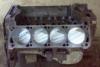
OK, another poster asked for general pics, here are a few (there are more in my gallery if
anybody's interested):


I'm theorizing that there might be additional heat transfer to the intake manifold from the
heads seeing as how the coolant passages were blocked; it gets HOT! Too hot to touch,
hot enough to boil the gas out of the carburetor (a whitish vapor emanates from the
smokestack (vent tube) and you can hear it bubbling).
Or, is this already a known issue and they all do this?
OK, another poster asked for general pics, here are a few (there are more in my gallery if
anybody's interested):
Postmaster
Joined: Aug 2001
Posts: 4,270
Likes: 5
From: Delaware
The coolant get to the heads first, so the heads are not what is heating the intake manifold. It's probably the exhaust crossover.
Did this vehicle have single or dual exhaust?
Was one manifold blocked, completely or partially?
There should be a heat riser valve in one exhaust pipe at the end of the manifold. When cold this valve is closed, and forces the exhaust through the crossover port in the head, through the manifold and into the opposite head and on to the opposite exhaust manifold. After a short period, this valve will open and allow the exhaust through the other pipe. This will work for single or dual exhaust systems.
The purpose of the crossover is to facilitate rapid warmup of the carb for fuel economy. Many people, including myself, block off the exhaust crossover ports. This is better for performance, since the intake manifold stays cooler.
Did this vehicle have single or dual exhaust?
Was one manifold blocked, completely or partially?
There should be a heat riser valve in one exhaust pipe at the end of the manifold. When cold this valve is closed, and forces the exhaust through the crossover port in the head, through the manifold and into the opposite head and on to the opposite exhaust manifold. After a short period, this valve will open and allow the exhaust through the other pipe. This will work for single or dual exhaust systems.
The purpose of the crossover is to facilitate rapid warmup of the carb for fuel economy. Many people, including myself, block off the exhaust crossover ports. This is better for performance, since the intake manifold stays cooler.

New User
Joined: Apr 2008
Posts: 17
Likes: 0
From: Joelton TN
Edit: Can't tell in your pics, are there any deep gasket-scraping scratches or anything? That may also have been a reason it was done.
My intake gets too hot to touch (rather, to maintain contact for very long) as well, but so has every intake on any vehicle I have ever worked on. And, I've worked on quite a few (100+ over the years).
Posting Guru
Joined: Jul 2007
Posts: 1,355
Likes: 1
Hey ctubutis i was messign around your gallery and noticed you dont have an 80`s block, you have a D1ae block which means its a 71-73 block, also by the carvings on the valley walls i can tell its a michigan block.......
