CONVERTED?? Extra wires?
Thread Starter
|
Senior User
Joined: Aug 2009
Posts: 100
Likes: 0
From: Mohnton, PA
CONVERTED?? Extra wires?
I decided to go with a 12 volt alternator with an internal regulator for my 51 flathead. I was going to use the GM 1 wire but now I am considering the 3 wire. What do I do with the wires that will be left after I remove the 6 volt regulator?
Cross-Country

Joined: Jul 2003
Posts: 86
Likes: 0
From: Evans,GA
Wiring alternator
Hey 51Phil,
This is copied from a site called the Fifth Avenue Garage. Its covers using the 3wire alt. and DA PLUG so you can use the original key and starter button.
WIRING YOUR ALTERNATOR -- Now you are ready to wire your alternator into the charging system. Begin by removing the (BATT) wire, from the old voltage regulator (or cutout) and connect it to the (10/32) stud on the back of the alternator. This will be the 10 gauge, wire that connects through the amp gauge in the dash.
(Copyright 1999 Fifth Avenue Antique Auto Parts)
Next.... Remove and tape (using electrical tape) the remaining wires (leftover from the old voltage regulator) back into the original wiring harness. (That way everything will be there in case the next generation wants to do a 100-point restoration) Finally... remove the old voltage regulator.
POSITIVE GROUND -- If you vehicle was originally positive ground (battery (+) cable connected to ground) you need to reverse the cables on the battery (-) battery cable will now go to ground. Positive cable will become the “hot” cable.
Next...reverse the two wires on the back of the amp gauge or in the case of Fords; reverse the loop of wire on the back of the gauge. This will make your amp gauge read correctly. (If you fail to reverse the wires on the amp gauge nothing bad will happen, your gauge will just read backwards...) The only exception is 1939-1940 Fords that use a Buss Bar type Amp Gauge. DO NOT change anything and this style of Amp gauge will work fine.
Now snap the DA Plug, into the top of the alternator. The red wire (with the ring terminal) attaches to the same (10/32) stud on the back of the alternator that you attached the (BATT) wire too. The yellow wire is called the “EXCITER “ Wire and should connect to the (+) terminal of the ignition coil or the (I) terminal on the ignition switch.
NOTE -- In some applications it may be easier to connect the yellow wire to the (S) terminal on the starter solenoid or the taillight side of the brake light switch (this is the case with Model A Fords). Any connection that turns off and on with the ignition key will work fine. Use only a 6-volt battery if you are installing a 6 - volt alternator. Do not use an 8 - volt battery.
BY THE WAY -- In case you are wondering... the “exciter” wire is what turns the alternator on when you turn the ignition key. Alternators were not introduced until the early 1960’s when most engines used in cars were V8’s and had idle speeds of about 1200 rpm. Because most older engines idle between 400-800 rpms, you need to trick the alternator into thinking it is spinning fast enough to begin charging.
THAT SHRINK-WRAPPED BUMP -- in the DA Plug harness is what allows your engine to be turned off with the original ignition key. (No we are not cheap and didn’t splice the wire there...) Because an alternator produces electrical current at idle (where as a generator does not) if you were to turn off the key (with the alternator installed, and no DA Plug) the engine would still keep running, because there is still electrical current reaching the coil from the alternator.
QUESTIONS -- If… you have questions about your installation or still are not sure which wire goes where... please call and we will be glad to help you. Our phone number is 785 - 632 - 3450 our fax 785 - 632 - 6154 or e-mail <fifthave@oz-online.net >
Thank You !
Fifth Avenue Internet Garage
Mitch J
This is copied from a site called the Fifth Avenue Garage. Its covers using the 3wire alt. and DA PLUG so you can use the original key and starter button.
WIRING YOUR ALTERNATOR -- Now you are ready to wire your alternator into the charging system. Begin by removing the (BATT) wire, from the old voltage regulator (or cutout) and connect it to the (10/32) stud on the back of the alternator. This will be the 10 gauge, wire that connects through the amp gauge in the dash.
(Copyright 1999 Fifth Avenue Antique Auto Parts)
Next.... Remove and tape (using electrical tape) the remaining wires (leftover from the old voltage regulator) back into the original wiring harness. (That way everything will be there in case the next generation wants to do a 100-point restoration) Finally... remove the old voltage regulator.
POSITIVE GROUND -- If you vehicle was originally positive ground (battery (+) cable connected to ground) you need to reverse the cables on the battery (-) battery cable will now go to ground. Positive cable will become the “hot” cable.
Next...reverse the two wires on the back of the amp gauge or in the case of Fords; reverse the loop of wire on the back of the gauge. This will make your amp gauge read correctly. (If you fail to reverse the wires on the amp gauge nothing bad will happen, your gauge will just read backwards...) The only exception is 1939-1940 Fords that use a Buss Bar type Amp Gauge. DO NOT change anything and this style of Amp gauge will work fine.
Now snap the DA Plug, into the top of the alternator. The red wire (with the ring terminal) attaches to the same (10/32) stud on the back of the alternator that you attached the (BATT) wire too. The yellow wire is called the “EXCITER “ Wire and should connect to the (+) terminal of the ignition coil or the (I) terminal on the ignition switch.
NOTE -- In some applications it may be easier to connect the yellow wire to the (S) terminal on the starter solenoid or the taillight side of the brake light switch (this is the case with Model A Fords). Any connection that turns off and on with the ignition key will work fine. Use only a 6-volt battery if you are installing a 6 - volt alternator. Do not use an 8 - volt battery.
BY THE WAY -- In case you are wondering... the “exciter” wire is what turns the alternator on when you turn the ignition key. Alternators were not introduced until the early 1960’s when most engines used in cars were V8’s and had idle speeds of about 1200 rpm. Because most older engines idle between 400-800 rpms, you need to trick the alternator into thinking it is spinning fast enough to begin charging.
THAT SHRINK-WRAPPED BUMP -- in the DA Plug harness is what allows your engine to be turned off with the original ignition key. (No we are not cheap and didn’t splice the wire there...) Because an alternator produces electrical current at idle (where as a generator does not) if you were to turn off the key (with the alternator installed, and no DA Plug) the engine would still keep running, because there is still electrical current reaching the coil from the alternator.
QUESTIONS -- If… you have questions about your installation or still are not sure which wire goes where... please call and we will be glad to help you. Our phone number is 785 - 632 - 3450 our fax 785 - 632 - 6154 or e-mail <fifthave@oz-online.net >
Thank You !
Fifth Avenue Internet Garage
Mitch J

Post Fiend
Joined: May 2008
Posts: 7,641
Likes: 21
From: Poway, Ca.
There won't be any wires left over. If you use an alternator with an external regulator, it will require the same number of wires that the generator does, except rather than being called "Field" and "Armeture," they will be called "Field and "Stator"

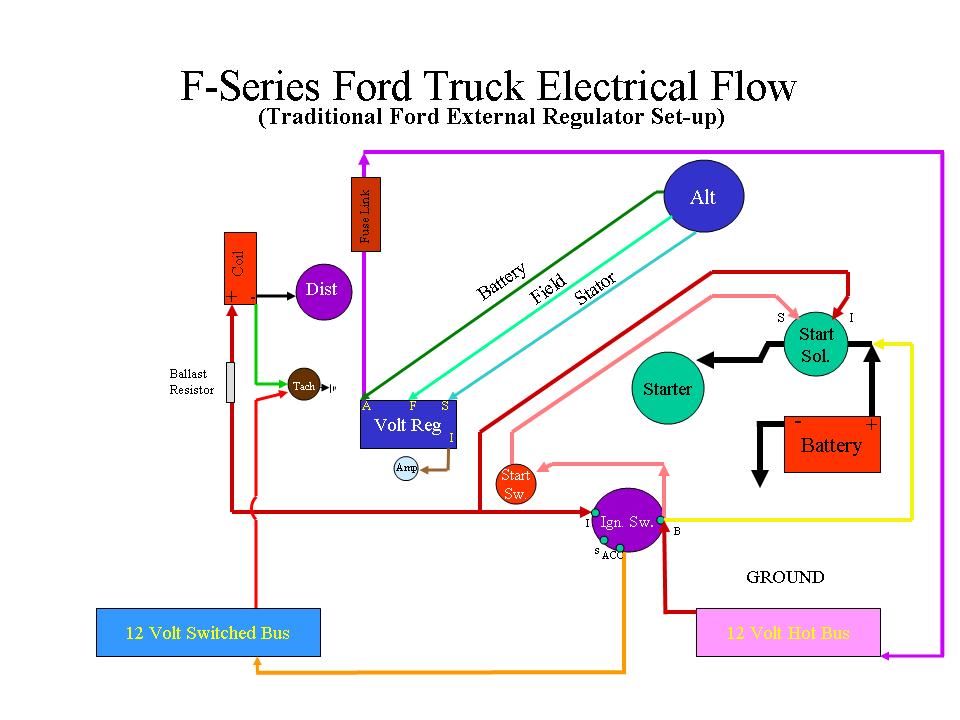
How this is installed is equally dependent on how your truck was rewired and how you are now distributing power (since the original 6 volt circuit breakers can no longer be used). And there are MANY variations to this, the very good instructions above are just one of the MANY variations to alternator wiring based on what type of 3 wire alternator you have as well. But, some of this is not applicable if your truck follows a traditional (50s) Ford wriring flow
For example in the post above the gentleman states that if you need a Da plug harness to allow the truck to shut off. If your wiring is following a stock flow - ie the power to the coil is coming directly from the ignition switch (which will have fewer post that a modern switch as in th eabove drawing) and your power from the alternator is flowing through your power distribution, then ignition switch, to the starter solenoid, then the truck WILL shut off when the key is turned off. The exciter wire is used to sense an amperage draw and thus activate the alternator, not trick the alternator into believing it is turning faster and thus allow it to produce at an RPM it wouldn't be capable of producing at unless it was fooled (which is a little silly to suggest). Running charge power directly to the power distribution load negates the need for an exciter. Not to mention that I do not believe that there is any modern Automotive V8 engine that is designed to idle warmed up at 1200 rpm. That number comes from generators which normally needed to have an engine rpm of 1100 to begin to produce - which is the real reason they switched to alternators - that and the diode technology of the 60s allowed for it.
So, if you mauntained you 12 volt wiring close to stock and are using fuse holders as protection (as you should) then the drawing above is correct for your older style Ford alternator.
The drawing below represents a flow for the Bonus/Economy Built Trucks that have been converted to 12 volt Negative ground and use the " traditional" Ford Alternator. "Bus" = Fuse Block.
By the way, what prompted you to sway from the one wire alternator to the three wire? The one wire is much cleaner! I use a 100 Amp true one wire on my 51 and it is as clean and as efficient as can be - no regulators, no exciters, problems, just one wire, not a bundle - $120.
A true "One Wire" wires up just like this:

How this is installed is equally dependent on how your truck was rewired and how you are now distributing power (since the original 6 volt circuit breakers can no longer be used). And there are MANY variations to this, the very good instructions above are just one of the MANY variations to alternator wiring based on what type of 3 wire alternator you have as well. But, some of this is not applicable if your truck follows a traditional (50s) Ford wriring flow
For example in the post above the gentleman states that if you need a Da plug harness to allow the truck to shut off. If your wiring is following a stock flow - ie the power to the coil is coming directly from the ignition switch (which will have fewer post that a modern switch as in th eabove drawing) and your power from the alternator is flowing through your power distribution, then ignition switch, to the starter solenoid, then the truck WILL shut off when the key is turned off. The exciter wire is used to sense an amperage draw and thus activate the alternator, not trick the alternator into believing it is turning faster and thus allow it to produce at an RPM it wouldn't be capable of producing at unless it was fooled (which is a little silly to suggest). Running charge power directly to the power distribution load negates the need for an exciter. Not to mention that I do not believe that there is any modern Automotive V8 engine that is designed to idle warmed up at 1200 rpm. That number comes from generators which normally needed to have an engine rpm of 1100 to begin to produce - which is the real reason they switched to alternators - that and the diode technology of the 60s allowed for it.
So, if you mauntained you 12 volt wiring close to stock and are using fuse holders as protection (as you should) then the drawing above is correct for your older style Ford alternator.
The drawing below represents a flow for the Bonus/Economy Built Trucks that have been converted to 12 volt Negative ground and use the " traditional" Ford Alternator. "Bus" = Fuse Block.
By the way, what prompted you to sway from the one wire alternator to the three wire? The one wire is much cleaner! I use a 100 Amp true one wire on my 51 and it is as clean and as efficient as can be - no regulators, no exciters, problems, just one wire, not a bundle - $120.
A true "One Wire" wires up just like this:
Hotshot


Joined: Oct 2009
Posts: 16,188
Likes: 4,792
From: Burbank, WA
Let me know if I'm missing something, but it appears if one wanted to add a safety feature to the starting circuit, the "pink" wire from Ign Sw. "B" to Start sw. (button?) could pass through the brake light switch, necessatating the operator to have the brake pedal depressed before power would go to the button and the starter engaging. Correct? Any unintended concequences I'm not thinking of possible with this scenerio?

Fleet Owner

Joined: Jul 2004
Posts: 27,297
Likes: 1,059
From: NM
On 48-51 (?) the starter button is always hot, but '52's are thru the ign switch. Right? Don't need a safety? Does your starter switch have one or two terminals? Maybe it was '53-on, at any rate I think that's all you can buy now, so I have one that is only hot thru the ignition sw.
Thread Starter
|
Senior User
Joined: Aug 2009
Posts: 100
Likes: 0
From: Mohnton, PA
There won't be any wires left over. If you use an alternator with an external regulator, it will require the same number of wires that the generator does, except rather than being called "Field" and "Armeture," they will be called "Field and "Stator"
Attachment 26769
How this is installed is equally dependent on how your truck was rewired and how you are now distributing power (since the original 6 volt circuit breakers can no longer be used). And there are MANY variations to this, the very good instructions above are just one of the MANY variations to alternator wiring based on what type of 3 wire alternator you have as well. But, some of this is not applicable if your truck follows a traditional (50s) Ford wriring flow
For example in the post above the gentleman states that if you need a Da plug harness to allow the truck to shut off. If your wiring is following a stock flow - ie the power to the coil is coming directly from the ignition switch (which will have fewer post that a modern switch as in th eabove drawing) and your power from the alternator is flowing through your power distribution, then ignition switch, to the starter solenoid, then the truck WILL shut off when the key is turned off. The exciter wire is used to sense an amperage draw and thus activate the alternator, not trick the alternator into believing it is turning faster and thus allow it to produce at an RPM it wouldn't be capable of producing at unless it was fooled (which is a little silly to suggest). Running charge power directly to the power distribution load negates the need for an exciter. Not to mention that I do not believe that there is any modern Automotive V8 engine that is designed to idle warmed up at 1200 rpm. That number comes from generators which normally needed to have an engine rpm of 1100 to begin to produce - which is the real reason they switched to alternators - that and the diode technology of the 60s allowed for it.
So, if you mauntained you 12 volt wiring close to stock and are using fuse holders as protection (as you should) then the drawing above is correct for your older style Ford alternator.
The drawing below represents a flow for the Bonus/Economy Built Trucks that have been converted to 12 volt Negative ground and use the " traditional" Ford Alternator. "Bus" = Fuse Block.
Attachment 26770
By the way, what prompted you to sway from the one wire alternator to the three wire? The one wire is much cleaner! I use a 100 Amp true one wire on my 51 and it is as clean and as efficient as can be - no regulators, no exciters, problems, just one wire, not a bundle - $120.
A true "One Wire" wires up just like this:
Attachment 26771
Attachment 26769
How this is installed is equally dependent on how your truck was rewired and how you are now distributing power (since the original 6 volt circuit breakers can no longer be used). And there are MANY variations to this, the very good instructions above are just one of the MANY variations to alternator wiring based on what type of 3 wire alternator you have as well. But, some of this is not applicable if your truck follows a traditional (50s) Ford wriring flow
For example in the post above the gentleman states that if you need a Da plug harness to allow the truck to shut off. If your wiring is following a stock flow - ie the power to the coil is coming directly from the ignition switch (which will have fewer post that a modern switch as in th eabove drawing) and your power from the alternator is flowing through your power distribution, then ignition switch, to the starter solenoid, then the truck WILL shut off when the key is turned off. The exciter wire is used to sense an amperage draw and thus activate the alternator, not trick the alternator into believing it is turning faster and thus allow it to produce at an RPM it wouldn't be capable of producing at unless it was fooled (which is a little silly to suggest). Running charge power directly to the power distribution load negates the need for an exciter. Not to mention that I do not believe that there is any modern Automotive V8 engine that is designed to idle warmed up at 1200 rpm. That number comes from generators which normally needed to have an engine rpm of 1100 to begin to produce - which is the real reason they switched to alternators - that and the diode technology of the 60s allowed for it.
So, if you mauntained you 12 volt wiring close to stock and are using fuse holders as protection (as you should) then the drawing above is correct for your older style Ford alternator.
The drawing below represents a flow for the Bonus/Economy Built Trucks that have been converted to 12 volt Negative ground and use the " traditional" Ford Alternator. "Bus" = Fuse Block.
Attachment 26770
By the way, what prompted you to sway from the one wire alternator to the three wire? The one wire is much cleaner! I use a 100 Amp true one wire on my 51 and it is as clean and as efficient as can be - no regulators, no exciters, problems, just one wire, not a bundle - $120.
A true "One Wire" wires up just like this:
Attachment 26771
I am looking at running a gm 3 wire alternator with a built in regulator. Do you have a diagram for that set up
Fleet Owner
Joined: Jul 2004
Posts: 27,297
Likes: 1,059
From: NM
Trending Topics
Hotshot
Joined: Oct 2009
Posts: 16,188
Likes: 4,792
From: Burbank, WA
On 48-51 (?) the starter button is always hot, but '52's are thru the ign switch. Right? Don't need a safety? Does your starter switch have one or two terminals? Maybe it was '53-on, at any rate I think that's all you can buy now, so I have one that is only hot thru the ignition sw.

FTE Stories
Ford Trucks for Ford Truck Enthusiasts

3 Best / 3 Worst Parts of Modern Ford Ownership
Brett Foote
10 Amazing Upgrades That Solve Common Ford Truck Owner Headaches
Pouria Savadkouei
Every 2026 Ford Engine Explained
Brett Foote
10 Ugly Ford Trucks That We Still Kinda Love
Joe Kucinski
10 Things Every Truck Owner NEEDS (2026 Edition)
Michael S. Palmer
Rezvani's Latest Post-Apocalyptic Monster Is a Ford F-150 Raptor Underneath
Verdad Gallardo
Top 10 Most Expensive Ford Trucks Ever Sold on Bring a Trailer
Joe Kucinski
2027 Ford Super Duty Buyer's Guide (Every Model, Engine, & Package)
Brett Foote
Top 10 Ford Truck Tragedies
Joe Kucinski
Fleet Owner
Joined: Jul 2004
Posts: 27,297
Likes: 1,059
From: NM
Kids love to push buttons too
Post Fiend
Joined: May 2008
Posts: 7,641
Likes: 21
From: Poway, Ca.
Let me know if I'm missing something, but it appears if one wanted to add a safety feature to the starting circuit, the "pink" wire from Ign Sw. "B" to Start sw. (button?) could pass through the brake light switch, necessatating the operator to have the brake pedal depressed before power would go to the button and the starter engaging. Correct? Any unintended concequences I'm not thinking of possible with this scenerio?
There are lots of "safety" options you can use by wiring your starter circuit differently.
I intentionally wire my starter buttons hot so the engine will turn over without spark. I do this so I can "pre oil" the engine if it's been sitting for awhile. But, true, as you noted, if the parking brake is off, the truck is in gear, and you hit that button - key or not - the truck is gonna move. It's very embarrassing - don't ask me how I know. But these trucks were built when society believed in individual compotence and intelligence, not warning lables. You were expected to know how to "operate" these vehicles and know what you were doing, or stay the H out of them.
Two things can be done to prevent this - one VERY easy, the other just KINDA easy. First, you can power your starter button off the "ACC" post of the ignition switch instead of the "BATT" post forcing the key to have to be on. That elliminates inadvertant button pushes (especially if you have a floor mounter starter button), you have to put the key in first - so there has to be some deliberate action on your part. But there again you can still start the truck in gear if you aren't paying attention, and then it will really move!
The second option is to install a "Neutral Safety Switch." This attaches to your shifters and completes the starter button wire connection to the solenoid only when the shifter is in the neutral position. On modern stick shift trucks, there is also a clutch pedal push switch that forces you to step on the clutch pedal to complete the starter circuit and turn over the starter - as you suggested, this could be used as well for safety. Same idea on both, a mechanical inturupter in the starter curcuit that needs to be positioned correctly (either neutral or clutch pushed in) to complete the circuit and allow the starter to turn.
56 was the first year I believe that had the start position in the ignition switch. But the key to Waynes point, as I interpret it, is not so much where the starter was actuated from, but rather, what could be done for safety to prevent turning the starter with the drive train engaged.
EDIT NOTE: Ah! a "GM" three wire alternator - kind of important to know that! LOL! Never mind!
Hotshot
Joined: Oct 2009
Posts: 16,188
Likes: 4,792
From: Burbank, WA
Back to my original thought, it occured to me while studying the diagrams that a simple safety solution would be to run the starter button through the brake light switch, for two reasons. One, it's a switch that's hot all time and is already in place. No need to add additional switching or wiring. Step on the brake pedal, push the button, starter goes rur-rur-rur. Trying to rig up a neutral safety device on a on a column shifted manual transmission would be cumbersome at best, and nearly impossible on a toploading floor shift. A clutch pedal switch wouldn't be difficult, but again, that's a second switch and extra wiring to mess with. And two, it gives the flexability like you have to operate the starter independantly of the ignition circuit, which I can see as being a good thing.
I just wanted to make sure I wasn't missing something.
Post Fiend
Joined: May 2008
Posts: 7,641
Likes: 21
From: Poway, Ca.
Haven't missed a thing! And a great idea. As a matter of fact I see no reason why that wouldn't work very well. Only possible scenario I see that might be an issue would be if for some reason you stalled in rolling traffic and had to use the starter to restart (automatic transmission) and couldn't use the brakes. I only did that once by going around a corner (way) too fast and my Edelbrock Carb sloshed over and stalled the engine. I suppose in that case you could put a bona fide Neutral Safety Switch on your automatic transmission - if it didn't have one already anyway. And it would work well for a start switch that is 12volt/dual post start button (with a four post starter solenoid) - as drawn in my drawing.
But, if you were using the older style single contact to ground type button on the 6 volt 3 post starter solenoid, then you'd have to come up with a different set up. That's because in that scenario, the starter button circuit power comes FROM the starter solenoid and goes to ground to activate the solenoid - it back flows with the button providing ground - (thus the technical explanation for Ross' "originally the buttons were hot all the time") - as opposed to completing a power circuit TO the solenoid as with the two post type button.
So there's no way you could route the power from the starter solenoid through the brake switch because every time you stepped on the brakes, the brake lights would provide a ground and turn over the starter.
Have I confused anyone yet?
Maybe a "T" with a second brake light switch and the starter button coming down from the solenoid, through the second switch then up to the botton to ground could be used.
Here's a graphic representation of that older style flow:

But, if you were using the older style single contact to ground type button on the 6 volt 3 post starter solenoid, then you'd have to come up with a different set up. That's because in that scenario, the starter button circuit power comes FROM the starter solenoid and goes to ground to activate the solenoid - it back flows with the button providing ground - (thus the technical explanation for Ross' "originally the buttons were hot all the time") - as opposed to completing a power circuit TO the solenoid as with the two post type button.
So there's no way you could route the power from the starter solenoid through the brake switch because every time you stepped on the brakes, the brake lights would provide a ground and turn over the starter.
Have I confused anyone yet?
Maybe a "T" with a second brake light switch and the starter button coming down from the solenoid, through the second switch then up to the botton to ground could be used.
Here's a graphic representation of that older style flow:
Cross-Country
Joined: Jul 2003
Posts: 86
Likes: 0
From: Evans,GA
Starter buttons
Doesn't the key switch have to been turned to the on position in order for the starter button to work? Been a while since I cranked one up, but seems like thats what I had to do. I had a 51 a few years back and now a 52.
Mitch J
Mitch J
Post Fiend
Joined: May 2008
Posts: 7,641
Likes: 21
From: Poway, Ca.
There are two types of starter buttons. The OEM single post button simply provided a ground for the start lead coming off the solenoid - thus it was hot all the time.
However, with the newer style 4 post solenoids (12 volt negative ground), the two post button doesn't provide the ground, but rather, power is routed from the Ignition Switch, through the button (which, when pushed, completes the circuit) then to the Starter Solenoid.
With that type of set up you have the option of wiring it "HOT" or "SWITCHED." If you want it "HOT" you wire the power off the "BATT" post of the Ignition Switch (which is hot all the time).
If you want it "SWITCHED", you would wire the power off the "ACC" post of the ignition switch - which has power only when the key is turned on - and subsequently will only turn over the engine when the ignition system is powered as well.
BUT just as before, if the truck is in gear and the emergency brake off, it's gonna move as well, and if it starts up, it's gonna move ALOT and be a race to step on the brake, or be stopped by what's in front of the truck! Thus Waynes safety suggestion!
Here the differences in a pic: