When you click on links to various merchants on this site and make a purchase, this can result in this site earning a commission. Affiliate programs and affiliations include, but are not limited to, the eBay Partner Network.
Hi, I'm looking for some advice on a knock sound in a 1969 F250 Ranger I just bought. Beautiful, straight truck, with supposedly a good running 390 in it. It belonged to an old fella that passed and his son was selling it. The dad was a mechanic by trade (had a garage full of tools to prove it), but the son's knowledge extended only to vehicle basics I think. It hadn't been driven in like 2 years, and used sporadically before that. The battery was dead, so i didn't hear it run, but he was nice and i had no reason to doubt there was a problem (ya, i know, but i spoke to him after i discovered the knock and he's going to work with me on the sale price, which was decent to start with). Anyway, so i came back the next day to load it on the trailer and we were able to get it started with a new battery. I checked the oil before we started it and it was pretty dark, but I didn't see anything else out of the ordinary. When it finally fired off, it spun up to a pretty high RPM, i'm guessing 1600-2000. I was a little surprised, but let it go and tried tapping the throttle to drop the speed. After a few times trying to drop the speed, i turned it off and we fiddled with choke. It spun up pretty high again because i had to work the throttle, so i killed it again and we totally removed the choke. Now the meat of the story. When it first started up, it was pretty darn loud with lifters pounding, but i figured it they just needed to pump up due to sitting, but they were taking their sweet time to do it. I checked the pressure gauge at one point and got pretty alarmed because it was really low, but i figured bad gauge, again because I thought the guy was reliable (cue the nerves at this point). As the lifters slowly were quieting down (think minutes), i could hear a knock (only above idle if i remember correctly) that was pretty concerning. Figuring it was a little late now, we just went ahead and finished easing it on the trailer. That night after unloading, i pulled the dipstick again and the oil was like water. I guess my smeller isn't that good anymore, and I figured water had leaked in since it wasn't foamy like if radiator fluid gets in. When i changed the oil, it came flooding out and i could smell the gas. Either the carb or the fuel pump was leaking into the block. I discovered old puddled gas on the intake, so i'm think something was going with the carb.
I'd like to think there was a preexisting bearing problem caused by prior driving with bad oil and i didn't kill it, but i'm not that knowledgeable. So, is it possible to do that much damage in such a short period of time? My dad was outside and he said he thought he could hear a knock on startup and it didn't go away. He didn't say anything because like me he thought it just needed to circulate after sitting so long. Now with fresh 15-40 oil and some Lucas, it's fine at idle, but as the engine ramps up and down, the knock is pronounced, especially when coming down. Its quieter, but still there, at a constant higher PRM. Overall, it's not super loud knock, but its there. I listened at the pan with a PVC pipe and i can hear it, so i assume it's probably a rod bearing? Any other reasonable possibilities? Anyway, i'll keep doing some investigating (need to cut open the filter and inspect the "oil" came out of the engine), but if anyone has some opinions on whether the knock/bearing problem was preexisting or a self inflicted wound, i'd appreciate it. If it's likely my fault, i might not take any money the fella offers me. I truly think he didn't know; he really talked up his dad as a mechanic, and i think the dad was not doing to well in the last few years and may not have know there was a problem.
I kick my self because i thought about changing the oil before starting it, but figured, nah it looks ok and changing the oil onsite would be a pain. Now i just feel like a doofus.
Thoughts appreciated, heckles accepted. It's a learning experience, albeit difficult.
My quick comment here. Starting and revving the engine to 1,600 to 2,000 rpms didn't 'create' the knock noise...and if it did then it would likely have become an issue once you got the truck home and drove it a few more times. The FEs are durable engines in my opinion, and starting it up at that high if rpm shouldn't have hurt it. When you say the oil pressure was low, how low? I would take the money he offers, you'll need it for the rebuild. These trucks don't run on hopes and dreams, but hard work and creativity.
Once you get the money, measure the stroke and confirm it is indeed a 390. Do a compression check and vacuum test as well to see where the engine is at in its lifespan. A lot of these trucks came with FE360s and even if the truck came with a 390 (it is a Ranger), may have been swapped for a 360. You just never know.
Be thankful for the beautiful straight truck. The engine was likely on its last leg when you arrived. The FE's can be rebuilt really nice. Spend time making your strategy and learning before tearing into it.
Thanks for the the thoughts. After I posted, i realized i should have mentioned oil pressure. When it was first started, I recall it showing about 10(!) which was at the fast idle, and then later on probably at idle RPM, it was even lower, which is why i was fingers crossed for a bad pressure sender. After the oil change and filter, pressure hit about 55lbs cold (maybe 60 degrees air temp) and went down some after it warmed up a bit. I didn't get the engine super hot, so i don't know what hot idle pressure will be.
On a positive note, the guy agreed to refund some money. It's enough that I should be whole if i sell it. I've done most other work on a car, but never an engine. That would be a big project for me and i need to think about taking it on. But first I'll keep investigating the noise in case I get lucky and it turns out to be something other than a bearing.
I do analysis work on large pipeline engines. I use an accelerometer on the block to see if the bearings are knocking. I attach an encoder to the crankshaft that puts out a pulse once every degree of rotation to record where the knock sound happens (if it's knocking). But you can also tell by the tone of the sound if it is related to the bottom end or top end. The bottom end has a deeper tone and the valve train is made up of smaller parts so they have a higher tone. The valve train is usually described as a clicking sound. Usually if you take the load off of the cylinder that is knocking the sound will go away. Do this by pulling or shorting out the spark plug of each cylinder one at a time while you are hearing the knocking sound. If the sound does go away it is a bottom end knock, if it doesn't it is more likely some other part of the engine because they are not affected as much by load.
The bottom end deeper tone knock can come from the piston being loose in the bore, the upper rod bearing or the lower rod bearing. Crankshaft main bearings a harder to diagnose without the aid of an accelerometer.
Ever figure out the fuel in oil problem? I had a fuel pump go bad on me once, still delivered fuel but the pump drive arm wouldn't return fully and made a slight knock noise as it slapped the cam lobe. Probably not your issue, but something to look at.
Got a late start today and i don't work that fast, but got a few things checked out. I cut open the filter and there was small bits of metal in there so not a good start. Wasn't shiny but stuck to a magnet. Got it warmed up after awhile. Cold oil pressure was about 58. After it was warmed up, pressure was around 35 (not super hot, but it was good and warm). I was getting the same noises as yesterday in the same patterns, but there wasn't much (any?) noise in the first minute(?) after starting. Anyway, i used the PVC pipe to listen around and it seemed like there was two spots i was hearing the strongest noise, and could feel some physical movement through the pipe (banging). First spot on the fuel pump and second on the valve cover over cylinders 2/3. We started pulling spark plugs one at a time and cylinder 3 caused the knocking to begin at idle very consistently. We plugged #3 in again, it went away at idle, then pulled it again, and it returned. Figured i had it isolated, but when I plugged #3 back in again, it continued knocking at idle. Pulled the valve cover and all looked ok, and started and observed while running, and all looked ok. That was it for the day, and i cleaned up after that.
When i have time i'm going to pull the mechanical pump. I snagged a cover plate for the opening when at the junkyard a few years ago and there's an an electric pump already inline (pushes thru the mechanical). I'll also do a compression check and pull the other valve cover to take a look. Not sure what else to do. It seems like the ignition system is fine, but i think the engine feels running unbalanced, so hopefully those tests give me a clue.
For the source of gas, i'm pretty sure it was the carb. I found pools of old gas on the intake. I've been pulling the dipstick periodically to see if the oil seems to be thinning. Not so far.
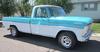
Anyway, here is photo of the truck, and the only body damage on the whole thing. Pretty amazing. Plus no rust except surface rust and small spot under the driprail.
Had some more time to work today, and actually went through a tuneup. The timing was waaay retarded, being made up with tons on vacuum advance (over 20; i didn't find the limit using a Mighty Vac on the diaphragm). I set it to 10 BTDC and left the vac advance unplugged. The idle screws were also way off and when i got done it was idling pretty nicely.
As for the knocking issue, with the mechanical pump removed, there was no change. Then i did a compression test that showed 150 to 170 on all except #3 which was at 133. Squirted some oil in and it only went up to 139, so that indicates a problem with a valve I think? I also used a vacuum gauge and was getting just under 17, but there was a slight wiggle in the needle that corresponded with knock, and the louder the knock, the bigger the wiggle. So, am i somewhat lucky here in that i probably have a lifter problem as opposed to a bearing problem? I can absolutely say that when revving, the sound seems like a hard tap in the valve train, but when throttle is snapped closed, the knock seems deeper and harder sounding.
One other thing: the timing chain seemed loose to me, but i don't have much reference to go by. I could flop it back and forth with my finger through the fuel pump opening. The timing light was not jumping around at all during timing checks.
Am i headed in the right direction thinking it's a lifter? Would a loose timing chain factor in to the issues? Any suggestions help as i try to figure out how deep I want to dig in the motor.
Last edited by shorty73; Mar 6, 2022 at 11:45 PM.
Reason: add more
If there is gas in the oil, would that not thin the oil where you will not get a true compression reading
I did an oil change after i discovered the problem. 15-40 Rotella and a quart of Lucas. I don't think the thicker oil made any change in the sound. I've been looking at the dipstick periodically and I'm not seeing any new issues with the oil thinning.
I member on another forum just installed a reman motor, did a proper cam break in etc.
I dont even know if he got any drive time in as he was still "dialing it in" when he heard a knock down low.
He had good oil psi and think compression but he had to be careful on just what he did not to void warranty.
With the ok he pulled a valve cover and was able to find 1 rocker a little lose but did not make noise like you would think.
I think he measured lift on that rocker and some others and found it had less lift.
He got the OK to pull the lifter and sure enough it was showing signs it and cam was going bad.
So if you have a cam going flat the lifter could be bouncing off the cam making it sound like something bad down inside.
Good luck
Dave ----
Thanks, I'll start investigating this as a lifter problem. I understand the intake weighs about 75 pounds and I'm not looking forward to pulling it. I'll do what i can before going that far, but I can do a cam replacement if needed. I appreciate the information everyone has given me.
You should be able to pull the valve covers and measure the lift of the push rod at the rocker with a dial indicator.
If you find 1 or 2 that dont lift as much then you have to dig deeper.
Think thats how the other guy found the bad cam, less lift at the rocker that lead to pulling intake and lifter.
Dave ----
Shorty, sounds like you are making some progress. As for how far to go, what is your plan for the truck? If you are going to fix it up to use, I would go through the engine. I have done most of the work on mine short of the machining and it is not that difficult at all. I am no expert and am self taught on everything auto related. Go for it, you have a real nice truck there!