


Oil Filter

Thread Starter
|
Junior User
Joined: May 2020
Posts: 52
Likes: 0
From: Sudbury
Oil Filter
I am rebuilding a 1951 Flathead V8 - 8BA and have been advised that i should not reinstall the oil filter cartridge and filter that fastens to the left side of the head.
'The filter apparently only filters up to a maximum 15% of the oil and with this vehicle operating in ideal conditions with limited mileage I should be OK.
What are anybodies thoughts and have others done this?
Thanks
Flipper 55
'The filter apparently only filters up to a maximum 15% of the oil and with this vehicle operating in ideal conditions with limited mileage I should be OK.
What are anybodies thoughts and have others done this?
Thanks
Flipper 55
Hotshot


Joined: Oct 2009
Posts: 16,155
Likes: 4,754
From: Burbank, WA
I'm not sure who you're talking to, but personally, I would never advise anyone not to use the filter, but it is definitely your choice. Back when these cars were daily drivers the oil filter system was an extra cost option. Engine oil was changed every 500 to 1000 miles, and engines lasted about 60,000 miles before needing an overhaul. In fact, Kendall advertised their oil for years as superior to many others because it only needed changed every 1000 miles. It's true the way the filtration setup works on the flathead V8 was a bypass system, meaning the oil was pumped through the filter but returned back to the pan to be picked and sent through the engine, instead of being pumped through directly from the filter. The oil is still filtered, it just takes a different path from what we're used to, and is arguably less efficient since the filtered oil is also mixed with the drainback oil before going through the engine and filter again. One would think some filtering has to be better than no filtering at all, or maybe it doesn't really matter.
If the engine is all new and clean inside, if you're only going to drive a few hundred miles a year and change it at least once a year, you may never know the difference. If the engine is old and dirty or sludgy, I'd think any little bit of filtering you can get would help. My 2c. Others may have differing opinions.
If the engine is all new and clean inside, if you're only going to drive a few hundred miles a year and change it at least once a year, you may never know the difference. If the engine is old and dirty or sludgy, I'd think any little bit of filtering you can get would help. My 2c. Others may have differing opinions.

Fleet Owner


Joined: Jul 2004
Posts: 27,288
Likes: 1,053
From: NM
The bypass filter has a much finer media than full-flow filters, removing very fine particles that are the cause of most wear.
Most ring and bearing wear is caused by particles under 20 microns
A bypass filter will remove 98% of 2 micron sized particles
A full flow filter most likely will open the internal bypass valve on cold startup and not filter till the oil thins some, then ---
40% at 10 microns
60% at 20 microns
90% at30 microns
97% at 40 microns
87% capture rate for single pass ----
The "full flow" filter has to be a compromise between filtering and flow, the ideal setup would be a combination of full flow and bypass.
The million-mile Mercedes only had a bypass filter
Most ring and bearing wear is caused by particles under 20 microns
A bypass filter will remove 98% of 2 micron sized particles
A full flow filter most likely will open the internal bypass valve on cold startup and not filter till the oil thins some, then ---
40% at 10 microns
60% at 20 microns
90% at30 microns
97% at 40 microns
87% capture rate for single pass ----
The "full flow" filter has to be a compromise between filtering and flow, the ideal setup would be a combination of full flow and bypass.
The million-mile Mercedes only had a bypass filter
Thread Starter
|
Junior User
Joined: May 2020
Posts: 52
Likes: 0
From: Sudbury
Thank You Very Mich for the information and your perspective on oil filtration....it certainly has me thinking about installing the oil filter system.
Living in Northern Ontario in Canada the truck will only be driven maybe 4 months per year and well under 1,000 miles annually.
I am trying to be be as original as I can in my restore, so I think you have convinced me,
I found it interesting that the oil filter system was an extra cost option....I learn something new always when I participate in FTE forum.
Much appreciated,
Flipper55
Living in Northern Ontario in Canada the truck will only be driven maybe 4 months per year and well under 1,000 miles annually.
I am trying to be be as original as I can in my restore, so I think you have convinced me,
I found it interesting that the oil filter system was an extra cost option....I learn something new always when I participate in FTE forum.
Much appreciated,
Flipper55
Thread Starter
|
Junior User
Joined: May 2020
Posts: 52
Likes: 0
From: Sudbury
Trending Topics
Thread Starter
|
Junior User
Joined: May 2020
Posts: 52
Likes: 0
From: Sudbury
Thank You for your information.....my filter canister is fastened to the head using the head bolts.....getting a proper torque is one of my concerns.
Flipper 55
Flipper 55
FTE Stories
Ford Trucks for Ford Truck Enthusiasts

AEV FXL Super Duty - the Super Duty Raptor Ford Doesn't Make
Brett Foote
Lobo Vs Lobo: Proof the F-150 Lobo Should Be Even Lower!
Michael S. Palmer
Ford's 2001 Explorer Sportsman Concept Looks For a New Home
Verdad Gallardo
10 Best Ford Truck Engines We Miss the Most!
Joe Kucinski
2026 Shelby F-150 Off-Road: Better Than a Raptor R?
Brett Foote
2027 Super Duty Carhartt Package First Look: 12 Things You NEED to Know!
Michael S. Palmer
10 Most Surprising 2026 Ford Truck Features!
Joe Kucinski
Top 10 Ford Trucks Coming to Mecum Indy 2026
Brett Foote
5 Best / 5 Worst Ford Truck Wheels of All Time
Joe Kucinski
Fleet Mechanic


Joined: Aug 2019
Posts: 1,357
Likes: 415
From: Monmouth County, NJ
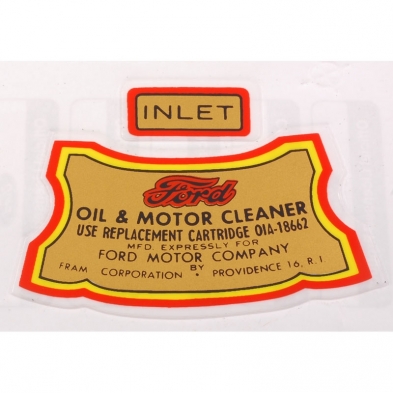
It seems that most Fords and the trucks in particular had the oil filter option on them correct? I don't think Ive see that listed as a separate line item on original invoices and dealer forms though? Most pictures of restored and unrestored V8 engines Ive seen have them. Whereas the Chevy trucks of the same era I see restored stock, hardly any of them have an oil filter on them and if they do they are branded Fram and have orange tops almost like they were really an after market option (Ford filter housings had Ford decals on them but made by Fram presumably). Now that chevy stove bolt 6 is a splash lubrication system beyond that Im not sure what the other differences are?
Hotshot
Joined: Oct 2009
Posts: 16,155
Likes: 4,754
From: Burbank, WA
I don't know if or when the filter on flat V8's ever became standard, but here's a picture of the decal used on them. It does say made by Fram.
Last edited by 52 Merc; Apr 15, 2021 at 12:01 AM.

Tuned
Joined: Sep 2017
Posts: 385
Likes: 29
From: Pinckney Mi.
Some filters use the 3 bolt holes cast in head(holes went cast,bosses were) others use 3 head bolts, even bigger filters,such as the one on my 51 M3 ,use 4 head bolts. And I am concerned aboot proper tork on the 4 headbolts,but gonna trust Henrey I guess....
Greg
Greg