


Camshaft

Post Fiend
Joined: Apr 2002
Posts: 19,311
Likes: 97
From: Waterloo, Iowa
It looks like it (301444) wants 9.5 to 1 compression, that's why I asked. But I don't understand cams and duration and that stuff. I'm not sure what a stock 292 Y-block is, maybe 8 to 1 on a good day. Mine measures 150 psi compression across the board so that's probably about right. At one time I had an extra engine could have built up, but I didn't have the room to keep it.
Logistics Pro
Joined: Mar 2005
Posts: 3,771
Likes: 80
From: tujunga, calif
It looks like it (301444) wants 9.5 to 1 compression, that's why I asked. But I don't understand cams and duration and that stuff. I'm not sure what a stock 292 Y-block is, maybe 8 to 1 on a good day. Mine measures 150 psi compression across the board so that's probably about right. At one time I had an extra engine could have built up, but I didn't have the room to keep it.

Moderator


Joined: Aug 2002
Posts: 6,099
Likes: 380
From: Southern California


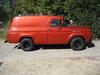
This e building in Culver City!!!!! it is still there...it is just used for storage now!

Cargo Master


Joined: Apr 2003
Posts: 2,389
Likes: 58
There's not much point in hopping up the cam on any engine without a complimentary increase in compression. That is not just a Y-Block thing. It's a 4-stroke pushrod engine, like any other and follows the same rules.
A factory 312 with G heads is the best case scenario for compression. It might barely reach 9:1 depending on how the tolerances worked out during machining. Odds are that it will be just under 9:1. Best case for a factory 292 is about 8.5:1 and the trend lower will continue with the smaller variants. The only way to get above 9:1 in most cases will be the use of domed pistons although at some point displacement alone is enough to increase compression sufficiently. The compression figures that Ford advertised, in many cases, did not take into consideration the gasket volume and the fact that the pistons were below the deck, both factors that decrease the compression figure.
A factory 312 with G heads is the best case scenario for compression. It might barely reach 9:1 depending on how the tolerances worked out during machining. Odds are that it will be just under 9:1. Best case for a factory 292 is about 8.5:1 and the trend lower will continue with the smaller variants. The only way to get above 9:1 in most cases will be the use of domed pistons although at some point displacement alone is enough to increase compression sufficiently. The compression figures that Ford advertised, in many cases, did not take into consideration the gasket volume and the fact that the pistons were below the deck, both factors that decrease the compression figure.
Logistics Pro
Joined: Mar 2005
Posts: 3,771
Likes: 80
From: tujunga, calif
Today they are in Gardena and a new more modern type building.. I've never been to the new one.

8th Gear
Joined: Sep 2023
Posts: 8
Likes: 0
Moderator
Joined: Aug 2002
Posts: 6,099
Likes: 380
From: Southern California
Tech Support Issue:
http://saacforum.com/index.php?topic=901.10;wap2
Valvetrain Failure:
Classic Cam Failure:
http://www.hotrodders.com/forum/more...ure-48577.html
Cam Lobe Fracturing:
http://www.yellowbullet.com/forum/sh...d.php?t=458553
Cam Failure:
http://www.camaros.net/forums/showthread.php?t=121078
FAIL Comp cams trunion failure- Rockwell hardness low:
http://www.corvetteforum.com/forums/...n-upgrade.html
2nd Cam Failure:
http://www.performanceboats.com/gn7-...p-failure.html
Major problems with Comp Cams hydraulic roller lifters :
Major problems with Comp Cams hydraulic roller lifters
COMP CAMS FAIL (endless)
http://truestreetcars.com/forums/gen...cams-fail.html
Comp Cams Ultra Gold Aluminum Roller Rocker Failure
http://www.ls1gto.com/forums/showthread.php?t=388981
Comp Cams 918 spring failures
http://www.camaroz28.com/forums/ls1-...ilures-526319/
Cam Failure:
http://www.camaro5.com/forums/showthread.php?t=389981
Cargo Master
Joined: Apr 2003
Posts: 2,389
Likes: 58
Specifically concerning the Y-block, it has been found that quite a few grinders use an incorrect lifter bank angle when grinding cams. This poses a problem should you ever want to install the cam advanced or retarded and would pose a problem for many people because most don't even check and simply installing a cam as is, however it may end up when all of the tolerances add up. This has the effect of making the timing slightly different between the two banks and can present issues with tuning and with overall performance. Comp is one of those grinders and when informed by one of the best Y Block builders, seemed not to care. Even if they may be good for other engines, steer clear of them for a Y-Block.
FTE Stories
Ford Trucks for Ford Truck Enthusiasts

AEV FXL Super Duty - the Super Duty Raptor Ford Doesn't Make
Brett Foote
Lobo Vs Lobo: Proof the F-150 Lobo Should Be Even Lower!
Michael S. Palmer
Ford's 2001 Explorer Sportsman Concept Looks For a New Home
Verdad Gallardo
10 Best Ford Truck Engines We Miss the Most!
Joe Kucinski
2026 Shelby F-150 Off-Road: Better Than a Raptor R?
Brett Foote
2027 Super Duty Carhartt Package First Look: 12 Things You NEED to Know!
Michael S. Palmer
10 Most Surprising 2026 Ford Truck Features!
Joe Kucinski
Top 10 Ford Trucks Coming to Mecum Indy 2026
Brett Foote
5 Best / 5 Worst Ford Truck Wheels of All Time
Joe Kucinski
5th Gear
Joined: Oct 2023
Posts: 5
Likes: 1
It looks like the OP's concerns have already been addressed, but I would like to add a couple of things: unless you are just after the wow factor of running 3 x2s, you'll be happier with an OEM 57 ECZ-B, Mummert, or Blue Thunder intake manifold and a single 4-barrel carburetor between 465 and 600 cfm/w vacuum secondaries. Ted Eaton routinely opens up the plenum/carburetor base of the ECZ-B to two ovals, does minor relief porting at the plenum-to-runner transitions, and mills the carburetor base flat. He just did mine for $75. The Mummert and Blue Thunder aluminum intake manifolds are comparable in performance; however, the Blue Thunder has the heat crossover for the choke (not needed for carburetors with manual/electric choke) and is considerably more expensive. Ted Eaton (eatonbalancing.com) recommends Topline Hylift Johnson lifters for Y-blocks. He said that Isky's lifters are made by Hylift Johnson. A Clay Smith representative also confirmed that their lifters are made by Hylift Johnson. A Hylift Johnson rep. confirmed that the Comp Cams Y-block lifters are also made by them, but that might have changed during the last couple of years since it was confirmed.
As it's already been said, posting the camshaft duration numbers @ .050 lift will be more helpful than the advertised duration numbers. The LSA (Lobe Separation Angle) should be included as well.
Even with a zero-deck block, flat-top pistons, and ECZ-G heads (69 cc nominal chambers), your static compression ratio won't be more than 9:1. You can increase the SCR by milling the heads, but most "G" heads aren't "posted." Unless they are posted, they should not be milled more than .025. Also keep in mind that it's the DCR (Dynamic compression Ratio) that determines whether your engine will require 87, 91, or higher octane to prevent detonation. The more duration the cam has, the lower your DCR will be. For 91 unleaded, you'll want to Keep the DCR at/below 8:1. UEM has a good static and dynamic compression ratio calculator, but you'll need the rod length and IVC (intake valve closing) number @ .020 lift to determine the DCR. A later IVC will lower the DCR.
As it's already been said, posting the camshaft duration numbers @ .050 lift will be more helpful than the advertised duration numbers. The LSA (Lobe Separation Angle) should be included as well.
Even with a zero-deck block, flat-top pistons, and ECZ-G heads (69 cc nominal chambers), your static compression ratio won't be more than 9:1. You can increase the SCR by milling the heads, but most "G" heads aren't "posted." Unless they are posted, they should not be milled more than .025. Also keep in mind that it's the DCR (Dynamic compression Ratio) that determines whether your engine will require 87, 91, or higher octane to prevent detonation. The more duration the cam has, the lower your DCR will be. For 91 unleaded, you'll want to Keep the DCR at/below 8:1. UEM has a good static and dynamic compression ratio calculator, but you'll need the rod length and IVC (intake valve closing) number @ .020 lift to determine the DCR. A later IVC will lower the DCR.
Last edited by 55blacktie; Oct 5, 2023 at 04:55 PM. Reason: Added Remarks

Thread
Thread Starter
Forum
Replies
Last Post
william16339
Big Block V8 - 385 Series (6.1/370, 7.0/429, 7.5/460)
1
Mar 5, 2018 09:04 PM
rockher_man
Small Block V8 (221, 260, 289, 5.0/302, 5.8/351W)
8
Dec 3, 2009 01:31 PM
STGFordCrazy04
Big Block V8 - 385 Series (6.1/370, 7.0/429, 7.5/460)
0
Aug 9, 2006 06:40 PM